




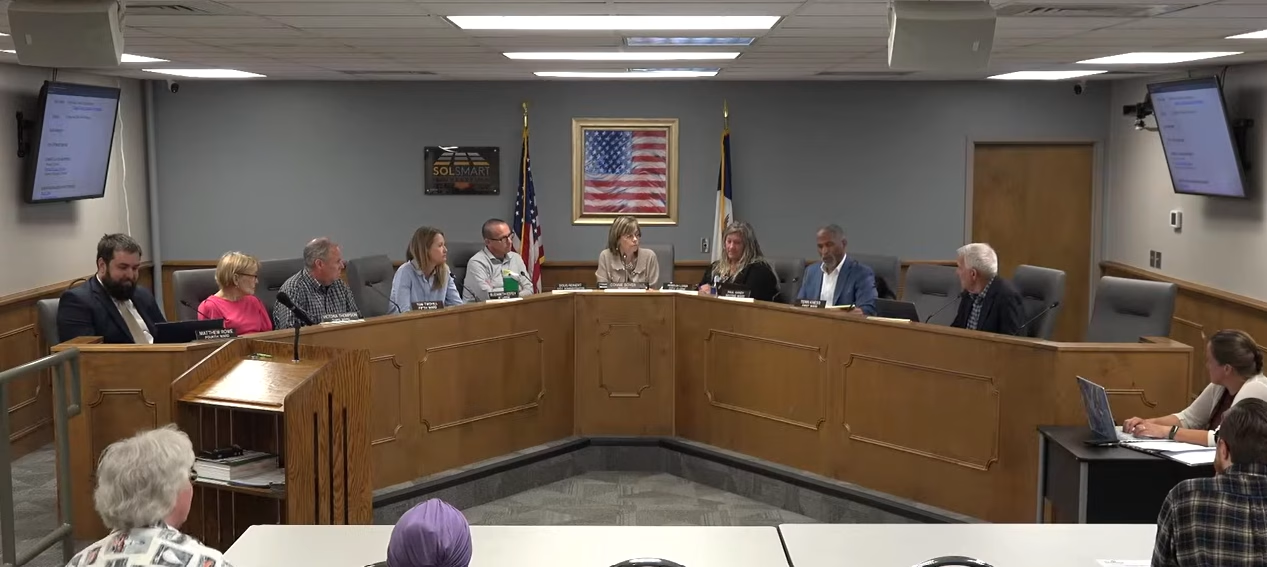
The Fairfield City Council voted 6-0 on Monday, August 24th to pass a data center moratorium ordinance, waiving the second and third readings to put it on the books in a single meeting — less than two weeks after the Jefferson County Board of Supervisors adopted a similar measure at the county level. Council member Terri Kness was absent.
The ordinance was recommended to the council by the Fairfield Planning and Zoning Commission following a public hearing held August 17th, at which city staff, legal counsel, and community members discussed the scope and strength of the proposed moratorium. The commission voted to recommend the ordinance with one addition — language stating the moratorium is being enacted “as studies of all things germane to such facilities are underway.”


At Monday’s meeting, the council heard public comment before voting. Doug Bricker asked the council to rewrite the ordinance to make it stronger, saying he had identified at least 25 weaknesses in the current draft. He pointed specifically to what he said was a lack of a clear definition of a data center, warning that developers have sued cities in other states over that very issue. “There are plenty of cases out there where the developer is suing the city because they don’t have data center defined in their code,” Bricker said. He also argued the ordinance could allow a 4.9 megawatt data center to be built anywhere in Jefferson County under the current language, drawing a comparison to the county’s moratorium. He said he has compiled his analysis into a 100-page document and urged the council to review it before passing the ordinance.
Council member Paul Gandy pushed back, noting he had attended the Planning and Zoning Commission meeting where Bricker’s concerns were discussed at length. “I believe all seven members of the planning and zoning commission were present, as was the city administrator, city attorney, the mayor, and a large part of city government,” Gandy said. “The PNZ commission considered what you were saying, your comments, your suggestions quite carefully.” Gandy said he has read the ordinance and is satisfied with it. “I’ve read the ordinance. I’m familiar with it — the very first paragraph refers to our zoning of B2 and M2 districts. It’s in the ordinance itself,” he said. “Not perfect, but combined with our zoning scheme, it is sufficient in my opinion. If we’re going to pass an ordinance that implements a moratorium on data centers for 12 months, I think this is sufficient and good. We can always make it better. We can always make it longer. We can always make it more complex, but I’m satisfied with the PNZ’s recommendation that we go forward with this particular ordinance.”
Estey also responded directly to Bricker’s concerns about gaps in the ordinance. “Have you read our moratorium in conjunction with our other city ordinances? Because we have zoning ordinances that also speak to this,” she said. “It would work in conjunction with the ordinances that we currently have.” She added that the difference between the city’s ordinance and the county’s is that the city has zoning — something the county does not have. “If you haven’t read our zoning ordinances, I can’t understand what the holes are.”
Community member Ananda Kesler raised a separate concern about a company called SAVRN that designs prefabricated data centers specifically to circumvent moratoriums being adopted across the country. Kesler said the units sit on approximately half an acre, do not connect to the local electrical grid, and instead use natural gas trigeneration, biomass, and closed-loop hydro systems — though she noted the biomass-to-AI component may be significantly worse for the environment than traditional data centers. “It operates in a way that completely sidesteps any current moratorium unless someone is aware of it,” Kesler said. She noted the company is actively monitoring state and local ordinances and developing products intended to work around them.
City Engineer and Public Works Director Melanie Carlson responded that the city’s zoning permit system would apply regardless of how a data center is constructed. “It doesn’t matter whether you’re breaking ground or you’re dropping it in or you’re changing a house into a data center — it’s what you’re building, it’s your use, it’s your zoning,” Carlson said. “No zoning permits shall be issued” for data centers and related uses under the moratorium. She acknowledged the city’s base fine for a zoning violation is $500, but said the code has additional mechanisms to escalate enforcement and take violators to court. “That process is already established,” she said.
Carlson urged the council to pass the ordinance rather than delay further. “It’s a stop gap until something further can be done — we can still make changes to it,” she said. “It does not exist until it’s gone through its three readings and published. You can consider it even after you pass it through the third and final reading, but it does not exist until it goes through the third and final reading and is published. So I would ask the council to consider going through the third and final reading so that we at least have something and then we can continue to discuss it.” She added that the city intends to continue studying a water use ordinance and other measures being adopted by other cities. “There’s new information every day that we need to consider — including the prepackaged data centers she’s bringing up. We’re going to continue that path, but we have nothing until this passes.”
Council member Elizabeth Estey said passing the ordinance now was the right move even if additional improvements are needed. “What I’m hearing from a lot of citizens is that getting a moratorium on the books is the best thing we can do right now, and then we can continue to assess both the moratorium and our code to see if there are more protections we can put in place,” she said. Council member Bob Ferguson added: “Passing this tonight does not preclude improving it in the future.”
Council member Matthew Rowe asked that the matter of the data center moratorium be penciled into a council meeting approximately 10 months from now so it does not fall through the cracks. City Clerk Rebekah Loper clarified that Rowe was not necessarily asking to renew the moratorium at that point, but simply wanted the idea of renewing it brought before the council so it would not be forgotten. Loper also noted that the city’s legal counsel has advised against simply continuing to renew a 12-month moratorium indefinitely to keep it in place. “I do hope that in the next several months we come up with a long-term solution — ordinances that aren’t time based,” Rowe said. “If it comes up in 10 months, we can say we’ve got something better in place now and dismiss it. But I’d at least like to make sure it’s on the calendar.” Loper confirmed she had started a calendar item for the 10-month mark.
Mayor Connie Boyer floated the idea of forming a dedicated task force to study the data center issue more deeply. “It’s a big issue and I think some more eyes on this particular issue would be helpful,” Boyer said. The ordinance will take effect upon publication.