




Iowa’s official database of animal feeding operations, which serves as the state’s primary regulatory inventory of livestock facilities, does not include thousands of facilities that researchers say contribute to the state’s growing manure burden and potential water pollution.
After spending about a year reviewing aerial photographs, satellite imagery and state records, researchers with the Environmental Working Group (EWG), an environmental advocacy organization, identified 15,309 livestock facilities across Iowa using data current through July 2025, more than 4,000 additional operations beyond the roughly 11,000 listed in the Iowa Department of Natural Resources database.


The difference does not necessarily mean Iowa has overlooked thousands of regulated livestock facilities. Instead, the two inventories measure different things.
https://datawrapper.dwcdn.net/vIVdU/2
In an email, the Iowa Department of Natural Resources said its animal feeding operation database, which is updated daily, was developed to administer state and federal regulations and “does not include all animal feeding operations in the state.” The database does not include small confinement operations and open lots that are not subject to state or federal regulations, the agency said.
The Environmental Working Group’s inventory, by contrast, sought to identify every active livestock facility the researchers could verify using aerial imagery and public records, including many operations that fall outside the state’s regulatory database. The study authors said their analysis included facilities with at least 50 animal units, while the DNR data file generally includes facilities with more than 300 animal units.
For the analysis, the researchers classified facilities using the Environmental Protection Agency’s animal-unit thresholds. Operations with fewer than 300 animal units were classified as small, those with 300 to 999 as medium-sized and those with 1,000 or more as large. An animal unit represents 1,000 pounds of live weight — the equivalent of one beef cow, about 2.5 hogs or 125 chickens.
The researchers included livestock facilities of every size, not just those subject to state regulation, arguing that even smaller operations contribute to Iowa’s manure load and potential water pollution.

“We really thought it was vital to know where all animal feeding operations are located in Iowa and where manure is likely being produced in order to understand the full view of the impacts of this manure on water quality and public health,” said Anne Schechinger, senior director of agriculture and climate research at EWG and one of the study’s authors.
The mapping also documents the continued consolidation of Iowa’s livestock industry.
The researchers identified 4,444 large facilities in 2025, a 12.9% increase from the 3,936 they documented in a similar statewide analysis in 2019. Schechinger said the study documented an increase in the number of large livestock facilities but did not track whether existing facilities had expanded. That, she said, would require additional analysis.
Researchers have observed similar trends in other major livestock-producing states, including Minnesota and North Carolina, but Iowa stands apart because of the sheer concentration of hog production.
“There’s really nothing like the number of hog facilities in the state of Iowa, and the concentration in that northwest part of the state,” Schechinger said. “There’s just a lot of facilities up there.”
Five counties with the largest number of livestock facilities— Sioux, Lyon, Plymouth, O’Brien and Washington — contained 3,095 operations, or about one in every five livestock facilities identified statewide, according to the study.
Nitrate exposure associated with health risks
The study also offers a new estimate of the waste these facilities produce. Using industry-standard and the estimated number and type of animals at each operation, the study concluded that Iowa livestock operations generated 107.6 million tons of manure in 2025, equivalent to about 33 tons per Iowa resident each year.
The estimate includes manure from hogs, cattle, chickens and turkeys raised at confinement operations and open feedlots.
https://datawrapper.dwcdn.net/APpMg/2
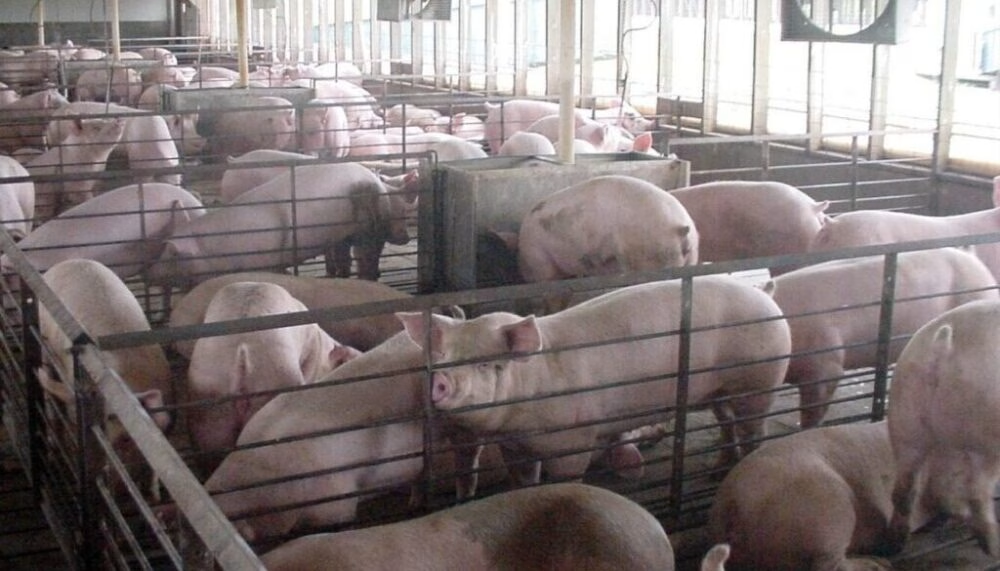
Hogs accounted for about 66% of the livestock facilities identified in the study, reflecting Iowa’s position as the nation’s largest pork-producing state.
The study found that manure production is increasingly concentrated among the state’s largest operations. Facilities with at least 1,000 animal units represented 29% of all livestock facilities identified by the researchers but generated about 60% of Iowa’s manure, according to the report.
“The largest facilities producing the most manure are growing in over time, more concentration to the largest facilities,” Schechinger said.
The researchers say the scale of manure production matters because most livestock waste is applied to nearby cropland as fertilizer. While manure supplies crops with nitrogen, phosphorus and other nutrients, those same nutrients can become pollutants when they leave farm fields.
Elevated nitrate concentrations in drinking water are a potential cause of methemoglobinemia, or “blue baby syndrome,” a potentially life-threatening condition that reduces the blood’s ability to carry oxygen in infants.
Studies have also associated nitrate exposure with an increased risk of certain cancers, including colorectal cancer, although the strength of the evidence varies across health outcomes.
Schechinger said the purpose of creating a more complete inventory was not simply to count facilities but to better understand where manure is generated and the cumulative pressures those operations can place on surrounding landscapes.
“You know that the public health implications are really important for this amount of manure that’s being produced,” she said.
According to the Iowa DNR’s 2025 Public Drinking Water Program Annual Compliance Report, nitrate concentrations above the Environmental Protection Agency’s drinking water standard were the most common health-based violations among Iowa public water systems.
The report documented 36 nitrate violations at 13 water systems, affecting 2,479 customers. Nitrate violations accounted for 41% of the 87 health-based drinking water standard violations recorded that year.
High nitrate concentrations have also strained central Iowa’s drinking water supply. During the summer of 2025, nitrate levels in the Des Moines and Raccoon rivers reached near-record highs, prompting the first-ever lawn watering ban in the Des Moines metropolitan area.
Elevated concentrations persisted through the winter, requiring Central Iowa Water Works to operate its nitrate removal facility in January this year before issuing another temporary lawn watering ban this summer.
Reining in Iowa’s industry pollution
The study is likely to add momentum to an ongoing debate over whether Iowa’s oversight of livestock operations adequately reflects the industry’s size and environmental footprint.

State Sen. Art Staed, a Cedar Rapids Democrat who has introduced legislation aimed at strengthening water-quality protections in at least the past two legislative sessions, said the new inventory highlights the need for better information about where manure is produced and applied.
“There’s more and more research on the correlation between the cancers and the toxins in our water,” Staed said.
Staed said previous proposals to strengthen oversight of livestock operations, including a moratorium on new large livestock facilities until Iowa improves its water quality, have failed to gain traction in the Republican-controlled Legislature.
“There are a lot of things that can be done,” he said. “There could be better fines, better regulation.”
Among his priorities, Staed said, are stronger manure management requirements and better public records showing where manure is applied.
“Manure management, for sure, and keeping track of where the manure spreads,” he said. “We need to have the records, and people can see where it’s being spread and how much is being produced.”
Tarah Heinzen, legal director for Food & Water Watch, said Iowa’s current regulatory framework fails to adequately oversee factory farms and called for stronger water-quality protections.
“Iowa’s deliberate head-in-the-sand approach to factory farm regulation is failing public health and the environment,” Heinzen said..
She said the group supports requiring factory farms to obtain Clean Water Act permits, mandating best management practices at animal and row crop operations, and permanently funding statewide water quality monitoring.
“Even as Iowans experience a worsening water pollution crisis, with agricultural nitrate contamination at its center, Iowa legislators and regulators are failing to adopt even the simplest of regulatory frameworks to rein in this industry’s pollution,” Heinzen said.
This article first appeared on Investigate Midwest and is republished here under a Creative Commons Attribution-NoDerivatives 4.0 International License.