




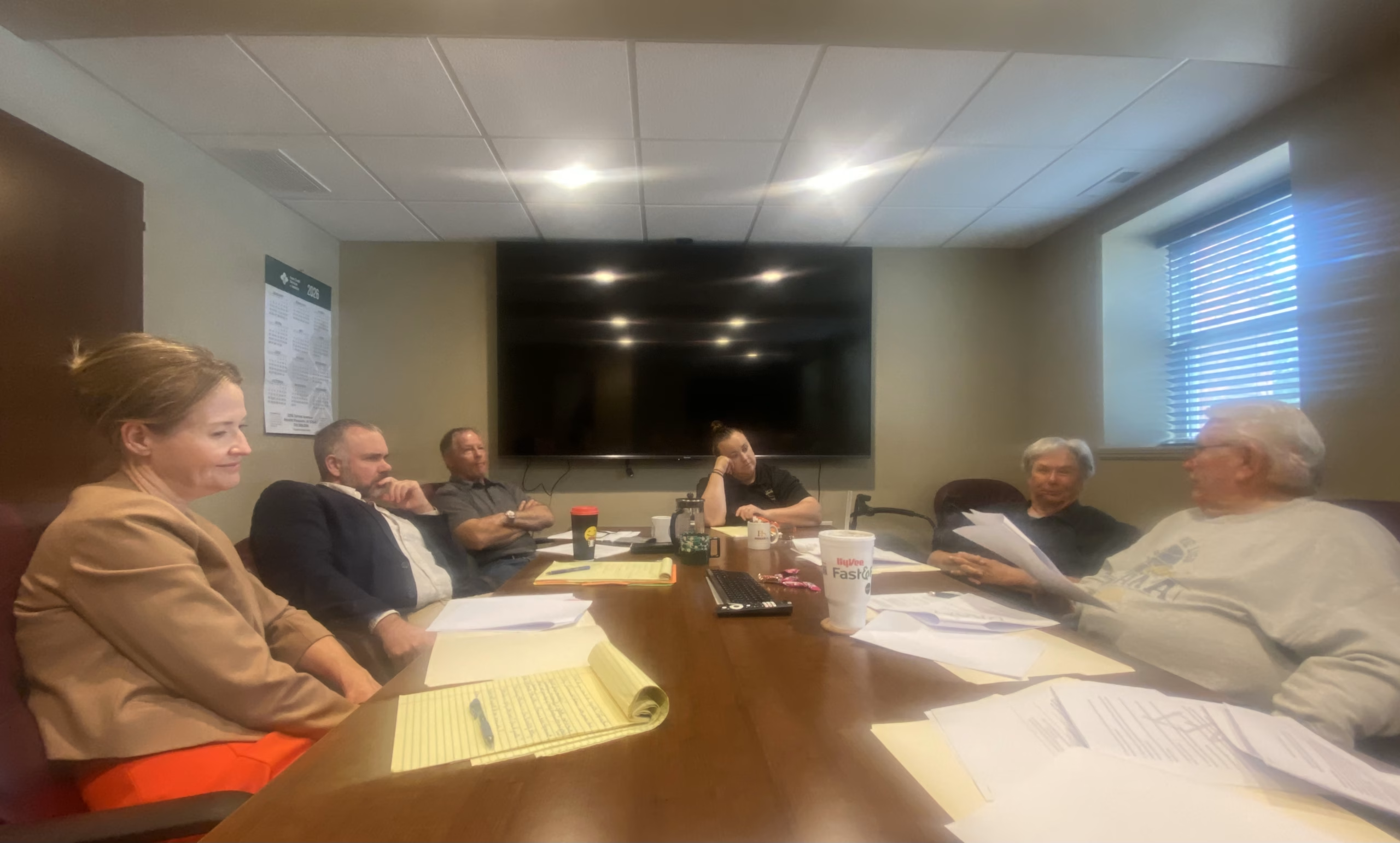
Jefferson County supervisors and the county attorney’s office held a work session on Friday, June 5th, focused on developing a data center ordinance, bringing together Supervisors Lee Dimmitt, Susie Drish, and Joe Ledger with County Attorney Chauncey Moulding, Assistant County Attorney Elizabeth Estey, and County Engineer DeWayne Heintz to work through the details of what such an ordinance might look like.
The session was a continuation of earlier meetings, with Estey having already drafted a starting framework and provided examples from other counties — including Linn County and Allamakee County — as reference points. The group spent a significant portion of the meeting working through the scope, structure, and specific provisions they want to include. The overarching goal is to give Jefferson County regulatory control over large-scale data center development before anything is proposed — giving the county the tools to review, restrict, or deny such development rather than being left without any recourse.


Defining the Scope
One of the central challenges the group wrestled with is defining exactly what type of development the ordinance should regulate. The definitions used in other Iowa counties vary widely — Allamakee County’s threshold starts at three megawatts, while Linn County’s begins at 20 megawatts. The group acknowledged that setting the threshold too low could inadvertently capture local businesses like LISCO or Liberty Communications, which operate data processing infrastructure but are not the large-scale developments driving public concern.
The consensus leaning was toward regulating large-scale development while leaving small-scale operations untouched, with energy usage emerging as a preferred metric for defining the threshold rather than physical footprint alone. The group noted that as technology advances, a facility could significantly increase its energy consumption without changing its physical size — making footprint-based regulation potentially less effective over time. However, the physical size of a data center remains a consideration as well, given the public’s concerns about large footprints consuming productive farmland.
Permit Costs and Economic Development Agreements
The group discussed how to structure permit costs in a way that both discourages large-scale development and offsets the impacts on the county if a project were to proceed despite the county’s regulatory framework. One proposal was setting the permit cost at 10% of total development cost, including land purchase and construction.
Discussion also centered on whether to tie fees to estimated construction costs upfront or to use an economic development agreement structure — similar to the Washington County Riverboat Foundation model — as a secondary mechanism to recoup costs and offset community impacts if development were ultimately to move forward. Supervisors made clear that the permit cost structure serves a dual purpose: acting as a deterrent while also ensuring that if a project cannot be stopped outright, the county is not left bearing the burden of its impacts alone.
Estey noted that a lower upfront permit cost paired with a robust economic development agreement might be more legally defensible than a high fixed permit fee, which could appear discriminatory. The group expressed interest in reviewing the Washington County Riverboat Foundation agreement more closely as a potential model.
Setbacks, Roads, and Other Provisions
The group discussed several specific provisions likely to appear in the ordinance. On setbacks, the current draft mirrors Linn and Allamakee counties with 200 feet to property lines and 1,000 feet to the closest outer wall of an occupied building — but supervisors indicated they want those numbers to be significantly larger. County Engineer Heintz was present for the discussion around road use, with the group agreeing that all proposed access roads used for construction or operation of a data center would need to be paved and that developers would be required to enter into a road use agreement with the county engineer.
The group discussed requiring a closed-loop cooling system as a way to address water use concerns, which Estey confirmed is something that can be regulated in an ordinance. Discussion also touched on requiring a pre-construction noise analysis, a backup power generation plan, a stormwater management plan, a water use agreement, and a decommissioning and site reclamation plan to ensure that the land can be restored if a facility is ever abandoned.
The question of crop suitability ratings also came up as a potential tool for protecting productive farmland — requiring applicants to include a corn suitability rating as part of their application so supervisors have that information when deciding whether to approve or deny a permit request.
The group also discussed extending school setbacks from the current draft’s one-mile distance to two miles, and briefly addressed what qualifies as a school under the ordinance, including private and faith-based institutions working toward accreditation. The ordinance draft also includes a provision requiring approval from any city within the county for projects proposed within a certain distance of city limits. The group discussed extending that distance as well, noting that Fairfield has a two-mile extraterritorial zoning jurisdiction and that Maharishi Vedic City and Fairfield overlap in some areas. The practical effect is that any data center proposed in those areas would need city approval before a county permit could be issued.
Eminent Domain and Foreign Ownership
Two topics raised by Supervisor Lee Dimmitt generated considerable discussion without clear resolution. On eminent domain, the group acknowledged that while the county could include language in an ordinance discouraging its use, the county does not have authority to prevent a private entity from exercising eminent domain if they have legal standing to do so. On foreign ownership, the group acknowledged the complexity of defining what constitutes a foreign-owned entity given the nature of corporate structures and tax inversions, and concluded that while the concern is legitimate, it would be difficult to regulate effectively in practice.
Legal Framework and Next Steps
Estey stressed an important legal point for the public to understand — because Jefferson County does not have zoning, the county cannot simply issue a moratorium the way Henry County recently has. In order to put a moratorium on issuing permits, the county must first have an ordinance that establishes a permitting process. An attorney from Hopkins and Huebner was consulted and agreed with that approach.
Estey cautioned against putting a placeholder ordinance in place purely to enable a moratorium without any genuine intent to use it, calling that approach legally risky. The better path, she said, is to develop a substantive ordinance that the county genuinely intends to adopt and enforce — one with real teeth — and then pause permits while additional research continues.
The group identified several next steps. Estey plans to follow up with the Allamakee County Attorney’s Office regarding the specifics of their ordinance. Supervisor Dimmitt and Estey may plan to look into how crop suitability ratings could be incorporated into the application process. Supervisor Dimmitt will reach out to Jamie Cashman at the Iowa State Association of Counties for additional resources. The group also discussed reaching out to a contact at Alliant Energy for expertise on the power usage side of the equation, as they want to see what businesses like LISCO use power-wise to not affect them in this process, and to supervisors in other counties that have already developed ordinances for guidance.
The supervisors were clear that their goal is to be proactive rather than reactive — to have meaningful regulatory control in place before any developer comes knocking, rather than scrambling to respond without any legal framework to fall back on. While no confirmed data center development is currently underway in Jefferson County that the supervisors know of, the group agreed that the time to act is now, before the county finds itself without options.
Meanwhile, the City of Fairfield and Jefferson County continue to seek public input on the data center issue through a 14-question online survey open to residents, business owners, property owners, employees, and anyone else with a stake in Jefferson County’s future. The survey, which followed the standing-room-only joint meeting held on May 18th, is expected to remain open through at least June 8th. Survey responses are intended to help inform future discussions and do not represent official policy positions of either governing body. Community members are encouraged to participate before the survey closes. The link is available through the City of Fairfield’s website.