





State regulators have ordered additional training for a nursing home worker accused of failing to intervene when a resident was in respiratory distress.
The resident’s family allegedly had to call 911 to obtain medical assistance, and the resident subsequently died, according to state records.


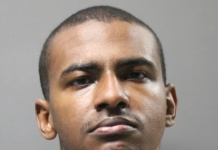
The Iowa Board of Nursing alleges that in July 2024, 55-year-old licensed practical nurse Ursella Minnea Washington of Perry began working at Edgewater Active-Life Community, a skilled nursing facility located in West Des Moines.
On March 24, 2025, a male resident was admitted to Edgewater after an extensive hospitalization related to late-stage cancer and generalized weakness. Two days after the man’s admission, according to the board, Washington was working an evening shift at Edgewater, during which she allegedly assessed the resident and documented his vital signs and respiratory status as normal. The board alleges that sometime later, a certified nurse aide noted the man’s respiratory status was declining and alerted Washington.
Based on her prior assessment, Washington believed the resident was stable, board records state. According to the board, Washington attributed the CNA’s concerns to an equipment malfunction and opted not to assess the resident over the next 45 minutes. The resident’s relatives were at the facility, and were so concerned they eventually called 911 to obtain medical assistance, the board alleges.
At some point, Washington went to the resident’s room, then contacted a physician to obtain orders to send the resident to the hospital by ambulance. The resident was admitted and died in the hospital four days later, on March 30, 2025, according to the board.
Inspectors: Family had to call 911
State inspection records paint a slightly different picture of what transpired that evening, with inspectors alleging that Washington first learned the man was in respiratory distress when one of the man’s relatives informed her of the situation. According to inspectors, Washington responded by indicating she was passing medications and would see the resident “real soon.”
The inspectors allege the resident’s relative eventually sought assistance from a CNA who found the man had a temperature of 102 degrees and an oxygen saturation level of only 75% — with anything below 88% generally considered dangerously low.
According to inspectors, the CNA placed the resident on bottled oxygen, then notified Washington of the man’s vital signs. Washington arrived in the man’s room 5 or 10 minutes later, which was about 45 minutes after family members first expressed a concern, the CNA allegedly told inspectors.
After being told the family had already called 911 to summon an ambulance, Washington contacted the man’s physician to obtain the order for him to be transferred to the hospital, the inspectors’ report indicates.
The state inspectors did not impose any penalties on Edgewater, but in response to a complaint about the situation they did cite the home for failing to provide treatment and care in accordance with professional standards of practice.
In September 2025, Washington was charged by the Board of Nursing with committing an act that might adversely affect a patient’s welfare, failing to assess or report the status of a patient, and failing to respond to, or comply with, a board investigation or subpoena.
In order to resolve the disciplinary case, Washington and the board recently agreed to a settlement that imposes no penalties or restrictions on her license but does require her to complete 30 hours of educational training on ethics, as well as 30 hours of educational training on nursing assessments.
The Iowa Capital Dispatch was not able to reach Washington for comment.