




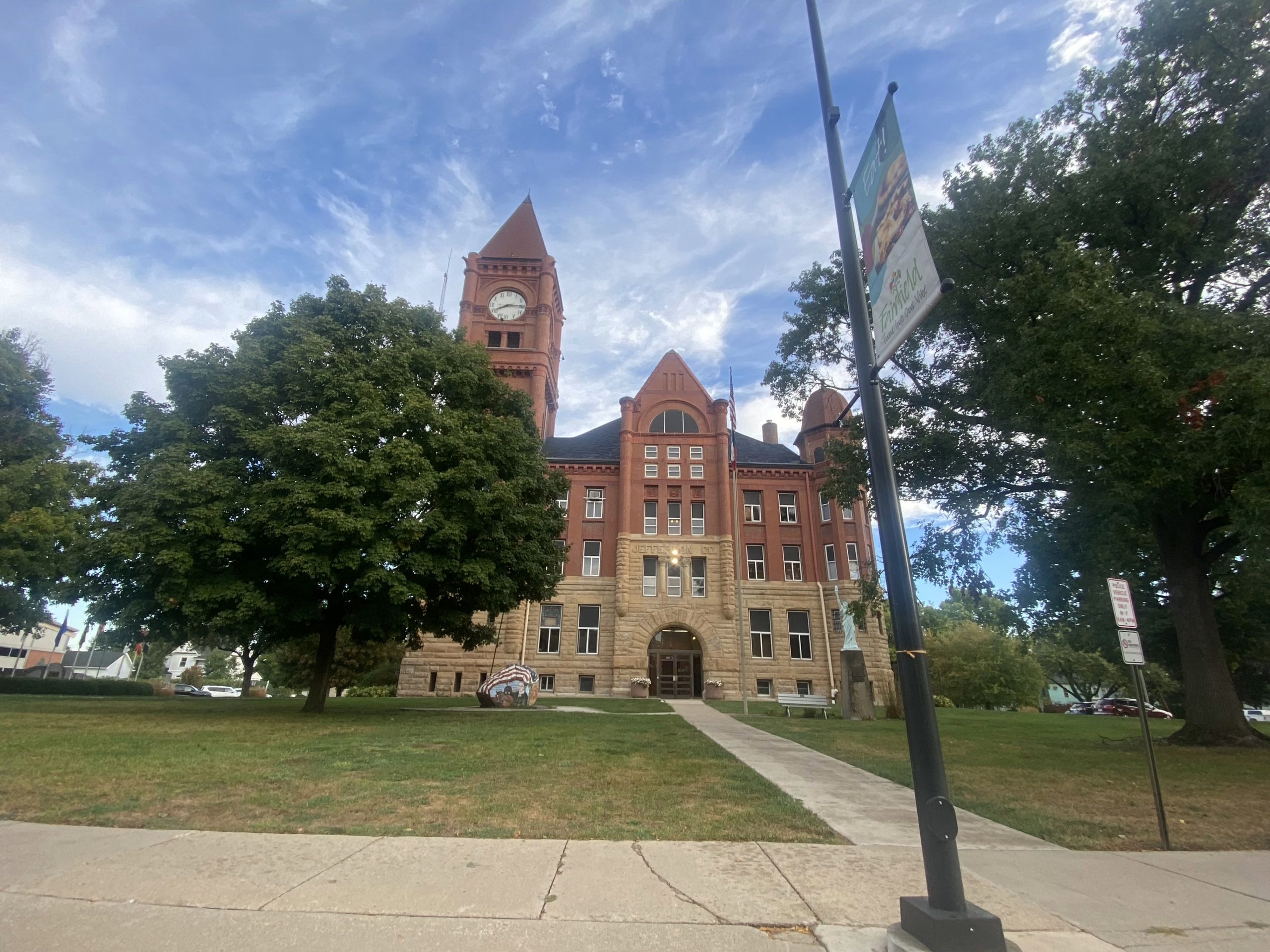
A federal judge has dismissed three counts in a civil lawsuit filed by former Jefferson County Ambulance interim director Judy Heisel, including claims of malicious prosecution and abuse of process against Jefferson County Attorney Chauncey Moulding and other county officials.
U.S. District Judge Stephen H. Locher issued the ruling May 4, 2026, granting a partial motion to dismiss filed by Jefferson County, Moulding, and Supervisor Lee Dimmitt. Counts IV, V, and VI of Heisel’s lawsuit — which alleged a Fourth Amendment violation, malicious prosecution, and abuse of process — were dismissed for failure to state a claim, though the dismissal was issued without prejudice, meaning Heisel may attempt to file an amended pleading.


Background
Heisel filed the lawsuit in November 2025, stemming from the county’s 2024 hiring process for a permanent ambulance director. After serving as interim director following the departure of Brian Thomas, Heisel applied for the permanent role but was passed over in favor of outside candidate Josh Hemminger. Her lawsuit named Moulding, Supervisors Dimmitt and Susie Drish, former Supervisor Dee Sandquist, and contract medical director Dr. Amanda Moreno as defendants, alleging civil rights violations, sex discrimination, slander, retaliation, malicious prosecution, and abuse of process.
Central to the dismissed counts was an incident on August 5, 2024 — the day Heisel learned she had not been selected and was effectively separated from employment. According to court documents, Moulding waved his hand over Heisel’s cell phone while it sat on a desk in the ambulance director’s office, causing the screen to activate. Moulding subsequently filed an affidavit alleging the phone had been recording a private closed-door meeting between himself, Supervisor Drish, and Assistant County Attorney Elizabeth Estey. That affidavit was forwarded to the Washington County Attorney’s Office, which prosecuted Heisel on wiretapping charges. A jury acquitted Heisel in June 2025.
You can read more about the original lawsuit here.
The Court’s Rulings
On the Fourth Amendment claim, the court found that Moulding is entitled to qualified immunity because it is not clearly established in existing law that waving a hand over a phone to cause it to illuminate constitutes a search under the Fourth Amendment. The court noted the legal landscape in this area is genuinely unsettled, pointing to a recent Eighth Circuit decision involving a similar situation where an officer’s incidental movement of a phone during a vehicle search was found not to constitute a search. The court acknowledged the facts here are somewhat different — Moulding’s action appeared intentional — but said the surrounding context, including Heisel having left the phone on the desk in a room where a private meeting was about to take place, raised real questions about whether she had a reasonable expectation of privacy in the phone’s home screen. The court concluded that because even it was unsure how the Supreme Court or Eighth Circuit would rule on the Fourth Amendment question, the right at issue was not clearly established, and qualified immunity applies.
On the malicious prosecution claim, the court found that Heisel had not plausibly alleged actual malice on Moulding’s part. The court noted there is nothing in the petition suggesting Moulding had personal animosity toward Heisel — no heated conversations, no disparaging comments, no prior conflict. The court also noted that Moulding did not immediately seek to have Heisel prosecuted after the August 5th incident, and that when he did move forward, he appropriately referred the matter to a special prosecutor from another county given his status as a witness and his proximity to the parties involved. The court also found that Heisel had not plausibly alleged a lack of probable cause, observing that her petition never actually states that her phone was not in recording mode — and in fact appears to concede it was.
On the abuse of process claim, the court found that the petition failed to plausibly establish that Moulding or Dimmitt used the legal process primarily for an improper purpose. Heisel had argued the criminal referral was intended to help the county defend against a separate Iowa Public Information Board investigation, seize her phone, and discourage her from pursuing civil action. The court rejected each of those theories, noting among other things that the IPIB investigation was already underway before the criminal referral was made, and that referring a matter to a special prosecutor — which is exactly what Moulding did — is not the kind of irregular misuse of process that supports an abuse of process claim.
The court closed its ruling with a pointed caution to Heisel about the prospects of any amended filing. “The Court does not believe she has come particularly close to stating a viable claim in Counts IV, V, or VI,” Judge Locher wrote. “Unless she can allege stronger facts — e.g., that Moulding flatly lied in accusing her of recording private conversations — she is unlikely to have a viable claim under § 1983 or state law theories of malicious prosecution and abuse of process.”
Three counts remain in the lawsuit — sex discrimination under the Iowa Civil Rights Act, violation of Iowa public policy, and slander — involving Jefferson County, Moreno, and several supervisors. Those claims were not part of the motion to dismiss and are still pending.
Moulding said he was pleased with the outcome. “I am confident the remaining counts will be resolved in the County’s favor in due time, but am pleased that in this case, justice has prevailed and shown that the claims of Ms. Heisel of malicious prosecution and abuse of process are unfounded,” he said. “In concluding its order, the Court noted that plaintiff had not come ‘particularly close’ to stating viable claims.”