





The Iowa Department of Natural Resources has temporarily halted Fairfield’s controversial plan to drain Walton Lake as part of a golf cart bridge replacement project, following a formal challenge from a local resident.
DNR Land Quality Bureau Chief Amie Davidson issued the suspension order on Friday, August 29, after resident Ed Noyes successfully appealed to the agency’s initial approval of the lake drawdown. The stay prevents the city from proceeding with drainage operations that were scheduled to begin this week.


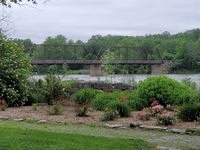
The golf cart bridge at the Walton Club was determined to be structurally unsafe and required complete replacement rather than repairs. The city became responsible for the project due to a lease agreement with the Walton Club that assigns bridge maintenance duties to the municipality. To facilitate construction, the city planned to drain Walton Lake by 11.5 feet and install a large box culvert within an earthen causeway. The design was modified from multiple smaller culverts to a single 8-by-10-foot opening that allows wildlife to pass between lake sections. This approach addresses environmental concerns by enabling fish movement at cooler, deeper water levels.
Noyes submitted his formal challenge to the DNR’s approval after learning about the project during the August 11th city council meeting. His legal argument rests on two main constitutional and contractual grounds.
First, he contends the bridge replacement violates Iowa’s constitutional requirements for public spending, asserting that the project primarily benefits the private Walton Club rather than serving legitimate community interests. This, he argues, conflicts with state constitutional provisions governing the use of public funds.
Second, Noyes disputes the city’s reading of the 2015 lease agreement with the golf club. He maintains that the city has incorrectly expanded the lease’s “maintenance” requirement to include full bridge replacement, an interpretation he believes lacks proper legal foundation.
According to Noyes, the historical precedent supports his position, as the club previously funded both earlier bridge constructions independently. He notes that when replacement needs initially arose, the golf club naturally assumed responsibility for the work before the city intervened.
The project remains suspended pending review by the Iowa Department of Inspections and Appeals or until the DNR lifts its stay order. The legal challenge represents the latest development in ongoing community debate over the appropriate use of municipal funds for infrastructure that critics argue primarily serves private interests.
The September 8th city council meeting may prove pivotal in determining whether officials pursue the contested drainage plan or explore alternative approaches that could resolve both the legal challenges and the underlying bridge replacement needs.