




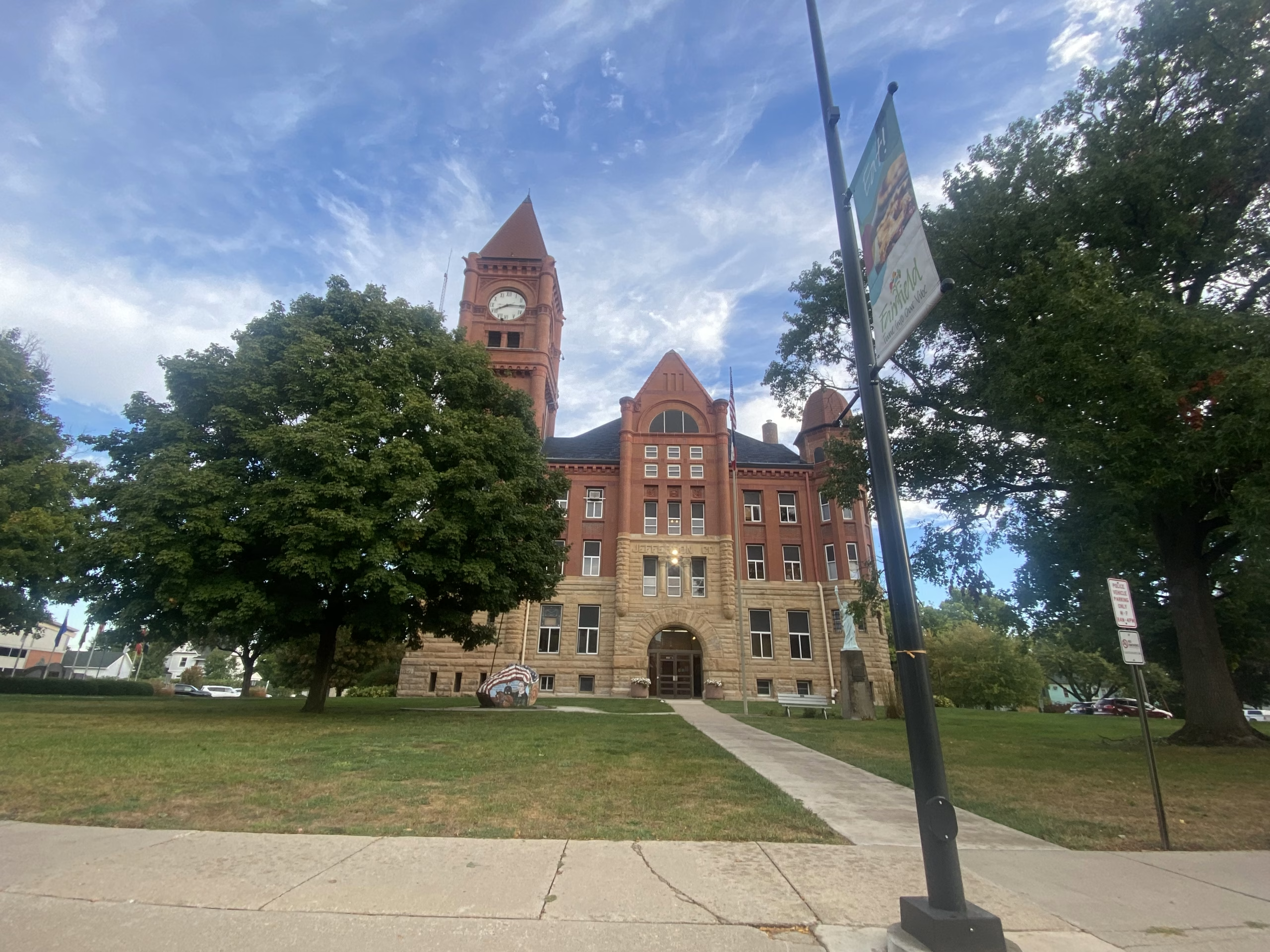
A Jefferson County resident came before the Board of Supervisors Monday, May 4th to raise concerns about the potential for large-scale data center development in the county, prompting a wide-ranging discussion about the county’s lack of zoning laws, water infrastructure, and what — if anything — local officials could do to get ahead of what she described as a rapidly accelerating national trend.
Taylor Ross, a Jefferson County resident, brought a prepared list of questions to the meeting focused on whether county officials had been contacted by developers, whether any non-disclosure agreements had been signed, and what zoning protections — if any — exist to regulate the kind of high-volume industrial development a data center would represent.


The answers, in short: no developers have made contact, no NDAs have been signed, and Jefferson County has no zoning laws.
Why the Concern?
Ross said her attention was triggered by the ITC Midwest transmission line currently being installed in the area, which she said makes Jefferson County more attractive to data center developers. Large-scale data centers require massive amounts of electricity — often drawing 15 megawatts or more on a continuous 24-hour basis — as well as enormous volumes of water for cooling their servers. Ross said the county’s flat farmland, access to the Jordan Aquifer, and now its proximity to a major transmission line check several boxes developers look for when siting new facilities.
“From everything I’ve read, southeast Iowa is really prime land for that,” Ross said. “We have water. We have accessible land. We have flat farmland. That’s exactly what they’re looking for. And now I’ve learned we don’t really have zoning laws.”
The concern is not theoretical. Google has pledged a $7 billion investment in Iowa’s data center infrastructure, and the company has been aggressively expanding in the state. In Linn County, Google approached local officials about building a six-building data center complex near the Duane Arnold Energy Center, a former nuclear plant northeast of Cedar Rapids. The proposed Linn County facility could require as much as 12 to 14 million gallons of water daily. After Linn County passed an ordinance requiring water protection agreements and environmental studies, Google pulled out of negotiations with the county and instead pursued annexation of the site into the city of Palo, where it would no longer be bound by the county’s regulatory framework. County officials in Jefferson County noted at Monday’s meeting that there are currently three or four data center projects in various stages in Linn County alone.
Ross said she is not necessarily opposed to data centers but wants the county to have enough information and enough legal framework in place to make an informed decision before a developer arrives. She specifically raised two concerns that she said are relatively well-established: that large data centers draw enormous amounts of water from aquifers, and that residents’ electric bills tend to rise as a result of the tax incentives and infrastructure costs associated with these facilities.
No Zoning, Limited Tools
Supervisor Lee Dimmitt explained that Jefferson County has no county-wide zoning — a situation rooted in a failed attempt in the early 1990s when a comprehensive land use plan was overwhelmingly rejected by residents. He said the process became so convoluted — with residents demanding so many specific provisions — that the resulting draft was essentially unworkable. Washington County, he noted, went through a similar process and eventually repealed its own zoning after it became too complicated to administer.
“There’s no zoning in this county, plain and simple,” Supervisor Joe Ledger said. “They didn’t want it, it never went through.”
Dimmitt said new county-wide zoning would require a public process, a zoning committee, and broad community buy-in — a high bar given the history. However, he said the county is not entirely without tools. Without zoning, the county still has a subdivision ordinance that discourages development on land rated as highly suitable for agricultural production. The county also retains some regulatory touchpoints — driveway permits, sanitation requirements through the county sanitarian, and DNR oversight of wastewater systems — meaning the county would at least have some awareness if a large industrial project came in.
Dimmitt pointed to the county’s experience with wind turbines as a model for how it can act without full zoning. He said Jefferson County effectively discouraged the wind turbine industry by passing setback requirements after residents raised concerns about the effects. “We pretty much neutered the wind turbine industry here because the residents were concerned about the effects,” he said. Estey confirmed that if a data center situation were to arise, the county could develop an ordinance specific to that type of development — similar to what was done with wind turbines — without needing to implement county-wide zoning.
The lack of zoning raised a pointed question from Ross: if a shell company simply purchased 200 acres in Jefferson County tomorrow, could it begin construction of a data center without any public vote or notification? Dimmitt said the answer is essentially yes, with limited exceptions. Certain regulatory touchpoints would still apply — driveway permits, sanitation oversight from the county sanitarian, and DNR review of wastewater systems — meaning the county would have some awareness that something was happening. But the public would not be required to be notified, and no vote would be required. “It wouldn’t necessarily get voted on,” Dimmitt said. “And the public isn’t required to be notified.”
Assistant County Attorney Elizabeth Estey noted that while a moratorium on data centers is theoretically possible, the county would first need to pass an ordinance before it could impose one — a process that itself requires public hearings and cannot happen quickly. She added broader context from the state level, noting she was recently present at an Iowa Attorney General’s committee meeting on governmental practice where moratoriums on data centers were actively being discussed. She noted that at least one data center is already going up in Linn County, and that without existing zoning in place, Jefferson County could not simply enact a moratorium — it would first need to pass an ordinance and then place a moratorium on that ordinance. “It’s not a simple process,” Dimmitt added. “There’s public hearings and everything.”
Estey also noted that the city of Fairfield does have zoning, meaning any development within city limits would require permits and be subject to city regulations. She added that the city would also have some control over water access, given that projects near existing city water infrastructure could be annexed into the city to gain access to sewer and water services.
Supervisor Reactions
After the meeting, all three supervisors offered their perspectives to Ottumwa Radio.
Ledger said he knows very little about data centers and had only become aware of the issue after receiving emails from concerned residents last week. “Apparently some residents are aware of them and not in favor of seeing one in our community,” he said. “At this time I am undecided until I have more information. To wrap up, I have not heard of anything in the county.”
Drish said she believes the county may be ahead of the curve after hearing Ross’s presentation. “I think it’s a caution. I think we are probably ahead of the game after listening to the young lady that came to the supervisors’ meeting today,” Drish said. “I know there are several data centers going in in Linn County, which seems like quite a lot. I’ve always heard they need a lot of water. Anyway, stay tuned.”
Dimmitt said he was candid about his own unfamiliarity with the issue going into the meeting. “I’m not sure what a data center is. I’m not sure what the angst is,” he said. After being given a definition — a secure, centralized facility housing thousands of networked servers used for cloud computing, AI, and data storage, requiring continuous power and cooling — he said his perspective shifted somewhat. He emphasized that agriculture is the foundation of Jefferson County’s economy and that he is not willing to give up farmland lightly. “I am not in favor of giving up farmland. In large part because agriculture is what Jefferson County survives on,” he said. “If agriculture was to go away, we would dry up and blow away, because that’s what we are.”
Dimmitt also raised the water supply question, noting that he does not believe the city’s infrastructure is capable of handling high-volume water use, and that while Wapello Rural Water and the Rathbun system also serve parts of the county, any water provided from the city’s system would come from the Jordan Aquifer. “Jordan well water is very hard water,” he said, adding that the DNR has previously determined that surface water is not ideal for human consumption in the area.
On the financial question, Dimmitt was equally skeptical that a data center would deliver meaningful economic benefit to the county, citing the 2% hard cap on budget growth that Jefferson County operates under. “Let’s just say they pay $20 million a year in property tax. We have a 2% hard cap on our budget. That means our budget can only grow 2%,” he said. He explained that the county would simply be required to lower its levy rate to offset the new tax base — and once that rate was lowered, it could not easily be raised back if the data center later closed. “The $20 million doesn’t benefit us because we don’t get to use it,” he said. He concluded that the financial case for welcoming a data center is weaker than it might appear. “From my perspective, I don’t see it as a great loss to the community if we never had one. If we had one, then I can see where there could be several detrimental aspects to having it here and not a great benefit — other than a tax base, maybe.”
What Comes Next
Supervisor Drish mentioned that Fairfield Mayor Connie Boyer had called her the previous week and is considering bringing together city and county officials to discuss the data center issue jointly. Ross said that kind of coordination is exactly what she believes is needed. “It seems more imminent that we get clear,” she said. “I know clarity within a community is essentially impossible, but some sort of something, because this stuff is moving really fast.”
Dimmitt said the county can be proactive on developing an ordinance even without full county zoning, pointing to the wind turbine ordinance as a model. Estey agreed, noting that an ordinance specific to data centers could be developed and passed without needing to implement county-wide zoning. Ross offered to research how other counties around the country have approached the issue and to share those examples with the board.
“Our land is precious and our water is precious,” Ross said. “We already have issues with our water. And I think a lot of different types of people in the county might actually agree that we want farmland to be farmland and we want our farmers to have access to water and we don’t want to pay more for electricity.”
Dimmitt said he concurred. “I think getting together with the city is a good start,” he said. “And then if we can be proactive and develop an ordinance, we don’t have to do zoning to be able to control it.”