




Jefferson County supervisors held two work sessions this week — a Tuesday, July 14th session attended only by the Board of Supervisors, County Attorney Chauncey Moulding, and County Engineer DeWayne Heintz with no members of the public present, followed by a second work session on Friday, July 17th that drew an unexpectedly large crowd of engaged community members to the Jefferson County Attorney’s Office meeting room. The work sessions were aimed at finalizing a data center ordinance that has been months in the making, with a formal public meeting scheduled for Monday, July 20th where the draft will be on the agenda for discussion and public comment will be available.
No data center company has approached Jefferson County with plans to build a facility here. But supervisors say the time to act is now — before any developer comes to the table. The document before the board remains a draft, and no final decisions have been made.


Background: How Jefferson County Got Here
The push for a data center ordinance in Jefferson County did not emerge from a vacuum. It grew out of a broader statewide conversation about the rapid proliferation of data centers in Iowa — driven by the state’s low electricity costs, available land, and favorable tax environment — and the concerns that rural counties have raised about whether they are adequately protected from the infrastructure, environmental, and fiscal pressures these facilities bring.
Supervisor Susie Drish said the effort began about six weeks before Friday’s session, when Fairfield Mayor Connie Boyer reached out to convene a meeting of local stakeholders. “About six weeks ago, the mayor had called me and said, we need to get together. We need to talk about this. We need to get all the partners together to talk about this,” Drish said. “That was done. It was in the chambers there at the city. There were, I think, 50 people showed up that day, plus some in an overflow. People are just concerned, because everybody is concerned about water and money these days, the cost of things.” You can read about that meeting here.
That initial community meeting set off a months-long process of research, drafting, and revision. Former Assistant County Attorney Elizabeth Estey, who has since left the office, did significant early work on the ordinance. County Attorney Moulding has been carrying the effort forward, with Supervisor Lee Dimmitt taking a hands-on role in shaping the provisions. The draft has drawn on ordinances from other Iowa counties including Linn County — known for having some of the state’s strictest data center regulations — while incorporating provisions specific to Jefferson County’s agricultural character, infrastructure capacity, and community values.
Dimmitt has been clear throughout the process about what he wants the ordinance to accomplish. Jefferson County is not looking to attract data centers — the ordinance is designed as a regulatory and deterrent framework, not a welcoming one. “We’re not out fishing for data centers,” he said earlier in the process. “But we realize that we can’t tell you who you can and can’t sell your land to.”
Tuesday’s Work Session: Page-by-Page Review of the Working Draft
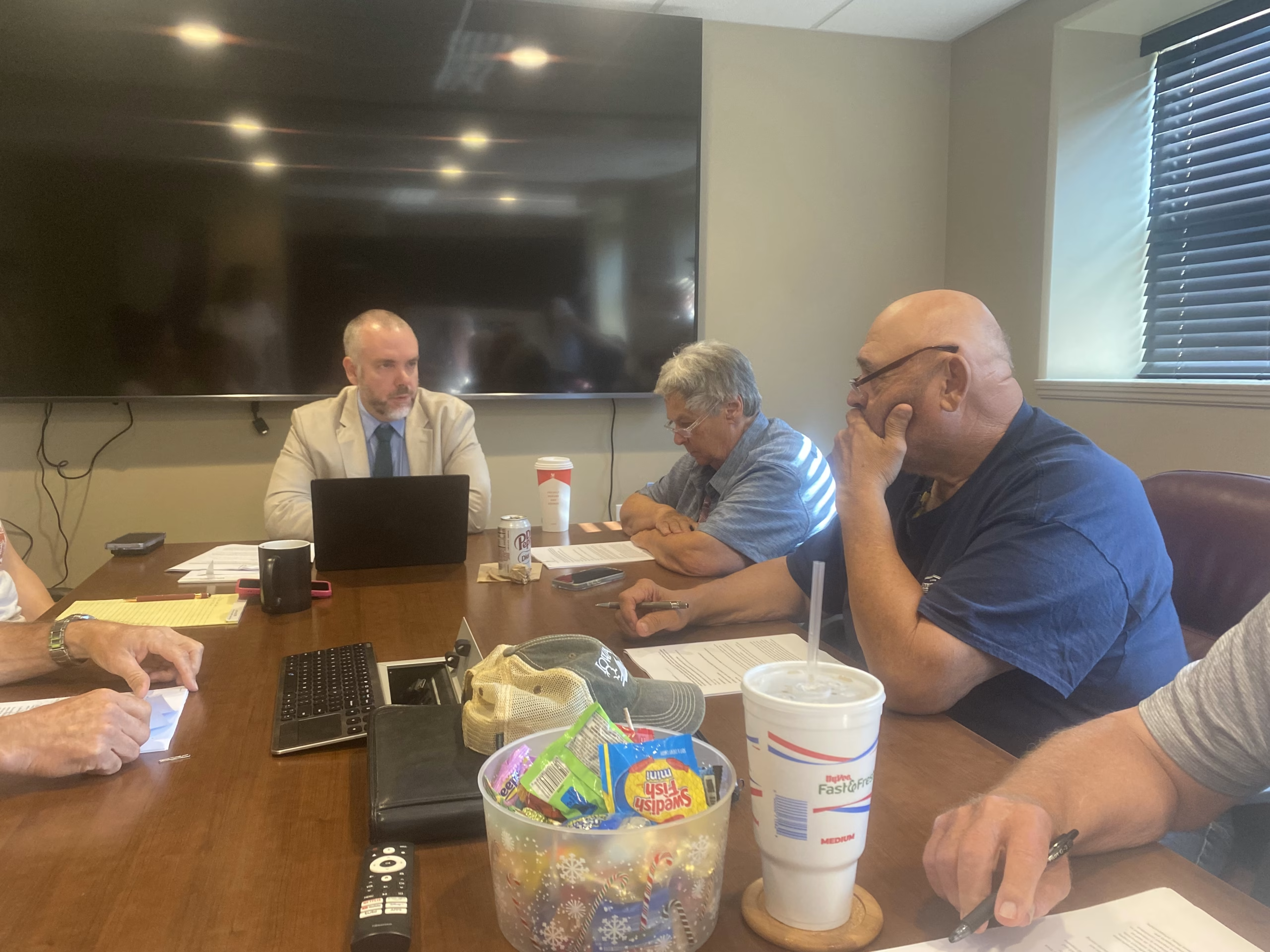
The Tuesday, July 14th session was a work session open to the public, though no members of the public attended. Present were Supervisors Lee Dimmitt, Joe Ledger, and Susie Drish, along with County Attorney Chauncey Moulding and County Engineer DeWayne Heintz.
The purpose of the session was to run through the working draft page by page, with some of Dimmitt’s proposed amendments marked in red, and get the document into a shape the board could stand behind. Moulding set the tone at the outset. “My hope today is that we just start at the start. We’ll run through what I’ve been calling the working draft,” he said. “Hopefully by the end of the morning, we’ll have something that’s, if not polished, but generally on the road to being something that the board stands behind.”
The draft at this stage was still a working document — a skeleton built around principles and key provisions rather than fully codified legal language. It was modeled in part after ordinances from other Iowa counties, including Linn County, which officials noted is considered among the strictest in the state when it comes to data center regulation. Former Assistant County Attorney Elizabeth Estey had done significant early work on the document before leaving the office, and Moulding had been carrying it forward.
The group worked through the draft’s definitions section first, establishing the distinction between small-scale and large-scale data centers. Small-scale was defined as a facility with an electrical design capacity of less than 20 megawatts using less than 50 gallons of water per minute. Moulding noted the language had originated with Estey, who drew it from Louisa County’s ordinance. The group agreed 20 megawatts was a reasonable threshold, noting that the very large facilities that tend to draw attention are in the 150-megawatt range.
Heintz brought printed schematics of a closed-loop thermal cooling system to help supervisors understand what that requirement would mean in practice. The group discussed water usage figures at some length, with Heintz noting that Iowa DNR rules currently allow facilities to use up to 2 million gallons of water per minute under state rules — a figure that drew a reaction from the room. The group agreed to leave the 50-gallon-per-minute threshold for small-scale classification in place and revisit it if public comment suggested otherwise.
Among the ordinance’s strongest safeguards discussed during Tuesday’s session were proposed limits on noise, minimum setbacks from property lines, and restrictions based on Corn Suitability Ratings. Dimmitt highlighted the CSR provision as a particularly powerful tool. “One of the biggest tools in our box is the 55 on the CSR,” he said. “Correct me if I’m wrong here, but I’m thinking — if you want these 45 parcels to build on, 30 of them qualify or allow you to build on, but there’s 15 of them that you don’t. That project is dead.” The ordinance initially had the figure at 60, but they decreased it to 55 after calling some members of the Jefferson County Farm Bureau to know what the average rating is here in the county.
Additional requirements supervisors said they would want to see before approving any permit included a mitigation plan addressing increased power usage in the county, a water study, and substantial insurance coverage. Moulding acknowledged that work still needed to be done on post-hearing requirements, compliance issues, inspection procedures, and a single point of contact provision. The group was candid about the limits of their knowledge at this stage. “I want to get it right unquestionably, but I don’t know what right is,” Dimmitt said. “I don’t think we’ll ever get it right.” Moulding responded: “We’re getting close.”
A key discussion at the close of the meeting centered on strategy — specifically, whether the board should have a moratorium resolution ready to consider the moment the ordinance passed, or wait until after the ordinance was approved to raise the issue. Dimmitt argued for efficiency — having the resolution ready to discuss immediately upon passage to avoid losing another week or two of time. Moulding pushed back gently, suggesting the board should not telegraph its intention before the ordinance was actually passed. “I don’t think you should decide to do a moratorium until the ordinance is passed and then you can discuss whether it’s appropriate to do a moratorium,” he said. Dimmitt clarified he was simply proposing to have the resolution ready to consider, not to predetermine the outcome. The group agreed to revisit the question at a future public meeting.
By the end of the session, supervisors agreed to schedule a second work session for Friday, July 17th at 9:00 a.m. in the county attorney’s office. Moulding said he would incorporate the changes discussed, add finishing touches including additional language, and have a more complete and properly codified document ready for Friday. “I’ll make the changes we talked about today, I’ll put some finishing touches on the end and hopefully we’ll get something wrapped up,” he said.
Friday’s Work Session: Packed Room, Final Refinements
The Friday, July 17th work session drew an unexpectedly large crowd to the Jefferson County Attorney’s Office meeting room, with around fifteen concerned residents packing the space — some sitting on the floor after the chairs filled up. Jefferson County Attorney Chauncey Moulding and County Engineer DeWayne Heintz were present alongside Supervisors Joe Ledger, Lee Dimmitt, and Susie Drish. Also present was Taylor Ross, a local resident who has been one of the driving forces behind the community push for a data center ordinance.
Because it was still a work session, no formal decisions could be made. But the turnout signaled just how closely the community was watching the process, and residents had an opportunity to observe firsthand and, at times, offer input before the draft heads to Monday’s formal agenda.
The only substantive change made to the ordinance during Friday’s session was the addition of historical and archaeological survey language, brought forward by County Engineer Heintz. As county engineer, Heintz regularly works with the federal government on road and infrastructure projects and is well aware of the requirement to identify and document historical and archaeological resources before breaking ground — and he felt the same standard should apply to large-scale data center development in Jefferson County. He offered to email Moulding the federal guidance he uses on his own projects, including sections addressing tribal exposure and cultural resources.
The provision requires applicants to document existing conditions and consult available records from the State Historic Preservation Office and the Office of the State Archaeologist, conduct field surveys when conditions indicate a reasonable potential for historical or archaeological resources, and document appropriate consultation with any potentially affected tribal entities. Upon discovery of human remains or previously unidentified archaeological materials, work must immediately cease pending notification of appropriate authorities. Moulding also corrected several typos he had identified in the document.
Dimmitt used the closing moments of the work session to urge the community and his fellow supervisors not to let the perfect be the enemy of the good. “Not trying to be a horse’s patoot, but I want to remind everybody — the longer it takes us to get to the point where we have the public hearings and get through the public hearings and approve an ordinance, that pushes out the ability to implement a moratorium,” he said. “Every time we go into a public hearing and then we decide we’re going to go back and change it, we have to start back at square one.”
He noted that under Iowa law the county must hold at least two public hearings with no fewer than four and no more than 20 days between them — what he called the “four and 20” requirement. Given that the Fairfield newspaper publishes only once a week, a best-case scenario puts the county roughly four weeks out from the first public hearing to the end of the second. “All I’m saying is that if we keep coming back to the drawing board, it just kicks that can further down the road. We think we can actually do something.”
As the session progressed, some community members began asking questions and interjecting, prompting supervisors to remind the room that it was a work session and not a formal public hearing. Taylor Ross stepped in to reinforce that message. “We are here in their work session — they’ve asked us three times to respect that. Monday is our chance, please let’s respect that,” Ross said. Moulding confirmed he would have a clean, typo-free document ready for Monday’s consideration, and noted that public comment would be available following the meeting with a three-minute time limit per speaker.
After the session, supervisors spoke with reporters. Ledger said the turnout did not entirely surprise him. “Not really, because of the feedback we’ve been getting and stuff. I thought maybe there would be more here, actually,” he said. Drish agreed. “I’m not surprised at all because Jefferson County has a lot of engaged people who want to give their opinions,” she said.
When asked whether any data center company had approached the county, Drish was direct. “We do not have any clue if there’s somebody coming. It’s just kind of, let’s plug the hole in the dike before the water even starts to come out, before you fill the other side,” she said.
Ledger said community concerns about electricity costs had been a significant driver. “They use a lot of electricity. Our electricity bill will go up if there’s more demand, so we’re trying to take care of that too,” he said. “I’ve received a lot of emails from concerned citizens, so I’ve tried to make notes, and I think we’ve got about everything incorporated in here that we need.”
He noted that the timeline was already slipping from the original goal of finishing by the end of August. “We’re not going to have this done by the end of August. We’re going to be somewhere into September by the time we do everything the right way.” Drish, however, noted that there was still a narrow path to finishing in August if the board moved quickly on Monday. “If we approve that on Monday, the draft, to go to a meeting for discuss-consider — Abby gave me a piece of paper that showed if this happens on Monday the 3rd, we might go through two readings. We could just barely get by in August,” she said.
Ledger also said he believed the most engaged community members had made it out to Friday’s session. “I think the core of the people that’s been emailing me was in the room today. I really feel like they were here,” he said.
What the Draft Ordinance Contains
The draft ordinance, as it stood following Friday’s session, is a comprehensive 22-page regulatory framework. A full version of the draft will be made available as a separate reference document here. What follows is a summary of its most significant provisions.
The ordinance applies only to large-scale data centers — defined as facilities with an electrical design capacity greater than 20 megawatts or that use more than 50 gallons of water per minute, measured on an annualized basis, which remained unchanged from Tuesday’s work session. The definition covers all planned phases of a multi-building campus, meaning a developer cannot avoid the large-scale classification by building in stages. The ordinance explicitly excludes cryptocurrency mining operations, internet service providers, telecommunications providers, and other information technology businesses that do not meet the definition of a data center — meaning the ordinance is narrowly targeted at large-scale data center facilities specifically.
The ordinance is also explicit that it is not a county zoning ordinance and does not establish zoning districts. It is adopted under Jefferson County’s home-rule and police powers and applies throughout unincorporated Jefferson County, with the understanding that incorporated municipalities control their own ordinances within their own jurisdictions.
Before any construction can begin, applicants must obtain a Large-Scale Data Center Permit issued by resolution of the Board of Supervisors. Applications must be filed with the Jefferson County Auditor and accompanied by an application fee established by the Board and a review-cost deposit from which the county may draw to cover engineering, legal, hydrological, environmental, financial, planning, and inspection costs. Any unused balance of the deposit is returned after final action on the application.
The application must include extensive documentation covering ownership and controlling entities, the legal description of all properties involved, a detailed project description and construction schedule, a full site plan, and documentation of coordination with all relevant regulatory agencies. For any project proposed within two miles of an incorporated city or accredited school, the applicant must provide written notice and a reasonable opportunity for those entities to submit comments.
The ordinance incorporates Corn Suitability Rating restrictions as a factor in evaluating permit applications. The draft states that land in Jefferson County with a crop suitability rating of 55 or greater is generally considered best suited for agricultural use, and that the CSR of any land proposed for a data center project will be strictly scrutinized by the Board of Supervisors when reviewing the proposal. However, as County Attorney Moulding noted during Friday’s session, the CSR provision is not a black and white determination — it is one of several factors the Board will weigh when evaluating an application rather than an automatic disqualifier.
Additional key safeguards include a mandatory closed-loop cooling system unless otherwise authorized by the Board of Supervisors, a comprehensive Water Study prepared by a qualified hydrological or civil engineer demonstrating that sufficient water resources exist without causing undue adverse impacts to existing water users or groundwater systems, a noise study confirming that no operating equipment produces decibel levels exceeding 50 dBA as measured from the outside wall of any occupied structure on privately owned land adjacent to the data center, and a detailed power utilization and mitigation plan demonstrating that increased electrical costs will be borne by the data center rather than existing Jefferson County residents and customers.
The ordinance requires a Road Use Agreement approved by the Board of Supervisors upon the recommendation of the County Engineer, identifying all state, county, and municipal roads proposed for use during construction and operation. A pre-construction roadway conditions survey must be conducted documenting the condition of all roads, rights-of-way, bridges, culverts, and public drainage infrastructure. The site must be accessed by a hard-surfaced road with a continuous hard-surfaced connection to a county arterial or state or federal highway. Roads and public infrastructure impacted by construction must be restored to pre-construction conditions upon completion.
Setbacks are not specified as fixed distances in the final codified ordinance — rather, the notice requirement mandates that property owners and occupants within 1,000 feet of the project area receive written notice at least ten days before any hearing. Projects within two miles of an incorporated city or accredited school must also provide written notice to those entities. The Board retains full discretion to evaluate setback adequacy as part of its written findings.
Additional required submissions include a pre-construction historical and archaeological survey, a Waste Management Plan detailing handling of all construction waste including hazardous substances and electronic waste, a Backup Power Plan identifying generators, testing frequency, noise and emission controls, and fire protection measures, a Lighting Plan requiring full-cutoff fixtures to prevent light from shining upward or adversely impacting adjoining property, an Ice Mitigation Plan created in collaboration with the County Engineer to address any buildup of ice on roadways from data center activity, an Emergency Response Plan developed in collaboration with the Jefferson County Sheriff’s Office and Emergency Management Director, and a Decommissioning and Site Reclamation Plan with a posted bond sufficient to cover estimated decommissioning costs.
On insurance, the ordinance requires the applicant to indemnify and hold harmless Jefferson County from claims arising from data center activity. The applicant must furnish a certificate of insurance evidencing coverage of not less than $10 million, which may be satisfied through a combination of primary and excess or umbrella coverage. Jefferson County must be named as an additional insured where commercially available.
On decommissioning, a large-scale data center must be decommissioned when permanently abandoned or when operation has ceased for 12 consecutive months without written extension from the Board. Decommissioning must begin within 90 days and be completed within 18 months. No decommissioning waste may be placed in a county-owned facility without prior Board approval, and disposal of any decommissioning waste within Jefferson County must first be approved by the Board.
Economic Development Agreement and the Permit Fee Question
One of the most significant topics Moulding addressed at the opening of Friday’s session was how to structure the county’s financial relationship with any future data center applicant without crossing into legally problematic territory.
The working draft from Tuesday had included language requiring a 10 percent application fee due before the county would even consider a proposal. Moulding explained why that would not hold up. “There’s a concept in the law where a municipality can’t basically extort an entity for something of value just to get approval of an application,” he said. He walked through the math — on a $500 million construction project, a 10 percent upfront fee would cost a developer $50 million just to have the county look at their application. “That’s not going to pass any kind of scrutiny,” he said.
To fix that, Moulding restructured the concept into an Economic Development Agreement. The key distinction is timing and what the payment is tied to — rather than paying to have the county consider an application, the developer commits to community investment as a condition of actually receiving a permit. That puts both sides on legally stronger footing because the county is exchanging something of value for something of value.
Moulding was also candid that even the EDA with a mandatory 10 percent community investment commitment could face scrutiny. “Again, I think that is something that would maybe be difficult, suffer difficult scrutiny,” he said. He included an alternative version of the agreement in the back of the package that would accomplish similar goals without the mandatory percentage — giving the Board flexibility depending on the scale and nature of any future project.
The other key advantage of the EDA structure, Moulding noted, is that contributions made through it do not count against Iowa’s two percent annual property tax revenue growth cap — because they are not a levy. That means the county can capture meaningful revenue from a data center through the EDA even when the property tax structure would otherwise limit how much of that benefit the county could keep.
The Community Investment Commitment must equal 10 percent of total construction costs and may be satisfied through cash contributions to a Community Betterment Fund, public infrastructure funding, workforce development programs, affordable housing initiatives, emergency response equipment, agricultural preservation programs, or other community improvements approved by the Board of Supervisors.
What a Developer Must Prove — And What Is and Is Not Black and White
Before the Board of Supervisors can approve any permit, the ordinance requires written findings on six specific criteria. The Board cannot approve an application unless it finds that the application is complete and materially accurate, the applicant has demonstrated compliance with the ordinance, adequate water, electrical, road, drainage, emergency-response, and public infrastructure capacity exists or will be provided, anticipated noise, lighting, traffic, water, environmental, and neighboring-property impacts will be avoided or reasonably mitigated, required agreements, insurance, and financial assurance have been executed or provided, and the facility can be constructed, operated, and decommissioned without an unreasonable threat to public health, safety, property, or county infrastructure.
A community member in attendance raised a practical question near the end of Friday’s session about how enforceable those criteria actually are — specifically, whether a permit application could be denied on the basis of any single item, or whether the board would have to evaluate the application in its entirety. Moulding said the answer depends on the specific provision. “Some of them are black and white, like they shall have an environmental impact assessment,” he said. “Some of them are not black and white, such as the county looks at corn suitability rating as 55 or higher being better suited for cropland. That is not a black and white, but that is certainly a factor that they consider.”
He explained that the written finding of fact and conclusion of law required upon any approval, partial approval, or denial is essential precisely because any decision is subject to appeal. “If the denial is on one minor aspect, that’s going to be a lot weaker on review than if they just completely blew off all of their obligations in the application,” Moulding said. “If they didn’t put a period at the end of a sentence, that’s not going to be a strong reason to deny. But if they blew off the environmental assessment, that’s going to be a stronger reason to deny.” The Board may also impose reasonable conditions directly related to the project’s anticipated impacts.
The exchange highlighted one of the broader themes of both sessions — that the county is building the strongest framework it can on a compressed timeline, knowing that refinements will likely follow once a moratorium is in place. As Ledger put it: “We spent a lot of hours on this. I’m happy with what we have. I think we’re getting about everything covered we can, but there’ll be something pop up somewhere. It’s an ordinance. You can always change it.”
Continuing Operations, Compliance, and Enforcement
Once a data center is operational, the permit holder must submit an annual certification by March 1 of each year confirming continued compliance and reporting annual and peak electrical demand, annual and peak water withdrawal and consumption, material changes to facility equipment or operations, fires, spills, hazardous releases, or other significant incidents, and the status of required insurance and financial assurance.
The operator must immediately notify appropriate emergency authorities of any emergency and must notify the county within 24 hours of any fire, hazardous release, significant spill, major infrastructure failure, or event reasonably presenting a threat to public health, safety, property, or the environment.
The Board of Supervisors retains authority to inspect the project area at reasonable times, issue stop-work orders when work presents an immediate threat to public health or safety, and suspend or revoke permits for material misrepresentation in the application, violation of the ordinance or permit, failure to maintain required insurance or financial assurance, failure to comply with a lawful corrective order, or creation of a substantial threat to public health, safety, property, or the environment.
The Path to a Moratorium
Throughout both sessions, supervisors repeatedly returned to the relationship between the ordinance and a moratorium. Jefferson County does not have county zoning, which means it cannot simply impose a moratorium on data center development the way some other Iowa counties have done. Instead, the county must first pass an ordinance establishing regulatory authority over data centers, and only then could supervisors consider adopting a moratorium using the authority created by the ordinance.
Moulding raised an important legal concept during Friday’s session that underscored the urgency of getting the ordinance right before it goes to a public hearing — the concept of no ex post facto legislation. “If we put this together now and somebody applies, pass it today, somebody applies tomorrow, and then they’re going to apply under this ordinance,” he said. “So if you see their application, they’re like, oh man, we forgot something — you can’t change it after they’ve applied and applied the new rules. So that would be, whatever is in force at the time is what would work for them.” That is part of the reason Dimmitt said he wants a moratorium — to give the county breathing room to refine the ordinance after seeing how it works in practice, without being locked in by an active application.
What Comes Next
The draft ordinance will be formally on the agenda at the Jefferson County Board of Supervisors meeting on Monday, July 20th. The meeting will include time for public comment following the meeting, with a three-minute time limit per speaker.
Supervisors have emphasized that the document before them on Monday is still a draft and that no final decisions have been made. The public hearing process — with its required notice periods and multiple sessions — will give the broader community a formal opportunity to weigh in before the ordinance is approved. But supervisors have made clear they want to move as quickly as responsible governance allows. The moratorium they hope to implement once the ordinance passes is the real goal, and every week of delay pushes that protection further out of reach.
As Drish put it after Friday’s session: “It’s just kind of, let’s plug the hole in the dike before the water even starts to come out.”