




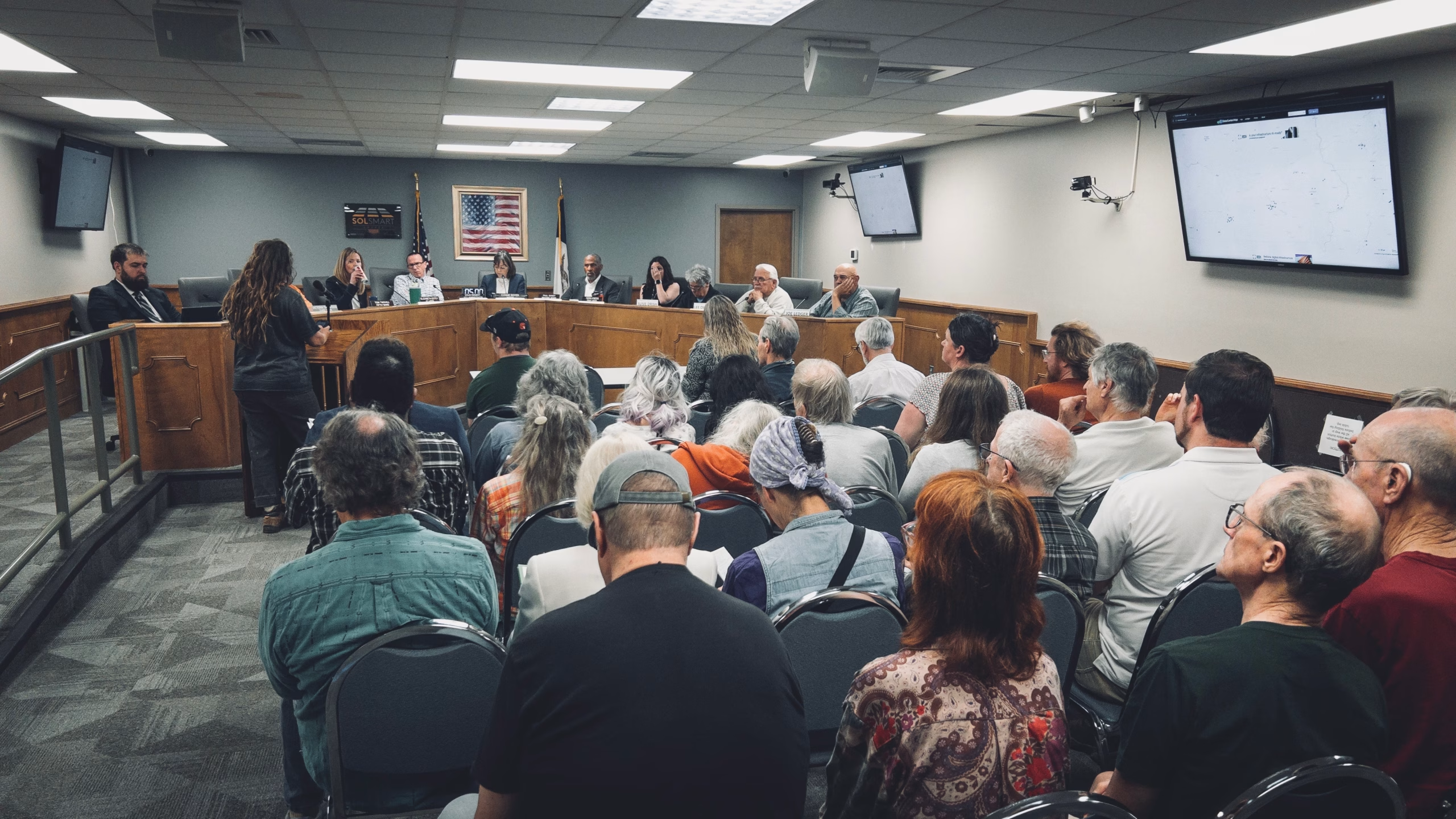
A standing-room-only crowd packed Fairfield City Hall on Monday, May 18th for a joint meeting between the Fairfield City Council and the Jefferson County Board of Supervisors focused entirely on the growing concern over large-scale data center development potentially coming to Jefferson County. The turnout was so large that an overflow room was set up at the Fairfield CoLab on the square, where additional community members watched a live stream of the proceedings and participated in a real-time online survey. Mayor Boyer thanked Jason Strong and Marla Brader for making the CoLab available.
Mayor Boyer framed the meeting at the outset as a conversation starter, not a debate. She noted that data centers are already concentrated in Iowa in cities like Des Moines and Council Bluffs, with activity also happening in Linn County, and that major players including Google and Meta have an established presence in the state.


She said city officials had already done preliminary research and found that the Iowa DNR has regulations around data center water use. She also cited a YouTube news segment documenting neighbors of East Coast data centers describing noise so severe they could not sleep. “Those neighbors had a lot to say about not being able to sleep, the noise, these kinds of things,” she said. Boyer reminded the room that any ordinance developed by city council or the supervisors goes through three readings, each with a public hearing, and encouraged residents to stay in communication with their elected officials.
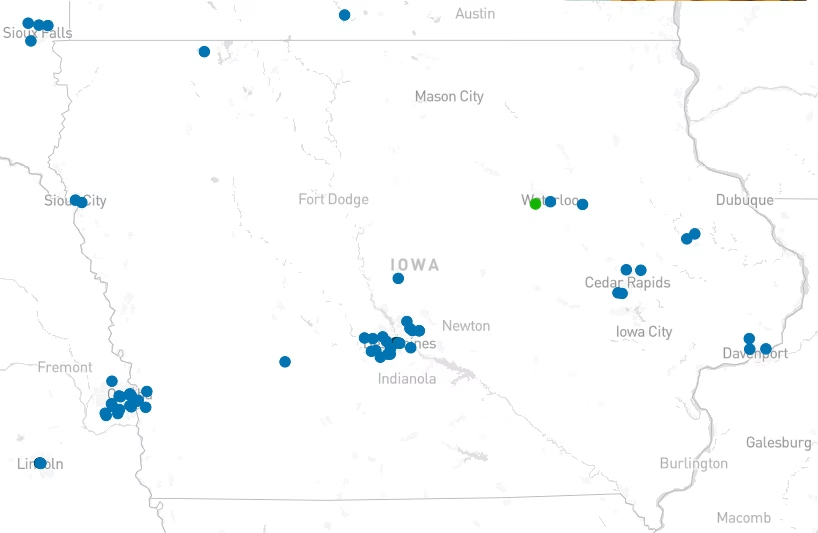
Boyer also shared a map she had found that day on datacentermap.com showing the locations of data centers across Iowa, noting it could be viewed for the entire United States as well. She was careful to add that she could not confirm the map was fully accurate or up to date, but shared it as a starting point for the room’s awareness.
Supervisors Open
All three Jefferson County Supervisors were candid about where they stand. Supervisor Joe Ledger went first. “Three weeks ago, I knew how to spell data center, and that’s about it,” he said. “I’ve picked up a lot of information. I was at Taylor’s presentation at the library, and it’s a learning curve. I’m here to learn more about it, all I can, to make an informed decision.”
Supervisor Lee Dimmitt echoed that sentiment but noted action is already underway. “We’re trying to get ahead of the curve,” he said. “If we get an ordinance in place, that doesn’t mean we can’t tweak it and improve upon it, but if we get something in place, then there are a couple of tools in our box that we can use.”
Supervisor Susie Drish kept her remarks brief. “This is very important that we get in on the opening of this, the infantile stages of what we’re dealing with,” she said. “I do believe we’re here tonight just to hear, to listen, to talk with each other.”
Council member Paul Gandy offered a note of urgency. “When it happens in an area, it can happen pretty quickly,” he said. “A large piece of land is purchased, and before you know it, a data center is being built. The idea of us being an informed community is important to see what our options are. It’s a timely conversation, a necessary conversation.”
Taylor Ross Presents Research
The centerpiece of the evening was a detailed presentation from Jefferson County resident Taylor Ross, who has spent recent weeks immersed in research on data center development and had previously presented to the Fairfield Public Library and the Board of Supervisors. She received a full room of applause when she finished.
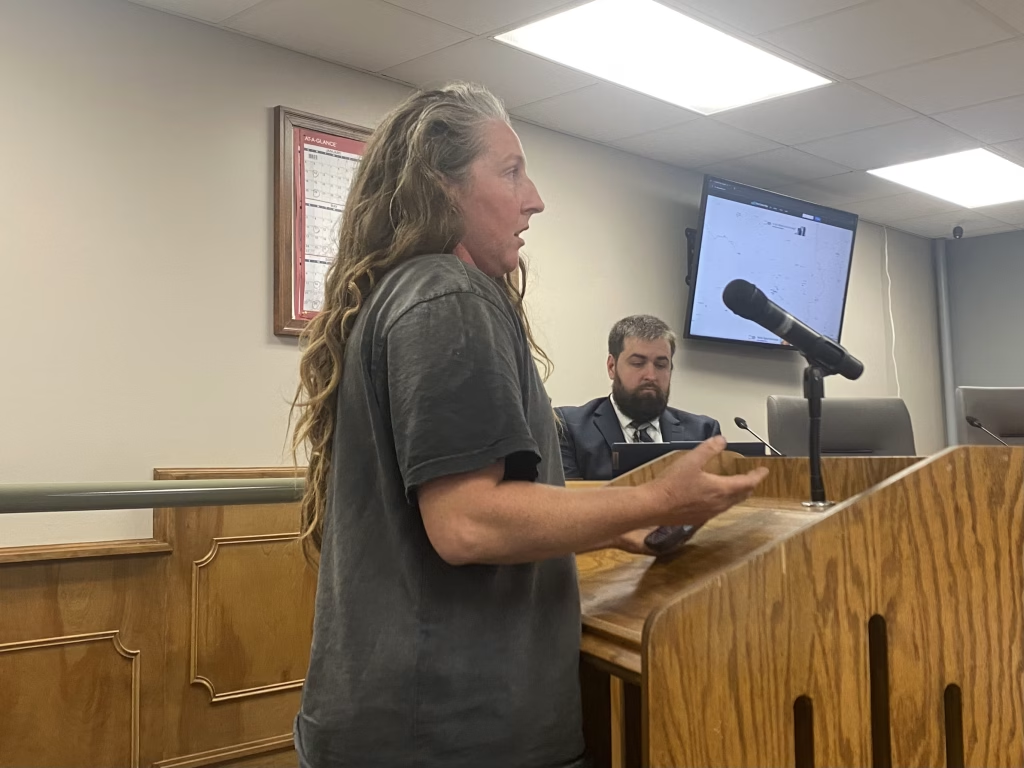
“I feel heartened that our city government and county supervisors want to explore this issue,” Ross said. “I am going to generally go over what data centers are, why they may be undesirable, and why I think our county should be concerned about and take actions around this type of development with urgency.”
What is a Data Center?
Ross defined a data center as a physical facility that houses and runs large computer systems, noting that U.S. data centers consumed approximately 176 terawatt hours of electricity in 2023 — approximately 4.4% of total U.S. electricity consumption — according to a Lawrence Berkeley National Laboratory report, not accounting for cryptocurrency. She noted that some projections show data center energy consumption could double or triple by 2028. She also clarified that cryptocurrency and Bitcoin mining fall under the same category of concern because they are continuous-use facilities that run and draw electricity 24 hours a day, seven days a week, while also needing to continuously cool their servers.
Why Data Centers May Be Harmful
Ross outlined a broad list of concerns. On water, she was explicit. “A midsize data center situated on 50 to 200 acres can draw up to 30% of the daily water use of a 10,000-person town,” she said. “A hyperscale data center can draw 500,000 to 5 million gallons a day — equivalent to two to six times the amount of water drawn for a 10,000-person town per day.” She referenced Iowa House bill HF 2447, which would require data centers to report water and electricity use, disclose where water comes from, and create separate utility rate classes. “What this bill tells us more than what it’s seeking to legislate is actually how much is not required by law for data centers to disclose at this time,” she said.
On the economic argument, Ross was skeptical. She cited Altoona as a cautionary example of tax increment financing deals gone wrong. “Property tax structures often heavily favor the operators, equipment may be exempt, electricity may receive exemptions, job creation is far less than expected, and local governments can end up receiving far less net new revenue than early public narratives suggested,” she said. “Altoona initially thought they would be getting $1 billion in property taxes, but we’re now seeing that the income from their intensive incentivized deal with Meta will likely be far less.” She also cited a cost-benefit analysis by Bob Ferguson that she said does not look favorable for communities hosting data centers.
On diesel generators, Ross noted that all data centers use them as backup and that they run when utility companies ask them to give the grid a break. “Diesel generator pollution at that scale can be significant,” she said. “The sound pollution alone can be quite severe.”
On cooling and water contamination, Ross explained that 80 to 90% of current data center builds use evaporative cooling techniques that evaporate 80% of the water but leave a concentration of heavy metals and nitrates discharged into local waterways. “If a data center were pulling from our beautiful, pristine aquifer, it would not be pulling nitrified water, but it would potentially be contributing to nitrification of our aquifer,” she said. Closed-loop cooling systems, she added, use biocides and other contaminants, and there are not currently strict laws in place to monitor appropriate disposal. She also referenced White House Executive Order 14318, which is fast-tracking data center environmental permitting. “This shows a trend towards pushing this kind of development before appropriate assessments can be made,” she said.
Why Jefferson County Should Be Concerned
Ross made the case that Jefferson County faces a particular and immediate risk. “As there is more and more pushback on data center development, developers are looking to unincorporated and unzoned areas where they can build without jumping through as many hoops,” she said. She noted that Jefferson County is now part of the ITC Midwest 345 kilovolt transmission line being installed. “This has effectively put us on the map for developers.”
She explained that if a developer wanted to build in the county, they would apply directly to ITC Midwest to hook into a substation and apply for state-level water permits — with no county supervisor vote and no public comment required. “Not only would there not be a county supervisor vote, there wouldn’t be any public comment,” she said. “We just don’t have any zoning. We don’t have any way to track it.”
Ross also raised concern about the ITC Midwest upgrade to the Jefferson County substation on Highway 1, currently being upgraded from 69 to 161 kilovolts. She said she was told by an ITC Midwest representative the purpose is to provide redundancy for Fairfield’s electricity supply, but noted that ITC Midwest legally has the authority to connect the substation to the 345 kilovolt line and use it to power a data center at any time. “While there is no proof of this and it may not be happening now, there’s also no guarantee that this will not happen, and therein is my concern,” she said. She also noted that a mid-scale data center can run off a 161 kilovolt line, meaning the county may already have or soon have the infrastructure to support one. Quoting assistant county attorney Elizabeth Estey from the previous week’s city council meeting, Ross said that without zoning, “we wouldn’t even know whether it was already happening.”
Ross’s Proposal: A 24-Month Moratorium
“I am requesting that the county consider writing an ordinance to allow for the implementation of a 24-month moratorium on data centers and other continuous-use facilities from two megawatts of draw and above,” Ross said. She was careful to note she does not want the ordinance to exclude traditional agricultural industrial uses like grain drying and food processing. She cited Tom’s Hardware as reporting that there are currently 69 temporary moratoriums in the United States and four total bans, ranging from six to 24 months, with Grant County, Indiana passing a 24-month moratorium as recently as March. “It is my opinion that we need time to watch and wait for peer-reviewed research and to figure out if we as a county want to take the plunge into writing zoning,” she said. “I know that’s controversial. This is why I’m proposing the drafting of a strict ordinance to allow for a 24-month moratorium.” The room responded with sustained applause.
Council member Gandy asked Ross directly whether Jefferson County currently has the electrical infrastructure to support a data center. Ross said that based on her research, a mid-scale data center operating in the range of 20 to 50 megawatts can hook into a 161 kilovolt line and does not require the 345 kilovolt line. She also noted that a developer could build a gas plant on county land as an alternative power source, and that unzoned areas are increasingly attractive to developers facing pushback elsewhere. “Unincorporated and unzoned areas are becoming rapidly more desirable because there are no permissions they need to go through,” she said.
Elizabeth Estey on Legal Options
Jefferson County Assistant Attorney Elizabeth Estey, also a Fairfield city council member, addressed the legal complexities the county faces in attempting to regulate data center development without existing zoning. “If anyone has found an example of a moratorium in an Iowa county that doesn’t have zoning and doesn’t have an ordinance, I would be very interested in seeing that,” she said. She explained that without zoning, the county cannot simply place a moratorium on building permits because it does not issue them, and that doing so risks a regulatory taking claim from landowners. She explained the concept: “If the government tells you that you can’t do something with your property that would allow you to get the most money from it, you’re basically making my property not as useful as it could be.”
Her preferred path is to draft an ordinance establishing a permitting process and then pause permit issuance while research continues — similar to the county’s approach with wind turbines. “We can get a really robust ordinance in place that everyone feels like protects the county’s interests,” she said to applause. “And then we can say, okay, we’re still doing more research on this, so we’re not going to be issuing permits at this time.” She said she has reviewed the Linn County and Allamakee County ordinances as models, while acknowledging both of those counties have zoning. “I am excited about drafting an ordinance that protects the residents of Jefferson County, protects our resources, and allows for continued best use of our farmland,” she said.
Ross confirmed she had also searched for ordinances written in unzoned counties and found none, calling it an exciting opportunity. “If we were able to figure out how to write an ordinance that could allow for a temporary moratorium, that would be something that could be used by other counties too,” she said. “We would have to be creative. There aren’t examples.”
State Representative Jeff Shipley
State Representative Jeff Shipley, who represents Jefferson County, offered some of the night’s most pointed remarks. He confirmed that the transparency bill referenced by Ross passed out of the Iowa House Commerce Committee but failed to receive a full floor vote and said he is not aware of a Senate companion bill. He attributed the bill’s stall to the lobbying power of major tech companies. “Google, Microsoft, Meta — they have an established footprint in Iowa, and I suspect they have a very effective government affairs lobbying team,” he said. “From what I’ve heard in other jurisdictions, they are very much involved in crafting these ordinances to their satisfaction or fighting them.”
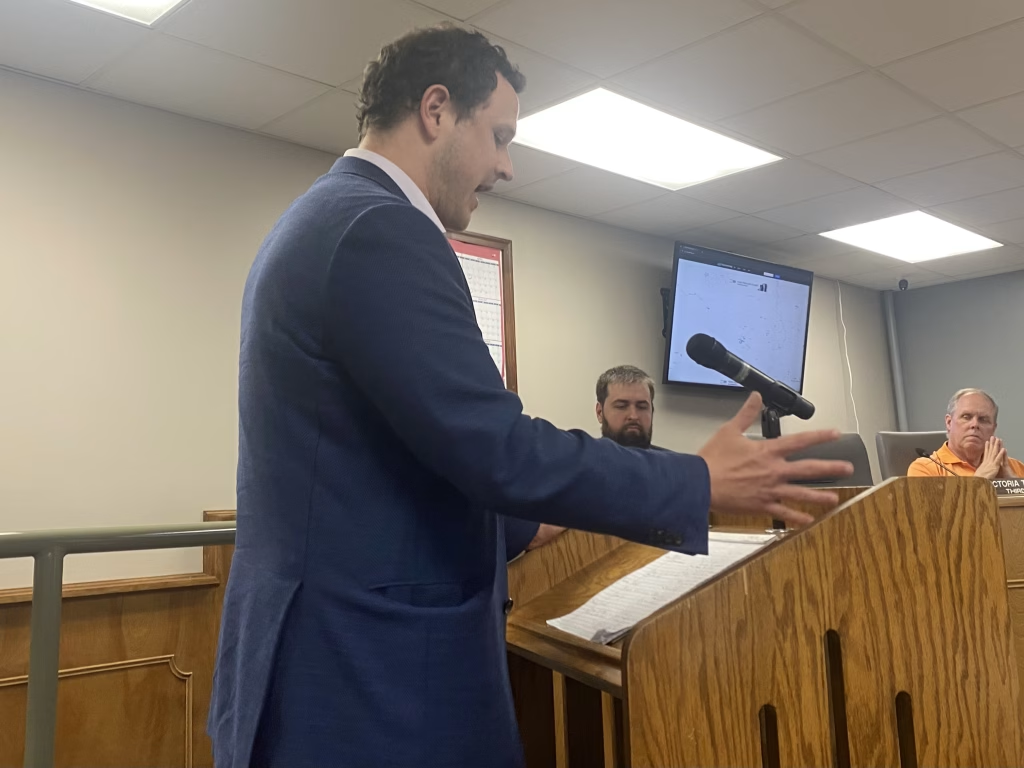
Shipley’s conclusion drew a room of applause. “Arguably, these corporations do not share our best interests. Arguably, these corporations are evil. State and federal authorities have demonstrated incompetence, possibly corrupt. And therefore, the way I see it, it is prudent for local authorities to urgently take every action necessary to protect the public from this industrial onslaught.” He encouraged community members to be vocal with statewide candidates in the upcoming election cycle. “These corporations are very well financed, they are established, and they are going to be very powerful. It will take a necessary counterforce from the public to counteract that and hopefully protect our natural resources.”
Following Shipley’s remarks, Mayor Boyer asked the room if anyone was in favor of a data center in Jefferson County. No one raised a hand.
Supervisors — Additional Remarks
Supervisor Dimmitt confirmed he had independently verified some of Ross’s research and said he supports a master matrix approach — similar to the wind turbine matrix — in which the state sets guidelines that entities must meet and that can be scored at the local level. He said he is particularly interested in using crop suitability ratings to protect productive farmland from being converted to data center use. “We could say, this ground is more suitable for agriculture than it is for development. That’s a tool in our box that we can use,” he said. He was also forceful on eminent domain. “I personally am vehemently opposed to eminent domain. This would never, in my estimation, be considered a public utility. The state needs to take a long, hard look at not allowing these entities to exercise eminent domain in an area where they might want to locate.”
Supervisor Ledger, a farmer of nearly 50 years, echoed the eminent domain concern and said he had spent considerable time at the statehouse in past years working to strengthen protections in that area. He also raised the idea of extending the meeting’s online survey to the public for at least five days so more county residents could weigh in.
On a lighter note, Dimmitt referred to Ross’s research as a “PowerPoint” during the discussion of posting it to the county website. Ross responded with a laugh, saying that was “generous.” She noted that someone had offered to help her improve the presentation’s design and that a better version would be available within the week. Supervisor Ledger added that he had already spent time that morning going through the research materials before the meeting, a sign that the supervisors are engaging with the issue beyond just showing up. “I’ve already been looking at stuff,” Ledger said.
Community Comments
On Electricity Costs
A Jefferson County resident of nearly 30 years addressed rising electricity bills. “When a data center is built nearby, it suddenly creates enormous new demand for electricity — often as much electricity as a small city like ours uses,” she said. “Utilities like Alliant must expand the electric grid by building new power plants, new substations, and new transmission lines, and many of those costs are recovered through higher monthly electric rates for consumers — not for the data centers.” She noted that data centers increase overall demand, which can force utilities to buy more expensive power on the wholesale market, with those added costs passed on to families and businesses. She cited Oregon as recently passing a law requiring large data centers to cover the full costs of grid infrastructure they consume, protecting residential customers from rising energy bills, and encouraged Representative Shipley to be aware of the issue at the state level.
Following her remarks, she noted that Northern Virginia — which has the largest concentration of data centers in the country — has seen residential energy costs rise significantly. She initially cited a figure of 276%, then corrected herself to 76%, though another resident in the room said they had also seen the 276% figure posted online. The room agreed that more precise research on the specific figure is needed, but that the direction of the trend is not in dispute.
Jerry Leonard — Water Well Permits
Jefferson County Environmental Health Specialist Jerry Leonard clarified that he is responsible for issuing water well permits in the county and would be aware if someone applied to draw a significant volume of water. He also confirmed that large-scale water draws require a separate DNR discharge permit. “When you pull a magnitude of a million gallons of water out of the ground, you got to have some ways for that to go,” he said.
Mayor Boyer added that per DNR data, any entity withdrawing more than 25,000 gallons per day must obtain a water use permit; industrial uses including data centers are restricted to a maximum withdrawal of 2,000 gallons per minute from the Jordan Aquifer; and Iowa law prohibits once-through single-pass cooling systems for industrial purposes, requiring cooling water to be used more than once. Leonard noted that even with 80% evaporation, a facility drawing a million gallons per day is still producing 200,000 gallons of discharge daily. Ross added that the evaporation process leaves behind concentrated nitrates and heavy metals that must be flushed, and that the discharge would need a flowing river as its outlet — something Jefferson County largely lacks. Leonard referenced a past experience with Occidental Petroleum that saw a company route discharge effluent down a county road right-of-way to a river several miles away. “That can be something that could happen,” he said. “There are areas in the county where that could happen.”
On Evolving Technology
A Fairfield general contractor raised a point that had not yet been discussed — that the technology powering data centers is rapidly advancing, meaning future facilities may require far less electricity and water than current ones. However, he said this raises a troubling question. “The promoters know this. They know the demand is coming down pretty rapidly, yet they’re still pushing for these massive requirements from local governments,” he said. “There’s something not right about it.”
Additional Community Voices
Another Jefferson County resident spoke to what he called a moral and values dimension of the issue. “The pride that you take in small government is the opportunity that these companies want to exploit,” he said. “The leaders of these companies are not looking at your county with the same values you are. They’re looking at it as an easy opportunity to literally put something into a formula that continues to make them rich. While the tangibles of environmental impact and energy costs are real, there is a values and moral issue here also.”
Supervisor Ledger shared that he had come across a recent approval in Utah for a data center twice the size of Manhattan that will consume more electricity than the entire state. Ross added that the facility is being built in a desert and noted: “It will release the equivalent of 23 atomic bombs in terms of heat, according to a study done by a physicist.” Mayor Boyer used the moment to note individual responsibility as well. “It does bring up the question of your own responsibility — how much you’re leaving on your phones, how much you’re leaving on your cloud,” she said.
A Fairfield resident raised the issue of heat domes — localized areas of elevated temperatures that large-scale data centers can produce — as an underexplored concern. He also pressed officials on urgency. “We’ve talked about taking time to figure some things out,” he said. “I think we’re all feeling a sense of urgency. So the next step is, what’s going to happen next, when, and how soon?”
Survey Results
City Engineer Melanie Carlson set up an online survey in real time during the meeting, distributed via QR code to those in attendance and those watching the live stream at the CoLab. Approximately 40 people responded — including viewers from the overflow location, as total responses exceeded the number of people physically in the room.
The results were striking. When asked about their largest concern related to data centers, 59% of respondents selected water usage and aquifer depletion. When asked whether they would support a moratorium on data centers in Jefferson County, 93% said yes, 7% were unsure, and no one said no. When asked whether they would be in favor of a data center being built in Jefferson County, 90% said no, 10% were unsure, and no one said yes.
Ledger requested the survey be extended to the public for at least five days. Boyer raised the question of whether results would be meaningful without the context of the evening’s presentation, with Carlson suggesting that the meeting recording — to be posted on the Fairfield Media Center YouTube channel — could accompany the survey link. Carlson said a Google survey would be a more practical tool for broader public participation as it has no participant limit and no time restriction.
Council member Gandy also put two questions to the room directly. He first asked how many people felt they had enough information to make a decision about whether they support or oppose data centers — a majority raised their hands. He then asked how many felt they had enough information to make a decision specifically about whether to support a temporary moratorium. Again, most hands went up. Gandy acknowledged that roughly 80 people in a county of 14,000 is a good start but said the conversation needs to reach more people. “You are sort of the leaders of this,” he told the room. “You want to make sure you talk with your friends, your neighbors, and let them know this is a concern. The county supervisors are going to need a lot of force behind them. This is the start of that.”
Closing Remarks
Boyer closed the meeting by urging officials and community members to continue doing their own research and to share any ordinances they find or points they think are important directly with a supervisor, city council member, or state-level representative, as people who should be kept informed of community concerns and what residents believe the state should do.
Boyer acknowledged that while the city of Fairfield does not have enough land within its limits for a large-scale data center, the issue is far from irrelevant to the city. A developer building in the county could come to the city and ask to use Fairfield’s water system. “The city has to think about things that we could or could not do, and would or would not want to do,” she said. “It’s more of an issue for the county because of space and land, but certainly it is a water issue for the city of Fairfield.”
She said the city and county will strive to be as transparent as possible as the process moves forward. Any ordinance developed will be publicly posted on meeting agendas, and residents will have the opportunity to weigh in at each of the three required public readings before any vote is taken. She encouraged anyone with concerns to stay engaged and keep talking to their neighbors and elected officials. “This is a good start,” she said, “but they are going to need some other people to talk to.”
Dimmitt cautioned that any changes made to an ordinance during the three-reading process require starting over, making it important to get the language right before moving forward. “We may have to put something together that isn’t the end-all, end-all, to have some tools in the box to slow the process down,” he said.
The meeting adjourned by motion. The full recording is available on the Fairfield Media Center YouTube channel.