





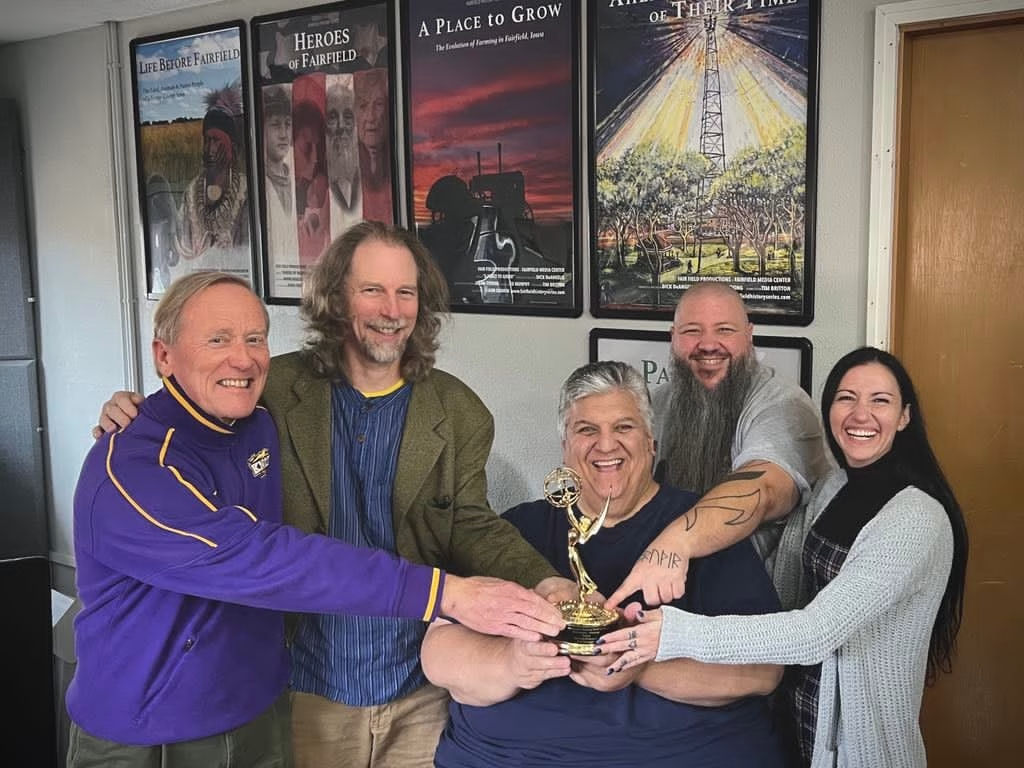
Fairfield Emmy Award-winning filmmaker Dick DeAngelis and his team at Fair Field Productions took home five awards from the Iowa Motion Picture Association’s 35th Anniversary Film Festival for his documentary “When Maharishi Came to Town,” which also screened publicly at Fleur Cinema in Des Moines on Saturday, May 30th.
The film received the following honors from the IMPA:


- Award of Excellence — Direction, Documentary Long Form (Dick DeAngelis)
- Award of Achievement — Documentary Long Form
- Award of Excellence — Director of Photography (Jason Strong)
- Award of Excellence — Soundtrack Audio Mix (Tim Britton)
- Award of Achievement — Voice Over Narration (Dick DeAngelis)

The documentary explores one of the most significant chapters in Fairfield’s history — the arrival of Maharishi International University in the 1970s and the transformation it sparked in the community over the decades that followed. DeAngelis said the film begins with the closing of Parsons College, which had been a centerpiece of Fairfield for 98 years before going out of business in 1972 and 1973, leaving the community with a large campus and an uncertain future.
“We tell what happens right after that — what happens when Parsons is gone,” DeAngelis said. “Fairfield tries to sell to different places, and what the feeling was like in Fairfield, but then how they actually invert from the other side.” The film traces the growth of the Transcendental Meditation movement, Maharishi’s rising popularity in the late 1960s and early 1970s, and how the idea of a university came about before ultimately landing in Fairfield. DeAngelis has a personal connection to that moment in history — he was living in Fairfield in 1975 when MIU arrived, giving him a firsthand perspective that shapes the film’s storytelling.
DeAngelis said the film intentionally focuses on those first few years surrounding the university’s arrival rather than what followed. “It is not about anything to do with the university after that — it’s really focused on those first few years,” he said. He described the range of reactions from Fairfield residents at the time. “Some people were not for it at all. Some people were actually very positively directed towards it. And yet other people — there’s a couple hundred people we found that learned to meditate from Fairfield and were very supportive.” He added that the film also highlights the unsung heroes who made room for something different while preserving the character of Fairfield. “Some of the people who were unsung heroes of allowing enough room for something a little different to come in and still have a place — and not totally lose the character of what Fairfield’s about, the agricultural background.”
The filmmaking process itself was full of surprises. DeAngelis said documentaries reveal themselves through the interview process rather than a predetermined script. “I don’t know what the story is until I interview the people,” he said. He noted that some subjects he expected to feature prominently didn’t make the final cut, while others he didn’t anticipate became central to the film.
When asked about the awards themselves, DeAngelis said what meant most to him was recognizing the team around him. “Personal awards, like my award for excellence as being a director — although it’s greatly appreciated — I’m 70 years old, I’ve really received a lot of accolades in my life,” he said. “My team — Tim Britton and Jason Strong and the whole group of awards — those are the ones that mean the most to me. Because these are people that, although I’m definitely the central figure in doing these films, you couldn’t do them without them.”
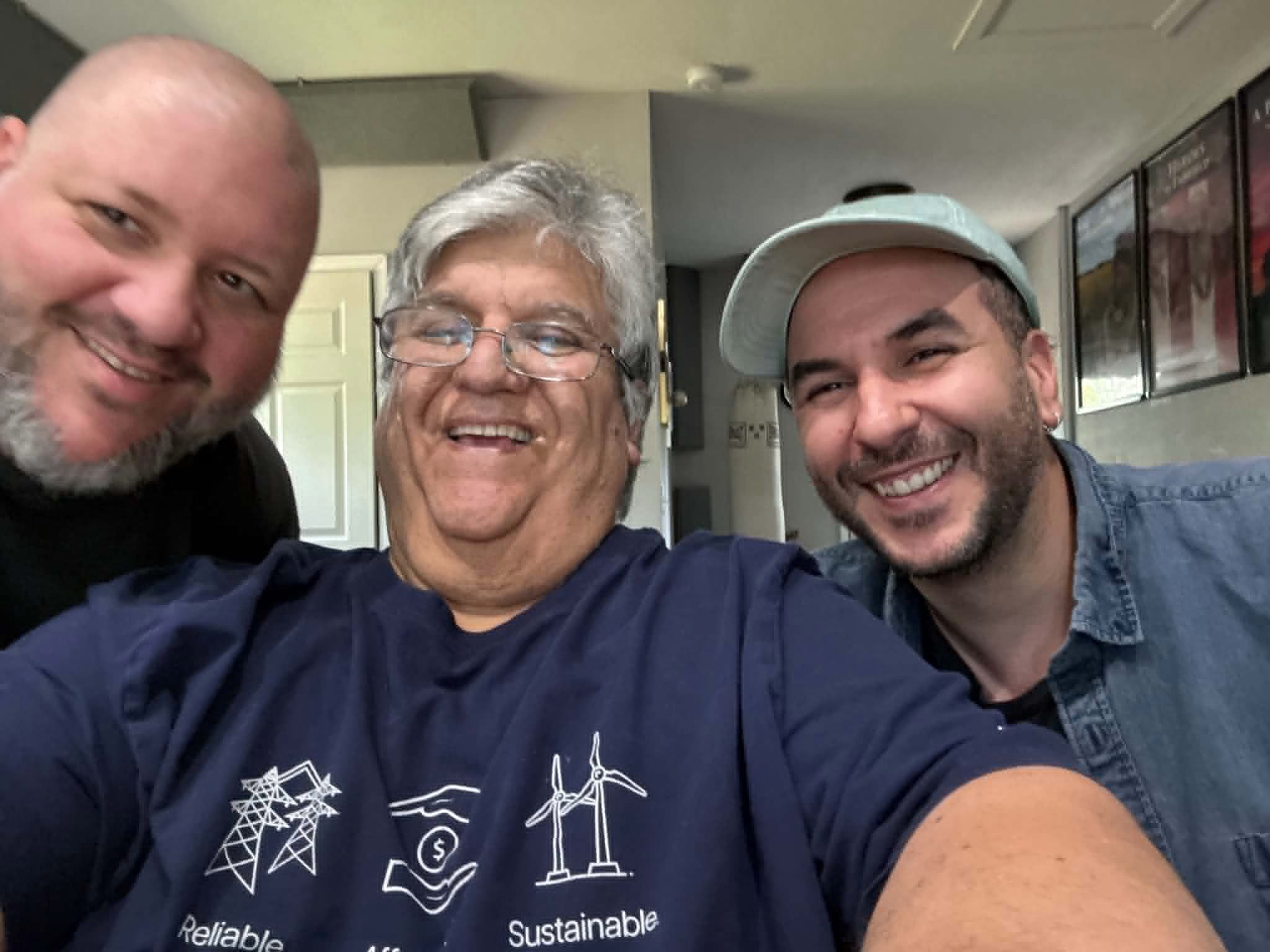
DeAngelis noted the film has resonated even with longtime Fairfield residents. “Even my kids who grew up here in town said this really filled in a lot of gaps for us as to how this all came about,” he said.
For DeAngelis, documentary filmmaking in Fairfield and the surrounding area is not just a creative pursuit — it is a mission. “Every community needs to understand the history of the place in which they work, live, and study,” he said. “Once you understand where you live, you look at the place you live differently. You interact differently.” He said local history is something that even artificial intelligence struggles to capture accurately, making the work of documenting it firsthand all the more important. “I’ve asked AI a whole bunch of questions about history, knowing the answer, and AI did not give me the right answer — especially local history. You really have to do a lot of digging, talk to a lot of people, and learn from the people who’ve lived here before.”
He noted that his films are funded in part through grants from the City of Fairfield and the Greater Jefferson County Foundation, and that the productions are made with intentionally lean budgets. He also described a matching grant arrangement currently in place for his next project — a donor committed $5,000 on the condition that it be matched by other donations. “We spend way less money than most people would to do this movie,” he said. “We do it for the good of our town. That kind of separates us — most of the people that have movies recognized by the IMPA, they’re filmmakers that maybe want to make some money. I’m totally mission-driven.”
Each film involves roughly 100 people as volunteers and donors, DeAngelis said. He also noted that a previous film in the series — his documentary on Parsons College — earned a regional Emmy Award, a handmade one-of-a-kind statuette that he described as “a real Emmy.”
DeAngelis said he has no plans to slow down. His next project will explore the history of art, music, and culture in the region — including a segment on Fairfield’s Chautauqua events of the early 1900s, which drew thousands of people to hear top speakers, musicians, and new ideas at the turn of the century. The film is expected to be released around Thanksgiving. He said Fairfield is a town now known for its art and music, but many people don’t know the stories of those who came before and helped shape that identity. “That’s what I’m going to tell them now,” he said. He will once again use local musicians to compose original soundtracks rather than sourcing generic music online.
The Iowa Motion Picture Association was founded in 1992 and is the longest continuously running showcase and celebration of Iowa filmmakers in the state.