





The Jefferson County Board of Supervisors voted unanimously Monday, April 6th to approve a settlement agreement with former Ambulance Director Brian Thomas, ending a legal dispute that was headed toward trial later this month.
The lawsuit, filed in Jefferson County District Court as Jefferson County, Iowa v. Brian Thomas, centered on claims by the county that Thomas violated the terms of the resignation agreement he signed when he left his position. Thomas later filed counterclaims against the county alleging defamation and breach of contract.


Jefferson County Attorney Chauncey Moulding told supervisors the two sides reached the agreement after a mediation session Friday that lasted between two-and-a-half and three hours.
“Friday, we had about a two and a half, three hour mediation,” Moulding said. “It was a managed mediation with Brian Thomas, former ambulance director, where we mediated a resolution to the pending claims that he had against us and we had against him.”
Moulding said the mediation was overseen by former Chief Judge Brown and included attorney Holly Corkery, counsel for the Iowa Community Assurance Pool, or ICAP.
“Just to remind everybody, the county had sued Mr. Thomas for breach of contract based on the fact that he had instituted a number of claims in agencies and courts against Jefferson County, which were contrary to the resignation agreement that he had made with the county,” Moulding said. “Mr. Thomas turned around and countersued or responded with claims of defamation and breach on the county’s part relating to some actions that the county took.”
Under the settlement, both sides will dismiss all claims against each other with prejudice, meaning the case cannot be refiled.
As part of the agreement, Thomas acknowledged that he “had interactions and/or contact with coworkers that could have been viewed as contrary to the Jefferson County Employee Handbook,” although he denied violating any professional standards. Moulding said Thomas also acknowledged that the county’s actions “were not discriminatory or retaliatory” and that he voluntarily resigned his employment with Jefferson County. In addition, Thomas acknowledged that media statements he made about Jefferson County and county officials “were inaccurate or incomplete,” though he denied any additional liability.
“The relevant part here is that Thomas acknowledges that he did have interactions and contact with co-workers that could have been viewed as contrary to the Jefferson County handbook,” Moulding said. “He would deny that he violated professional standards though. It’s my understanding that Mr. Thomas is trying to maintain his employability in the future.”
Moulding said the agreement essentially allows both parties to move on.
“What this really amounts to is everybody walking away from this with some acknowledgments and statements by Mr. Thomas,” he said. “I think that everybody on the county’s side thinks that this is a good idea for us to resolve in lieu of the trial that was scheduled to commence later this month.”
Under the terms of the settlement, Thomas will pay the county $1. The payment must be made no later than the day after the board approved the agreement. The agreement also bars Thomas from ever seeking employment or appointment with Jefferson County in the future.
“Thomas further acknowledges that he has no reinstatement or re-hire rights with Jefferson County, Iowa, and agrees that he will not apply for employment or appointment with Jefferson County, Iowa at any time in the future,” the agreement states.
The settlement contains a broad mutual release of claims. Thomas agreed to release not only Jefferson County, but also all current and former elected officials, employees, officers and agents of the county, along with the Iowa Community Assurance Pool, Gallagher Bassett Services and related entities, from any liability connected to the lawsuit or his employment.
The release applies to any claims that could have been raised, whether known or unknown, including negligence, employment claims, personal injury claims, attorney fees and other damages.
The county, in turn, agreed to release Thomas from all claims related to the breach-of-contract allegations. The agreement also includes a specific waiver of any age discrimination claims Thomas could have asserted under the Iowa Civil Rights Act or the federal Age Discrimination in Employment Act.
Thomas has seven days after signing the agreement to revoke that portion of the settlement. If he does so, the entire agreement becomes void and the county would be allowed to refile its claims without prejudice.
The agreement further states that neither side is admitting wrongdoing.
“With the exception of Thomas’s statements on page one of this Agreement, the Parties to this Agreement recognize that any payments or agreements made pursuant hereto are not an admission of any liability by either party,” the agreement states. “This settlement is solely made for the purposes of avoiding the costs and risks of litigation.”
The parties also agreed that neither side is considered the prevailing party and that each side will be responsible for its own attorney fees.
Supervisor Lee Dimmitt, who participated in the mediation, said he did not agree with every aspect of the outcome but believed settling the case was in the county’s best interest.
“I think that all things considered, it is in the best interest of the county to move forward and put this behind us,” Dimmitt said. “While I don’t necessarily agree with all of the outcome, that’s the purpose of a negotiation or a mediation.”
At one point during the meeting, Supervisor Joe Ledger passed Moulding a written question asking whether the county had received an apology from Thomas. Moulding referred the question to Dimmitt.
“No, but I didn’t ask for one,” Dimmitt replied.
Dimmitt said Thomas’s acknowledgment that his conduct may have violated the employee handbook, along with his admission that some of his public statements were inaccurate or incomplete, amounted to a type of apology — a mea culpa of sorts, as Dimmitt put it, meaning an acknowledgment of fault or wrongdoing, even if not a direct apology.
“What I will say is that the first thing that Chauncey stated there in terms of the circumstances regarding the relationship and then the subsequent statements about being inaccurate and incomplete constitutes the, I suppose would fall under the definition of the mea culpa of sorts,” Dimmitt said.
Still, Dimmitt emphasized that the county’s priority should be moving forward.
“I think it’s in the best interest of the county to move on,” he said. “And that’s the important thing — what’s in the best interest of the county, not my personal.”
Dimmitt then ended his remarks with a joke.
“I’m just going to take him off my Christmas card list,” he said.
Supervisor Susie Drish largely avoided discussing the specifics of the settlement, but said she hoped the controversy would finally come to an end.
“With all the public scrutiny, it would be nice if this was all over the media,” Drish said.
The motion to approve the settlement passed unanimously.
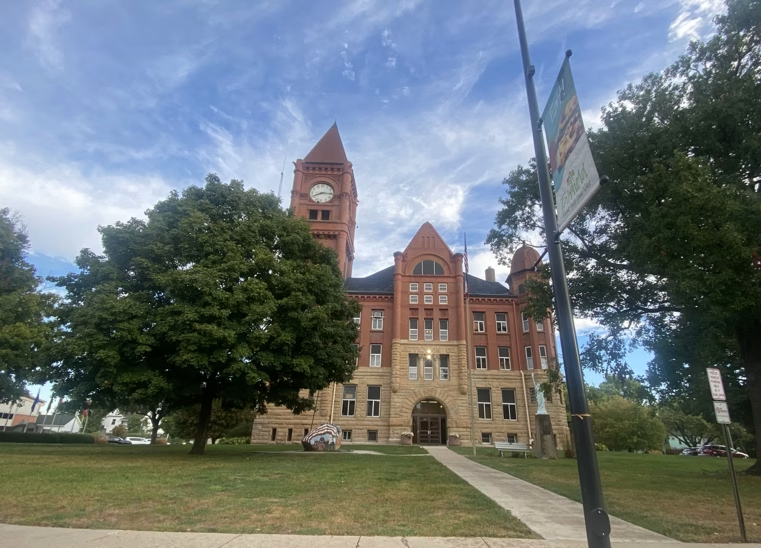
Photo by A.J. Roe.