




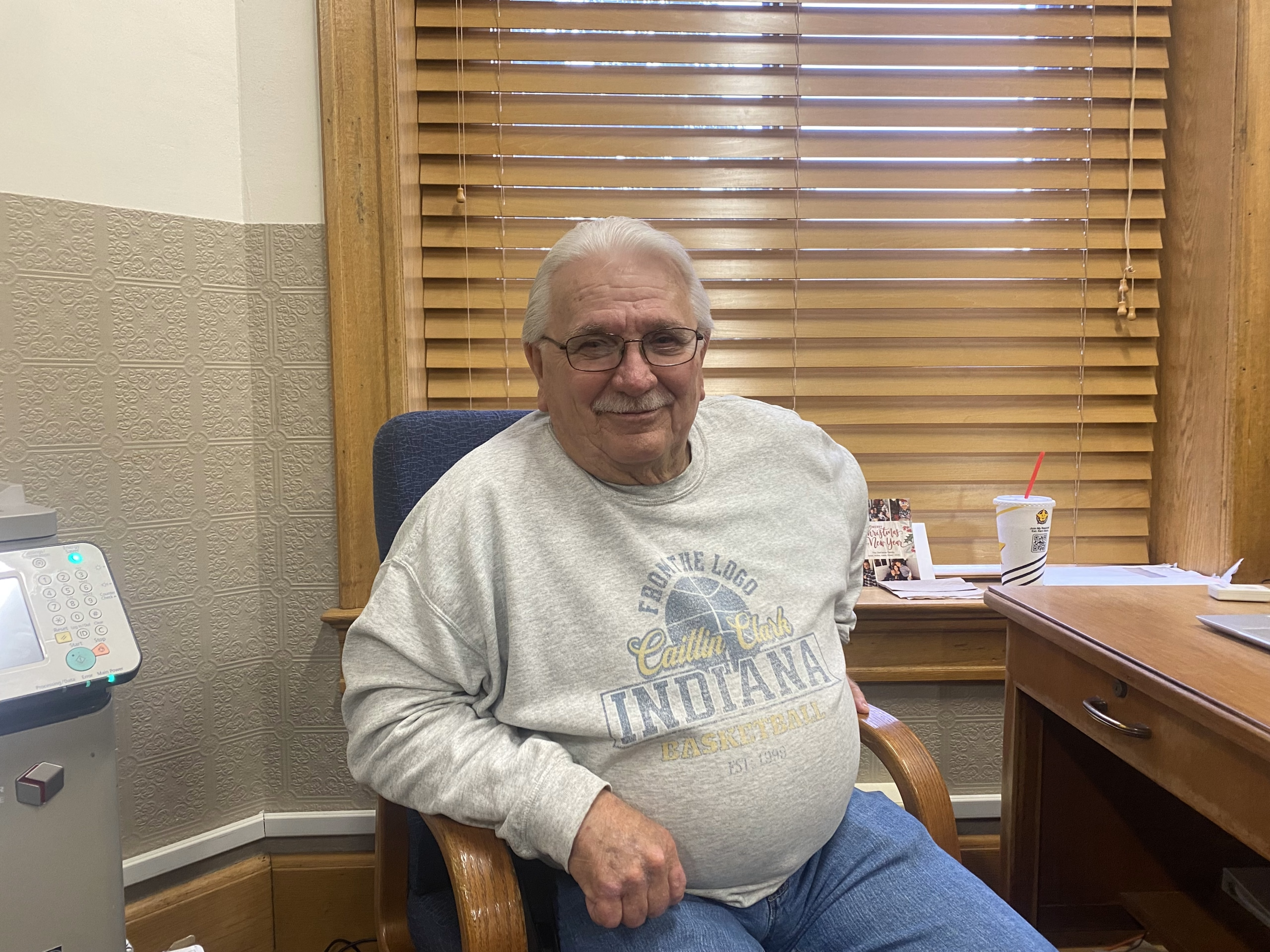
Jefferson County Supervisor Lee Dimmitt won re-election on Tuesday, November 3rd, defeating independent challenger Jerry Leonard 3,560 to 2,858 unofficially — a 702-vote margin that made him the only Republican elected countywide in Jefferson County this cycle.
In an interview with Ottumwa Radio’s A.J. Roe on Wednesday, Dimmitt said he was relieved the race was over but called it the toughest campaign of his career.


“I’m glad it’s over,” Dimmitt said. “Of all of the opportunities that I’ve had to run for this office, this was probably the most difficult in terms of the mental taxation, if you will.”
Dimmitt said national and state political dynamics made their way into the local race in a way he found unnecessary.
“I guess how I would see the national politics and the state politics, it finally trickled down to Jefferson County, which I absolutely don’t think that that was necessary,” he said. “I think that having policy differences or wanting to see the county go in a different direction or doing something different, I think those are all laudable efforts that each candidate can bring to the table. But I think when you take things out of context or make statements that are — and use the things that you take out of context to make statements that are maybe not factually inaccurate in terms of the number, but factually inaccurate when placed in the context that they were used.”
Dimmitt said he believes policy debate is healthy but drew a distinction between that and personal attacks.
“This election cycle, both at the national and state level and unfortunately at this local level, was not about policy,” he said. “I’m sure you’ve heard the term before, the politics of personal destruction. I think that that unfortunately occurred at the local level this year on one side of the equation and it was a little hard to, you know, to deal with.”
He added that the reason county boards have multiple members is precisely to allow for different perspectives.
“That’s why you have three people on the board and in some counties you have five, is because different people have a different view of things and they bring that idea to the table and then everybody has an opportunity to have those discussions,” Dimmitt said.
Dimmitt, who has served 16 years on the board, said he has never claimed to be perfect.
“I would never sit here and tell you that I haven’t made mistakes or that I haven’t had to revisit an issue because it didn’t work out like I thought that it would work out. That unquestionably has happened and over the 16 years I’ve been doing this,” he said. “But never once was there any reason behind any of it other than wanting to do what I thought was best for Jefferson County. Doesn’t mean that everybody agreed with that decision nor should they have to. That’s not the point.”
He said elected officials must be able to defend their decisions but acknowledged not everyone will agree.
“Should you have to explain your decision if the question is asked? Yes, you should and you should be able to defend it. But if I can give a coherent argument as to why I did what I did and I’m comfortable in that skin — I think the two hardest things about this job is putting my own personal biases aside, which is a difficult thing to do in and of itself, is to also make decisions that one side of the equation is going to go away unhappy. The other side is going to go away happy. There’s no way around that. You sign up to make decisions.”
He said he hopes his research leads him to the right conclusions, even when the outcome is uncertain.
“You hope that you did your research and that the conclusions that you arrived at based on your research are the right conclusions,” he said. “I go back to what I said a little bit ago. I think that having discussions about policy or the direction that we went or didn’t go, that’s fair game. Those are conversations that should be had. But taking things out of context to destroy an individual, figuratively speaking, is unacceptable in my book.”
Dimmitt said he used former state Rep. Curt Hanson as an example of how policy disagreement differs from personal attacks.
“When Representative Curt Hanson was a state rep, there was policy issues — bigger than local politics, but policy issues — that we didn’t agree on. But I never doubted his desire to do what was best for the residents of Jefferson County. Never did,” Dimmitt said. “That’s my whole point. It’s not that a person that disagrees with your policy or decisions that you’ve made, there’s nothing wrong with that. Absolutely nothing wrong with that. And having a conversation about that and having an election about that. But you’re running because you think you have better ideas. And give the public the chance to hear what your ideas are, and then let them take the ball and run with it. That’s how it should be done.”
Dimmitt was candid about the role ego plays in running for elected office.
“You can’t be running for an elected office and not have some ego involved in it and I think it’s true for most people that their name is important to them,” he said. “Anybody that tells you that your ego is not bruised when you lose, is not being honest and upfront with you. Because it is. So, it’s just like your biases. You’ve got them. Whether you want them or not, you’ve got them. So, if you’re really truly interested in doing what’s best, in this case, for Jefferson County, you’ve got to recognize what your biases are and how much of a role is that playing in the decision that you make? And is that role that is playing allowing you to make the best decision for the residents of Jefferson County?”
Dimmitt said he went into election night uncertain about the outcome, and admitted he was not fully confident heading in.
“In the interest of full disclosure, I wasn’t real confident about this election,” he said. “You could — wasn’t sure whether it was the same person writing the same thing on all the walls, you know, the handwriting’s on the walls, or if it was different people. You just, you know, you just really don’t know.”
The absentee ballot count also gave him pause. He said he has never not been behind after absentee ballots, but this time the gap was tighter than ever.
“I’ve never not been down after absentee, but this time was so much closer than any time before,” he said. “Initially you might go, whoo-hoo, but then you get to thinking about it. Well, if that many people voted early, how many votes does that leave on election night where you always overcame the deficit before?”
Dimmitt reflected on his history in previous elections, noting that his first race — when early voting wasn’t as prevalent — resulted in his largest margin ever, about 1,600 votes. In every race since, he said, he was always 1,100 to 1,200 votes behind after absentee ballots and would win on election night by 250 to 350 votes.
“Won that election by about 1,600 votes, largest margin I’ve ever had. So, every election after that, I was always 1,100, 1,200 votes at least behind when the absentee ballots come out, and I would always win on election night, and would overcome that deficit and win by 250, 300, 350 votes, usually somewhere in that ballpark,” he said.
He said he was only 386 votes behind after absentee ballots came in — closer than in any previous race — and that his mind immediately started running through scenarios.
“So last night, I’m only 386 votes behind. So, you know, initially you might go, whoo-hoo, but then you get to thinking about it,” he said. “And the human mind, I don’t know if I want to say plays tricks, but you just conjure up all kinds of things, scenarios.”
He said even campaign signs offered no clear read on the outcome.
“When you see signs, you know, campaign signs, that doesn’t necessarily translate to votes, but it doesn’t necessarily not translate to votes. So you just, I mean, there’s just all kinds of things that are out there. So when that first came in, yeah, I thought, hey, that’s a positive, and then almost immediately, the snap of the fingers, I thought, maybe that’s not so much of a positive,” he said.
He said he watched the numbers gradually shift in his favor throughout the night.
“Every time a vote total would come in, we were gaining. Every time we gained. Sometimes we didn’t gain much, just a wee bit, but we gained. We didn’t lose any ground at all,” Dimmitt said. “And then we got the big push that put us over about 172. Never looked back after that. Then the next push that came through, we were over 517, and the last push was 702 or 703.”
He said he felt confident the race was won once the lead hit 172, noting there weren’t enough votes left in the remaining township to overcome the deficit.
“I felt pretty confident when we hit the 172 mark that it was going to be — even if we just matched wits, so to speak, for everything else that was out there, it was going to be very difficult at that point. That late in the vote count for the other candidate to catch up. It just, it wasn’t going to happen,” he said.
He said winning 55% of the vote — an 11-point margin — given the broader political environment in Jefferson County, was meaningful.
“I got 55% of the vote. Okay, to me, that’s a big deal,” he said. “700 votes spread, especially considering what else happened in this county. That’s a pretty decent margin of victory, 11 points. So I’ll take it and move forward and changes are coming.”
Asked what those changes would be, Dimmitt declined to elaborate.
“You just have to wait around and find out,” he said.
Dimmitt said he was prepared for either outcome going into election night, and acknowledged that given the broader results across Jefferson County, there would be many people reflecting on what happened.
“I was prepared for either outcome in terms of winning or losing. I’ve done this for a long time,” he said. “Given the results of last night’s election, there’s a lot of people that are wondering why? What could I have done differently? What was the driving force? So on one level, I’m very, very grateful and appreciative not only for the support but for the opportunity. And look forward to the next four years.”
Dimmitt also reflected on being the only Republican elected countywide Tuesday, and said the experience reinforced a long-held belief that the position shouldn’t be partisan.
“I also think that it goes back to a thought process that I’ve had about this position for years, that it shouldn’t be a partisan position,” he said. “I know why it’s the way that it is, and I don’t think that you can change it, but I’ve often thought that it should be a lot like the City Council.”
He said he has never liked the partisan nature of county supervisor races.
“I never have liked being in elections,” Dimmitt said. “I don’t like the partisan nature of it. I get it at the state level, the national level, but that’s the hand you’re dealt, so that’s the hand you have to play.”
He added that he has always believed somebody once told him that having a job where there’s a referendum every two or four years would be difficult — and he understands exactly what that means.
“Somebody said last night, I would hate to have a job where there’s a referendum every two years or four years, and it is. Believe me, I understand exactly what the person is saying,” he said. “I think about our state representatives when they’re every two years. It is — well, even our House of Representatives are every two years, and so it is a — it’s really got to be hard, you know, on them.”
Dimmitt also commented on what he sees as a broader problem in politics today.
“I think unfortunately, to a certain extent, our whole political arena has become two-minute soundbites. And I don’t think that the American public gets an honest view of what’s really happening,” he said. “I told you during the Candidates Forum that I don’t do two-minute soundbites. You’ve known me long enough to know that I can talk your leg off, but I can’t get it in a two-minute soundbite. It’s just not in the nature of this beast. Other people are very good at that.”
Dimmitt mentioned the Jefferson County data center ordinance as an example of an issue that helped bring a divided community together.
“I believe in Jefferson County. I believe we can do great things. But I also am not naive, and I know that we have a very broad constituency, that sometimes one side of the equation is so far away from the other side of the equation, we can’t see each other,” he said. “There are some questions, something that kind of brings them closer together, like the data center thing, right? I think I kind of brought that up, which is a good thing. But we just have a very broad-based constituency that has divergent views of things, and sometimes the twain just doesn’t meet.”
He also touched on the learning curve that comes with the job, referencing fellow Supervisor Joe Ledger.
“I think you’ve heard Joe Ledger say that more times than once. He sat over there in that church pew over there for two years. The whole time that he was sitting there, he viewed it entirely different than the first time he had to sit in that chair and make a decision,” Dimmitt said. “And so I think all the years that I’ve been doing this puts more weight on my shoulders. I think I’m expected to, in some context, guide the other two. I would like to think that I have a better handle on the budget process because I’ve been doing it longer. When I first came in, it was Steve Burgmeier that we leaned on. And he knew the budgets and everything. And then when Steve moved on, it was Dick Reed. And Dick knew — but again, I’m not suggesting to anybody out there that I’m the end-all. That’s just absolutely not the case.”
Dimmitt said he applauds anyone who wants to run for office but cautioned that the reality of the job is different than it appears from the outside.
“I applaud anybody that wants to run, but I’ll say it one more time. It’s a lot different on the outside looking in than it is on the inside looking out. And that’s true for — it was true for me. I had this notion about, you know, when I get in there, I’m gonna paint all new walls. And then you find out that it’s just not that simple. It doesn’t work that way. And so it is a huge, huge learning curve,” he said.
Dimmitt, who said he has thought seriously about running for state legislature over the years but never followed through, said he believes local government experience should be a prerequisite for state office.
“I do think that people who run for state senators, state representative, should be in a local government role before they do,” he said. “Because I don’t think unless you sit there in that chair, and you do these budgets, that you really understand what impact the legislation has that you pass out of those chambers down here. I think you need to understand that and to know that, whether it’s a city level or the county level, either one. You need to understand that. And most of them don’t because they’ve never been here. It’s not that they’re not smart people or nice people or any of the rest of it, but if you don’t have experience at this level, how can you legislate at that level for something at this level?”
He said he has also always been drawn to the idea of serving in the state legislature, even if he knew it wasn’t right for him personally.
“I’ve always wanted to run for a state office, representative or state senator, because I think it would be an absolutely unbelievable honor to sit in that chamber. I mean, I just — I would be in awe of it,” he said. “But five minutes after I got to Des Moines, I’d be ready to go home, because I just despise Des Moines. Not the people, just — somebody had to lie awake nights designing the damn streets in that town and trying to get around. I don’t know what the hell they were thinking.”
Dimmitt said he intends for this to be his final term, putting him at 20 years of service when it ends.
“I always wanted to do 20 years,” he said. “And like I said last night, God willing, I don’t kick the bucket. The voters gave me four more years, which would make 20. I think at the end of that, at 78 it probably is time to pass the torch.”
He also noted that it is his intent for this to be his last run, though he stopped short of making an absolute promise.
“I learned a long time ago to never say never, but as somebody once told me here a couple, three weeks ago, if I was to get reelected at the end of that term, I’d be knocking on the door of 80. And that sounds in and of itself pretty scary when you get right down to it,” he said.
He closed with a message for anyone considering running for the board in the future, noting two seats will be up in two years.
“All I would ever ask is that whoever decides to run for this position — there’s gonna be two seats available in two years — is that you have the best interests of Jefferson County at heart. And that’s what you’re running for and that you have ideas that you want to put in place. Not to run against somebody, but to run for the county,” Dimmitt said. “And I think we’re better than the state and national level. I don’t think we were this time.”