



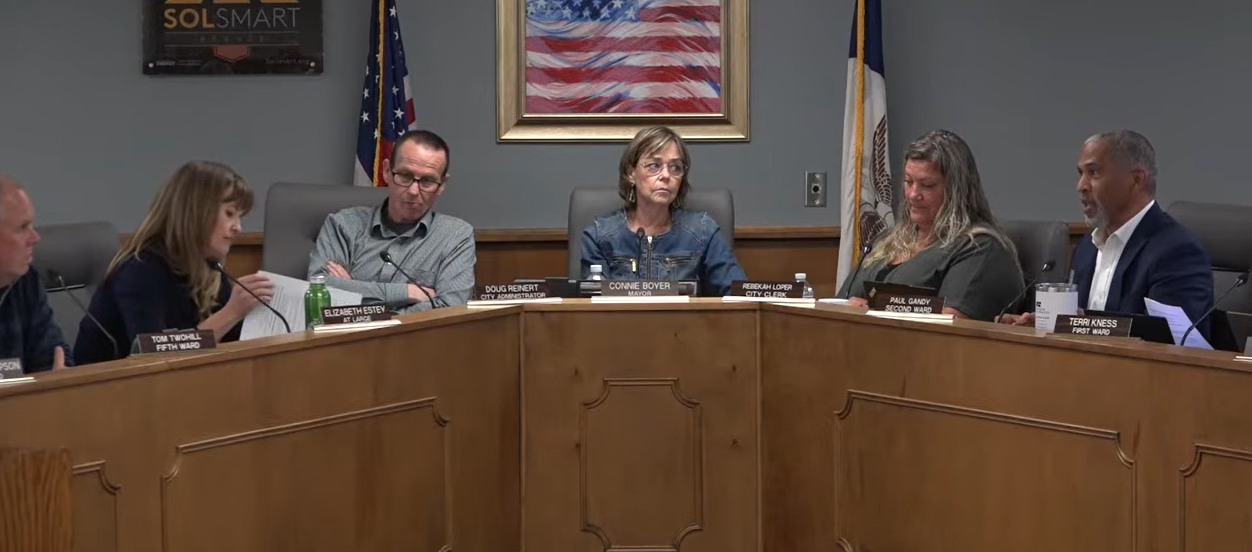
A proposal to raise compensation for Fairfield city council members and the mayor failed to advance Monday, October 26 after deadlocking 3-3, ending the first reading of an ordinance that council member Paul Gandy had introduced to modernize pay that has not seen a significant adjustment in more than two decades.
Under the proposal, council members would receive $700 per month, up from the current $232.75. The mayor’s pay would rise to $1,400 per month from $521.92. Gandy said the increases are needed because cumulative inflation since 2001 — when the current pay structure was established — has exceeded 86 percent, meaning today’s council stipend carries less purchasing power than the $150 per month set at that time.


“In real terms, today’s council stipend of $53 a week buys less than the 2001 baseline,” Gandy told the council. “In 2002 dollars, that $53 a week is worth only about $28.”
25 Years Without a ‘Meaningful’ Adjustment
The history of Fairfield’s elected pay goes back to October 2001, when the council passed Ordinance 961 setting council compensation at $150 per month and the mayor’s annual salary at $5,100. In March 2021, Ordinance 1198 made a modest adjustment — adding $50 per month for council members and $25 for the mayor — and introduced an annual cost-of-living adjustment tied to staff increases. With that COLA applied through the current fiscal year, council members now receive $232.75 per month and the mayor receives $521.92 per month. Gandy argued that even with the COLA factored in, the 2021 adjustment was not enough to keep pace with actual inflation, leaving elected officials earning less in real dollars than they were in 2001.
“We voted in 2001. This council did. Twenty years later, we voted for something which is still less than what it was in 2001,” Gandy said. “And I’m suggesting that in order for council to be compensated fairly, we should adjust the compensation in line with our peer cities. It’s as simple as that. It’s not complicated, the numbers are right there for anyone to see.”
Gandy framed the proposal in the context of the city’s overall growth. When Ordinance 961 was passed, Fairfield’s operating and capital budget stood at roughly $12.85 million. It now exceeds $38 million — an increase of nearly 300 percent. Over that same period, he said, elected governance expenditures fell from about 0.138 percent of city spending to just 0.067 percent. Under the proposed $700 per month structure, that share would rise to roughly 0.197 percent — restoring, he said, something closer to the historical proportion.
“At the same time, Fairfield has grown into a complex municipal enterprise with a certified budget exceeding $38 million,” Gandy said. “And as our enterprise and regulatory responsibilities have expanded, elected governance expenditures have fallen from about one-seventh of 1 percent of city spending to less than one-tenth of 1 percent today.”
How Fairfield Compares to Peer Cities
To support his case, Gandy distributed a spreadsheet comparing Fairfield’s compensation to similarly sized cities in southeast Iowa. The comparison, compiled by city administration, showed Fairfield currently ranking sixth out of 10 cities for council pay and seventh for mayor pay. Annual figures from the spreadsheet:
Pella: $9,972 for council, $19,954 for mayor
Fairfield (proposed): $8,400 for council, $16,800 for mayor
Ottumwa: $6,000 for council, $10,200 for mayor
Indianola: $5,900 for council, $10,250 for mayor
Grinnell: $4,000 for council, $10,000 for mayor
Fort Madison: $3,000 for council, $5,500 for mayor
Fairfield (current): $2,793 for council, $6,263 for mayor
Keokuk: $2,400 for council, $16,212 for mayor
Oskaloosa: $2,400 for council, $6,000 for mayor
Mount Pleasant: $2,400 for council, $5,400 for mayor
Washington: $1,800 for council, $18,000 for mayor
Gandy cited a legal safeguard built into the ordinance. Under Iowa Code Section 372.13(8), compensation changes for elected officials cannot take effect during the term in which they are enacted. The ordinance, if passed, would not take effect until Jan. 1, 2028 — following the November 2027 municipal election. No current council member would receive any increase during the existing term.
“This is not about who sits at the table tonight,” Gandy said. “It’s about ensuring that after 2027, working parents, hourly wage earners, and young professionals can afford to serve our community without having to subsidize municipal services from their own pockets.”
The fiscal cost to the city in the current year would be zero. The mid-year phase-in in fiscal year 2028 would total under $25,000. Over a full fiscal year, the net adjustment would amount to roughly 13 cents for every $100 the city spends.
Gandy said he had the draft reviewed by retired district judge Myron Gan, who served on the Fairfield city council for 14 years before his career on the bench. Gan, noting his law license is inactive and that city attorney John Morrissey’s opinion governs any final draft, told Gandy he found the ordinance “very well drafted” and that it “transparently informs the public of the need for a compensation change.”
Former Mayor Weighs In
Before opening the floor to council discussion, Gandy invited former Mayor Ed Malloy to address the council. Malloy, who took office in January 2002 — shortly after the current pay structure was first adopted — said the honor of service had guided his years in office but that his thinking has evolved.
“I’m going to say this is the first time I’ve given this thought in 25 years,” Malloy told the council. “During my period of time as mayor, the feeling was more about the honor of service, and that is essentially what guided my time and attention to the city.”
He said the demands on elected officials have grown in ways that are difficult to ignore.
“I think that the council and city government have changed to a degree where there is more of a demand on time from all of you,” Malloy said. “I don’t really mean the word sacrifice, but I’m not sure I’ve got a synonym — but there is a sacrifice. You do sacrifice to your family, to your other business and personal interests to serve in this way.”
Malloy said he believed the council should consider what the pay structure signals about the value of public service, both for current members and those who might serve in the future.
“I think that it is appropriate for the council to consider this and to consider for future councils the kind of people that you will attract if there is a little bit more to it,” he said. “I think the spirit of the council, in reflecting on the entire community, is one that — it is the body of government, but it’s another good group of souls who are willing to volunteer their time. Well, it’s not — it’s more than that.”
Malloy drew a distinction between the council and other civic boards or volunteer organizations in the community.
“To separate yourselves in that way from a board position at some other place within the community — that is important and is part of the overall partnership — but the responsibility and the authority that you take in the area of governing is what separates you from those other areas of the community,” he said.
A Contentious Debate
The council discussion that followed was contentious. Council member Elizabeth Estey questioned both the substance of the proposal and the manner in which it was brought forward, saying she felt colleagues had not been given a meaningful opportunity to weigh in before the item was placed on the agenda for a vote.
“Who told you to draft this ordinance?” Estey asked Gandy. “Nobody told you to draft this.”
Gandy replied that no one needed to — drafting ordinances is part of a council member’s role.
“No one has to tell me to draft an ordinance,” he said. “I’m a member of the council. As a member of the council, I have the right to draft an ordinance and prepare it for the council. That’s part of our job.”
Estey said the issue was not whether Gandy had the authority to draft the ordinance but whether the process allowed for genuine council input.
“Wouldn’t you rather get everybody on board with this before just lacing us with this ordinance?” she said. “You’ve set up this dynamic where people are opposing you. I prefer that we would have a longer discussion and you not just plop it on us and have this orchestrated event where you have different people speak.”
Gandy pushed back on the framing.
“On one hand, you say you want me to talk to people on the council,” he said. “On the other hand, you’re saying I’m orchestrating by talking to them. Which one is it?”
Estey pointed to what she described as a pattern at the study session two weeks earlier — that certain council members had been given the floor before others.
“The last time we spoke about this, you had designated council members who were able to speak before anybody else was,” she said. “And tonight too, you have specific people who you’ve allowed to speak before council can even talk about it.”
Gandy responded that when you support something, presenting your case is what you do.
“If you have something that you support and you advocate for, that’s what you do. You present your case,” he said.
Estey said she found the approach frustrating and pushed back on Gandy’s suggestion that the study session served as adequate prior discussion.
“That study session was ridiculous,” she said. “It wasn’t like you were actually trying to get us to discuss it.”
“I asked you to discuss it. We don’t have to agree,” Gandy replied.
After Gandy accused Estey of making personal accusations, she denied it.
“I’m not making personal accusations,” she said. “I’m saying that this just feels wrong the way that it is happening, and I feel like we aren’t really getting a full ability to talk about this as a council.”
Estey then challenged the scope of the increase, noting that the proposal would roughly quadruple the total annual council allocation from approximately $12,600 to $58,800. Gandy pushed back on how the figure was being characterized.
“That’s not accurate,” he said, clarifying that the $58,800 figure represents the annual total for all council members combined, not per person, and that in context it represents 13 cents per $100 of city budget.
“We haven’t done anything meaningful in 25 years,” Gandy said. “Our real dollar compensation is less than it was in 2001. I’m not sure how much more conversation we need to have about it, but we can certainly have it.”
Council member Tom Twohill said he was not opposed to revisiting compensation but raised concerns about the benchmark cities Gandy had chosen. He noted that city government differs from a corporate board in that the city operates without profits.
“I think we all took this job knowing we weren’t doing it for the money,” Twohill said. “I’m not opposed to looking at this and discussing it, but Pella is an anomaly on this list. They’re well above anybody else. If we throw out the top two and the bottom two and address other cities of our size in the area, we can readdress the numbers. I don’t feel comfortable at all choosing Pella as the one.”
Gandy noted that Pella was just one of 10 cities on the list.
“You can choose Washington. You can choose any of them,” he said. “There are 10 cities on that list. That just happened to be one.”
The Vote
Mayor Connie Boyer asked whether Gandy and Bob Ferguson would consider withdrawing the motion to revise the figures before bringing it back. Ferguson, who had seconded the motion, indicated he was open to that approach. City Attorney John Morrissey clarified that the three-reading process already provides roughly two months for the council to discuss and amend the ordinance before a final vote, making an immediate withdrawal unnecessary.
“You have the opportunity over the next two readings — that’s eight weeks, two months — to discuss it in whatever depth you choose,” Morrissey said.
Gandy said he wanted the ordinance to advance.
“If you’re going to kill it tonight, that’s not a good idea. I don’t want that,” he said.
The council moved to a vote without changes. Gandy, Ferguson and Victoria Thompson voted in favor. Estey, Twohill and Terri Kness voted against. Council member Matthew Rowe was absent. With no majority, the motion failed.
Boyer noted after the vote that Gandy could return with a revised proposal at a future meeting.