




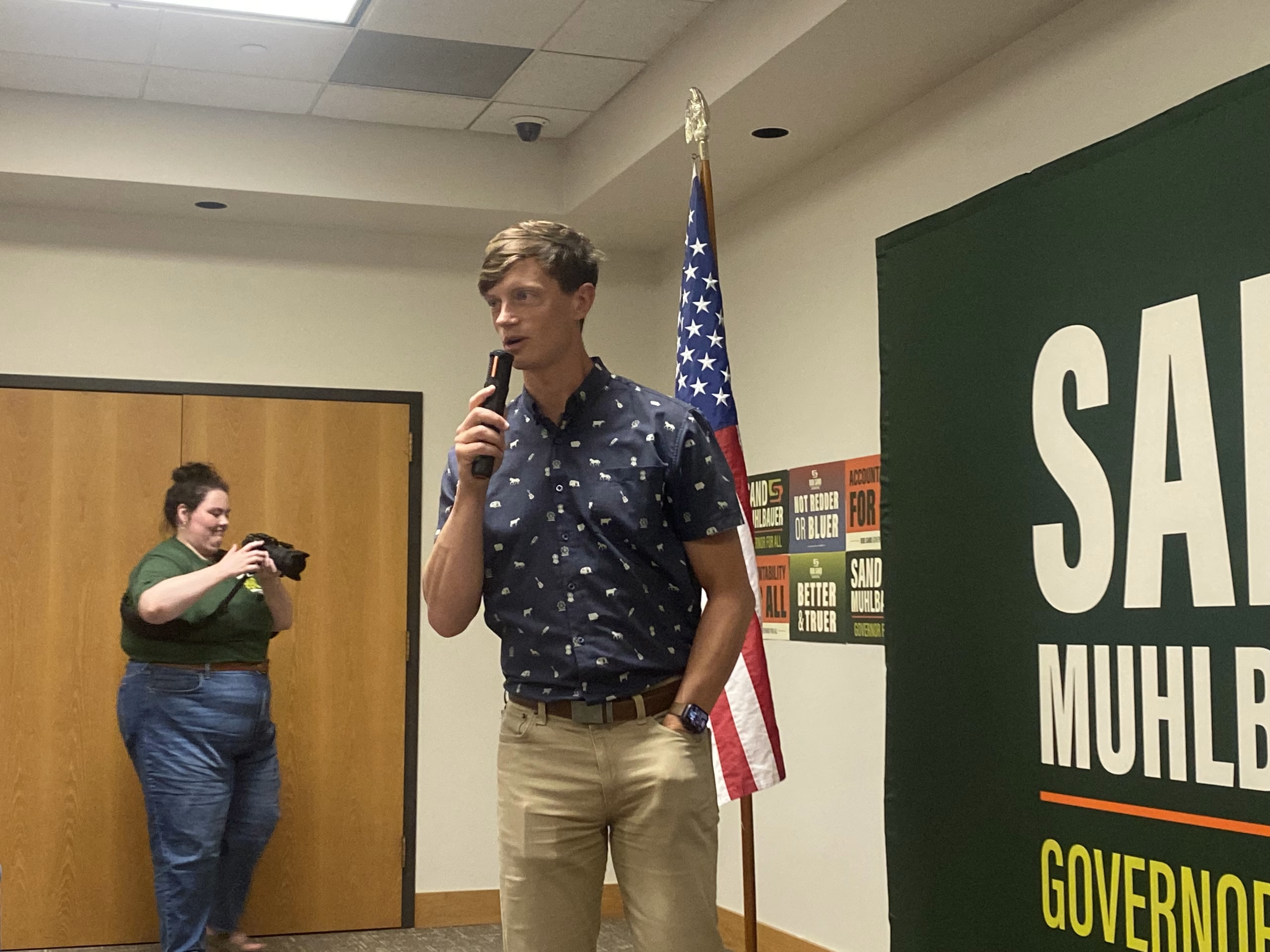
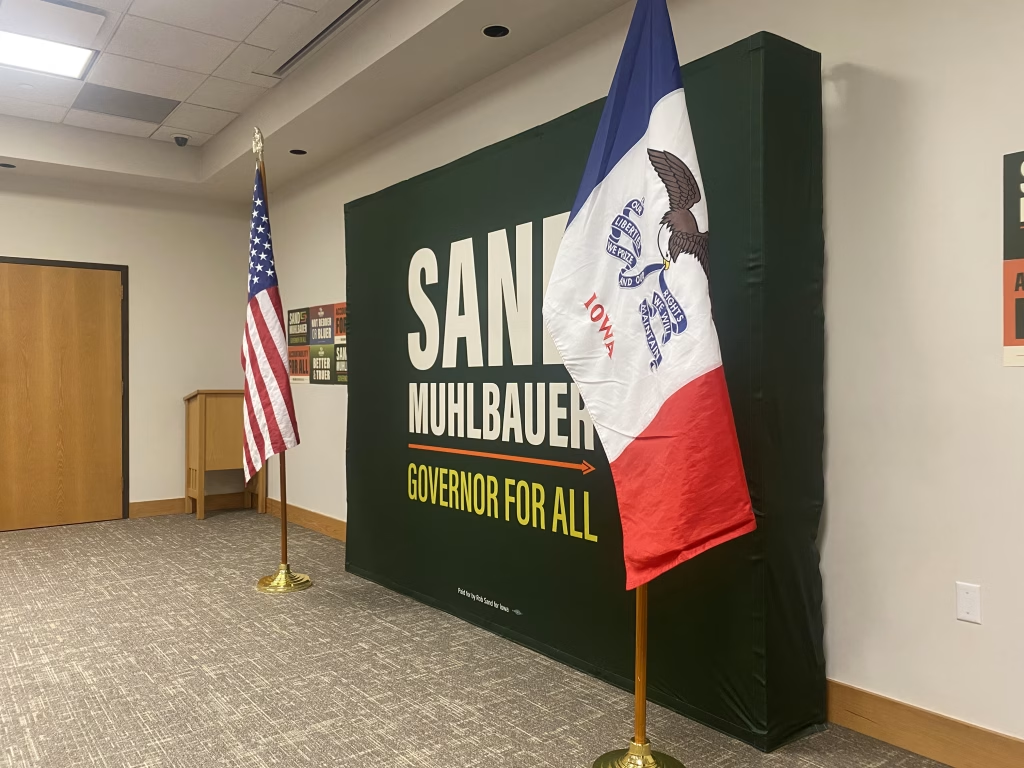
Iowa gubernatorial nominee Rob Sand made a stop in Fairfield at the Fairfield Public Library to a packed room on Monday, August 10th as part of his annual 100 Town Hall Tour through southern Iowa, spending time with Fairfield-area residents and taking questions on issues ranging from rural public safety and hospital closures to roads and bridges, agriculture, and the state of Iowa’s political system. Sand’s Fairfield stop was his second of the day, coming after a morning town hall in Bloomfield in Davis County, with plans to continue to Keosauqua in Van Buren County and Keokuk in Lee County afterward.
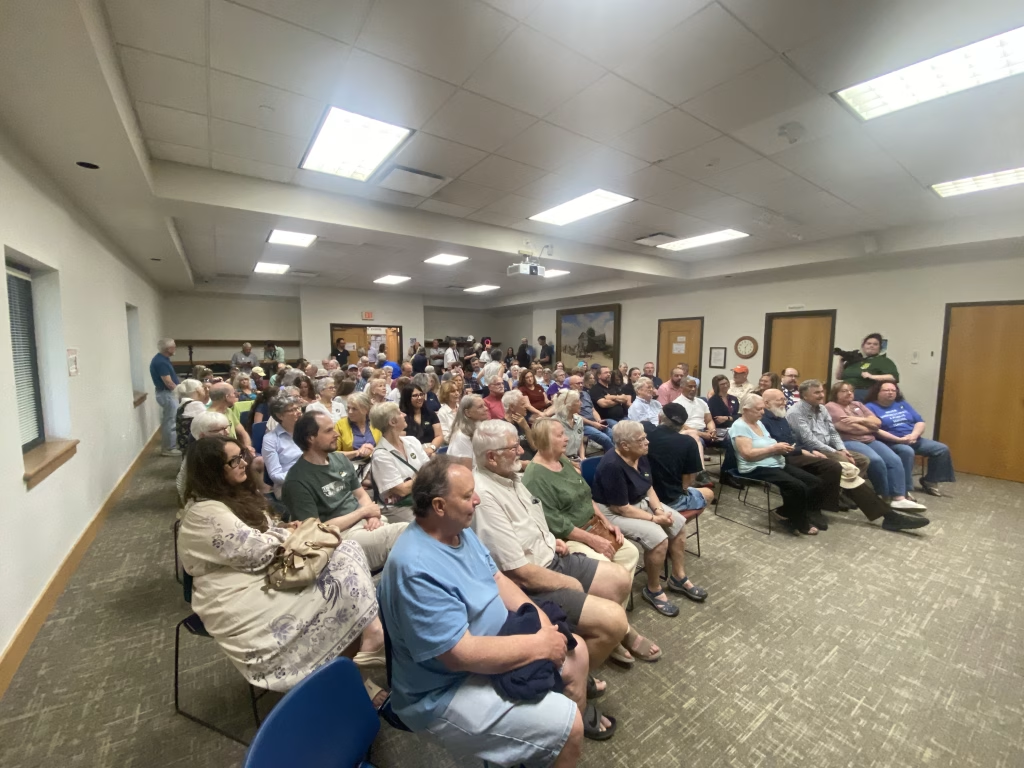
Before the town hall meeting began, Sand sat down with media — including Ottumwa Radio — for a brief question and answer session, taking questions on several issues important to rural Iowa.


Media Q&A
On the topic of rural public safety — specifically the staffing crisis facing the Keokuk County Sheriff’s Office — Sand drew on his background as a prosecutor. “I think this is a really incredibly important issue,” he said. “I worked as a prosecutor for seven years in the Attorney General’s office, oftentimes working with the state police, but also sheriff’s departments and police departments across the state. We need to prioritize public safety.” He said the new property tax reforms need to be watched carefully to ensure counties still have the resources needed to hire public safety workers. “I think we also need to talk about respecting law enforcement and the work that they do,” Sand said. “It’s a difficult job. And if you want people to be willing to do it, it’s important that they’re not being unfairly denigrated for the work.”
When asked about accountability and what promises he could be held to in his first 100 days, Sand was candid about the reality of working with a Republican-controlled legislature. “We’re going to be working with the Republican legislature if I win this race,” he said. “And so making sure that we actually are talking about things that we can accomplish and distinguishing those from things that I can do myself.” Among the things he said he could act on through executive order was allowing state employees whose jobs can be done remotely to work outside of Des Moines. On Medicaid, Sand said he wants to begin reversing privatization. “Most Iowans saw their taxes go up on their health care plan this year just to pay for the private companies’ profits in Medicaid,” he said.
When asked why he decided to run for governor rather than seek re-election as state auditor, Sand pointed directly to legislation he said undermined his office’s ability to hold government accountable. “When they pass the law to allow themselves to block us from finding misspent tax dollars, they did two things,” Sand said. “They made it very clear that continuing to be state auditor would not be a meaningful way to improve people’s lives because they can tell us no whenever they want to. And in addition to that, they really clarified the degree to which we need new direction in Des Moines. If these folks are willing to pass a law that every government watchdog in America who weighs in on the law says that it’s going to lead to waste, fraud, and abuse, and they do it anyway, then I think it’s time to rotate the crops in the capitol building.”
On the wave of rural hospital and OB unit closures — including facilities in Richland and Centerville — Sand again returned to Medicaid privatization and federal legislation. “One of the things that we can do is end the privatization of Medicaid,” he said. “If you talk to those facilities, my guess is that they will tell you that after privatization, they had an incredible increase in administrative costs. In fact, the folks in Centerville and in Ottumwa both said we are closing because of the cuts that are coming from the Big Beautiful Bill.” He said the federal legislation represents $130 billion in cuts, with $50 billion in new rural healthcare funding — netting out to an $80 billion reduction. “We need accountability for that and for the people who voted for it because we very easily could end up with additional medical facility closures in the future due to the cuts in federal funding,” he said.
On bipartisanship and where he is willing to compromise, Sand said the key is actually listening. “Good compromise is rooted in the idea that a person that you think you disagree with, if you actually listen to each other, you realize, okay, now I understand what you’re saying and that is a fair point,” he said. “If I want to do a lot of good and we’re willing to get a bill done that will do some good, well, doing some good is good. But I’m not going to take a bill that is bad and agree to make it less bad — that’s still making things worse.”
On agriculture, Sand said conservation program funding needs to keep pace with farmer demand and that he supports year-round E15 availability. “We need to be an advocate for E15,” he said. “I think that’s something that we want to see at the federal level year round. That would be positive for the state of Iowa.” He also said it is important to remind Iowans that agriculture is something the state can be proud of even as changes are needed.
On roads and bridges, Sand acknowledged the funding gap is real but said it has to be addressed alongside a $1.3 billion annual budget deficit. “They’re right that we haven’t kept pace with inflation and we do need to do something about addressing that,” Sand said. “The folks that have been in charge for 10 years with total one-party control have put us in a place where not only are we 49th in roads and bridges, but we also have a 1.3 billion dollar annual budget deficit. So every year we are spending 1.3 billion dollars more than we’re taking in.” He said it is time to bring decision makers to the table who actually acknowledge those problems.
When offered the opportunity to raise any issue not already covered, Sand outlined a series of governmental reform proposals. “I want government in Iowa to be serving ordinary Iowans, not special interest groups, not insiders,” he said. “The way we do that is by implementing reforms to make it easier for elected officials to do good and make it harder for them to do bad. Term limits, age limits, mandatory prison time if you steal from taxpayers, a ban on trading stock, civics tests, mandatory town halls so that if you’re doing something that’s obviously corrupt or bad, you actually have to go look people in the eye.” He also cited a quote he attributed to Daniel Webster that he said captures his governing philosophy: “The proper role of government is making it easy for people to do good and hard for people to do bad.” Sand said he wants to apply that principle to politicians above all others. “They have positions of trust and power. We should make it very easy for them to do good and very, very hard, and also very, very bad for them to do bad things. Because then they will use the power and the trust that they have to serve Iowans, not serve special interests and insiders.”
The Town Hall
Sand opened his remarks to the crowd with a blunt assessment of what he sees as the fundamental problem facing American democracy. “I want to start with something that I believe is common sense, and the vast majority of people believe it, but nobody that’s actually running for office or holding office wants to talk about it,” Sand said. “Our political system is broken because it’s run by two private clubs. Many of the people in leadership of these private clubs are much more interested in actually beating up on each other than they are in solving anyone’s problems.” He said the incentive structure of modern politics rewards demonization over problem-solving. “Who wants to read things and words and talk to people you don’t like if you can just lie about and demonize your opponent and then get elected anyway without solving anybody’s problems?” he said. “I’m sick and tired of this, and I think it’s one of the biggest problems that we face.”
He asked the crowd whether they found his description of politics unfair. The room said no. Sand agreed — and then pressed the crowd on why voters do not treat political dysfunction as their top issue. “If we agree that this is such a big problem, why aren’t we making it our number one issue?” he said. “The one thing that unites every single problem that we have is the fact that our problem-solving system itself is broken.”
Sand said he is not promising perfection. “I am not promising you utopia,” he said. “I am not promising you rainbows and puppy dogs. But maybe puppy dogs.” He said the path forward requires reforming the system of self-governance so it serves ordinary people rather than insiders and special interest groups. “When we make it work for us, it’ll actually begin to address issues,” he said.
Sand introduced himself to the crowd, sharing that he was born and raised in Decorah, that his wife grew up in the Ames area, and that they have kids. He shared that his upbringing included church, hunting, fishing, and catching chickens for his first job — and that his first taste of civic engagement came when he worked in high school to get a skate park built in Decorah by bringing together skateboarders and property owners who were not happy with skateboarders. “It taught me that people who think differently from each other, if they work together, can actually get good things to happen,” he said.
Sand was candid about his relationship with political party affiliation, noting he registered as an independent voter when he first registered but later registered as a Democrat because he wanted to vote in the primary. “I have never understood, and you cannot give me a good answer, why do we have to be Democrats and Republicans? These are just two private clubs that have written into the law special legal privileges for themselves to try to force us to be a member of their private clubs,” he said. He was particularly pointed about the requirement that voters register with a party to participate in a primary. “In America, you tell me that in order to exercise my constitutional right to vote in an election that my tax dollars pay for, I have to join a private club first. Get out. It’s un-American, isn’t it?” he said. He argued that giving independent voters a stronger voice would produce less divisive politics. “Maybe if independent voters had an equal right to participate, we wouldn’t be so divided, because they would actually have an equal voice in the middle.”
Sand described his background as state auditor in detail for the crowd, noting that he served seven years as the Chief Public Corruption Prosecutor in the Attorney General’s office before running for auditor in 2018. He said he ran after noticing that the auditor’s office — made up almost entirely of CPAs and accountants — was conducting public corruption investigations in ways that would not hold up in a courtroom. “I thought, hey, maybe if I ran, we could balance that out a little bit and make sure those investigations are going to work in a courtroom,” he said. He also started a government efficiency program called PIE — Public Innovations and Efficiencies — which he said has been used to save tax dollars across the state, including in Jefferson County and Fairfield, and has been copied in two other states. During his tenure, he said the office recovered a record amount of missing money across Iowa government. He also described taking a stand against using taxpayer dollars to settle harassment and discrimination claims without pursuing the perpetrators. “Why, if someone in state government is harassing their coworkers and the state is settling a claim for millions of dollars of your money, would we not then turn around and file a suit as the state against the person that did it?” Sand said. He acknowledged establishment figures from both parties told him it had never been done that way before. “Well, guys, maybe we should start,” he said. “Maybe fewer people would harass their coworkers if they knew that a couple million was waiting for them personally.”
Sand described the legislation passed to block his office from auditing certain programs as the tipping point that led him to run for governor. He noted that every government watchdog in America — including George W. Bush’s comptroller general, who wrote a letter to the Iowa legislature — said the law would lead to an increase in waste, fraud, and abuse. The legislature passed it anyway. “The governor signed it anyway,” Sand said. “So we’ve been locked from auditing your board of parole, your board of educational examiners, and the school vouchers program for two years running.” He said the situation reminded him of a simple but powerful truth about accountability. “If you make a rule that says law enforcement isn’t allowed to patrol on Jefferson County roads, what do you think is going to happen on Jefferson County roads? Bad stuff.”
When an audience member asked about ranked choice voting, Sand said he prefers a different but related system called approval voting, already in use in Fargo, North Dakota. He described it simply: the top four candidates from a single open primary advance to the general election, and in the general, voters can approve as many of the four candidates as they choose, with the candidate receiving the most approvals winning the race. “Here are four candidates,” Sand said. “Vote for as many of them as you approve of, and the person with the most votes wins the race.” He argued the system would fundamentally change the incentives for politicians. “Think for a moment about how much more accountability we get over lazy, unproductive politicians once we have that mechanism of accountability,” he said. He described a scenario where candidates running against each other under approval voting would have every incentive to treat their opponents respectfully because their opponents’ supporters could also vote for them. “Whoa. You mean to tell me that we can get politicians to be respectful to each other?” he said to laughter from the crowd.
Sand devoted significant time to water quality, calling it one of his most personal issues. “I want to be here and I want my kids to want to be here when they get the choice as to where they live,” he said. “We’ve got to clean up our water.” His plan centers on a reverse auction system to restore wetlands — sending out a notice to landowners asking what low spots they would sell and at what price per acre, then matching the most willing sellers against a GIS map of the highest-need areas for wetland restoration. “A wetland is a wetland is a wetland 365 days a year,” Sand said, arguing that wetlands outperform cover crops and other conservation tools because they filter water continuously regardless of weather conditions. He also called for funding water quality monitors — which he said are currently being defunded — and making manure management plans more publicly accessible. “Your definition of a water quality problem is that we know about it, not that the water is dirty,” he said of the current administration’s approach. He also noted that Iowa is 49th in the country for public land, and said wetland restoration would not only clean water but create public spaces for fishing, hunting, and photography.
On school vouchers, Sand said he has no problem with private schools but argued the current voucher law is an invitation to waste, fraud, and abuse of taxpayer dollars. He described the lack of financial accountability in the program — noting that private schools receiving voucher money are not subject to audit by the state auditor’s office. “Right now, if you were a for-profit private school in the state of Iowa, you can literally have an unwritten or written rule that half the money you get from taxpayers goes into your pocket as profit. That would be legal,” he said. He responded to an audience member who argued accreditation requirements provide adequate accountability, acknowledging the point partially but pushing back on its scope. “There’s nothing about the accreditation process that necessarily involves financials,” Sand said. “It involves, do you have a bank account? Do you have teachers on payroll? What is your curriculum? What are you teaching?” He also noted that multiple schools have taken public dollars while in the process of seeking accreditation, then failed to achieve accreditation and closed. “You’re not wrong that accreditation exists, but it doesn’t provide for financial accountability,” he said.
Sand laid out several specific reforms he said would make the program work better. He said private schools taking public money should follow the same financial rules as public schools and receive annual audits. He also proposed that private schools receiving voucher funding should not be able to turn students away. “If you want public money, then you operate the same way a public school does,” he said. “If Timmy says, I’d like a seat in your classroom, you say, good. Pull one up.” He also noted that the Reynolds administration itself estimates that 80 percent of the money in the voucher program is going to students who would already be in private school without it. “Let’s put an income limit on this,” Sand said. “Let’s put the money to where it’s actually making a difference and not give it to the wealthiest people in the state of Iowa who are already paying for private school anyways and don’t even notice when they write the check.” He said savings from a more targeted program could be redirected to early childhood education. “Every dollar you spend on early childhood education, we get $17 in savings when that thing grows up,” Sand said. “Less reliance on public assistance, less crime being committed — that is a smart investment.”
Sand was also asked directly about data centers — a particularly timely issue given Jefferson County’s ongoing efforts to regulate large-scale data center development — and gave a clear answer. “This is pretty simple to me,” he said. “If you’re going to contribute to the state of Iowa the way that everyone else does, then that’s one thing. But if you’re not going to do that, you can build somewhere else.” He said data centers should receive no additional tax breaks and should pay full taxes like any other business. He also called for monitoring of water and electrical usage, transparency around what is being built, and a ban on non-disclosure agreements between data center companies and local governments. “The whole point of zoning is that people have a chance to understand what the change is going to be in their neighborhood and speak against it if they want to,” Sand said. “But if you’re not allowed to tell them who it is, it doesn’t really work so good, does it?” He said development is welcome in Iowa if it is good for Iowans. “If they’re just coming in here and taking land and water and electricity and making life hard for everyone else, then that’s not the kind of development that we want,” Sand said. “But if they’re going to contribute and make things better for the people around here, then we can find a deal. And I want it in a law on my desk, because it shouldn’t be based on them just saying they’re going to do it. It should be the law that they have to follow, and there should be real consequences if they don’t.”
Sand also addressed his opponent directly in his closing remarks, raising questions about residency. He noted his opponent voted in Kansas in 2018, 2020, and 2022, and registered to vote in Iowa just in time in 2024. He said records show his opponent spent 75 nights in Wichita, Kansas — where he started a private school — compared to 51 nights in Iowa after announcing his campaign for governor. “I’m a numbers guy,” Sand said. “And when you got the numbers, you don’t really have to argue that much. 75 is more than 51.” He said the concern is not personal. “What matters is you, 3.1 million people in this state who have real problems. We have a water quality crisis. We have an education crisis. We also have a corruption crisis. But we can’t fix those problems with someone who half the time is just going to be in Kansas.”
Sand cited what he called strong cross-partisan support for his campaign, noting more than 2,400 Iowa Republican donors and more than 100 Republican endorsements, including current county-level Republican officials. “That is more donors than my opponent has entirely from people from any state, anywhere,” he said. He closed by invoking Iowa’s tradition of independent, pragmatic governance, noting Iowa was the first state to create an independent redistricting commission and the first to create a merit-based judicial selection system. “Iowans have the humility to understand that no one person or party has all the right ideas and the common sense to understand that even a broken clock is right twice a day,” Sand said. “That is an Iowa that isn’t about being redder or bluer, just better and truer.”