




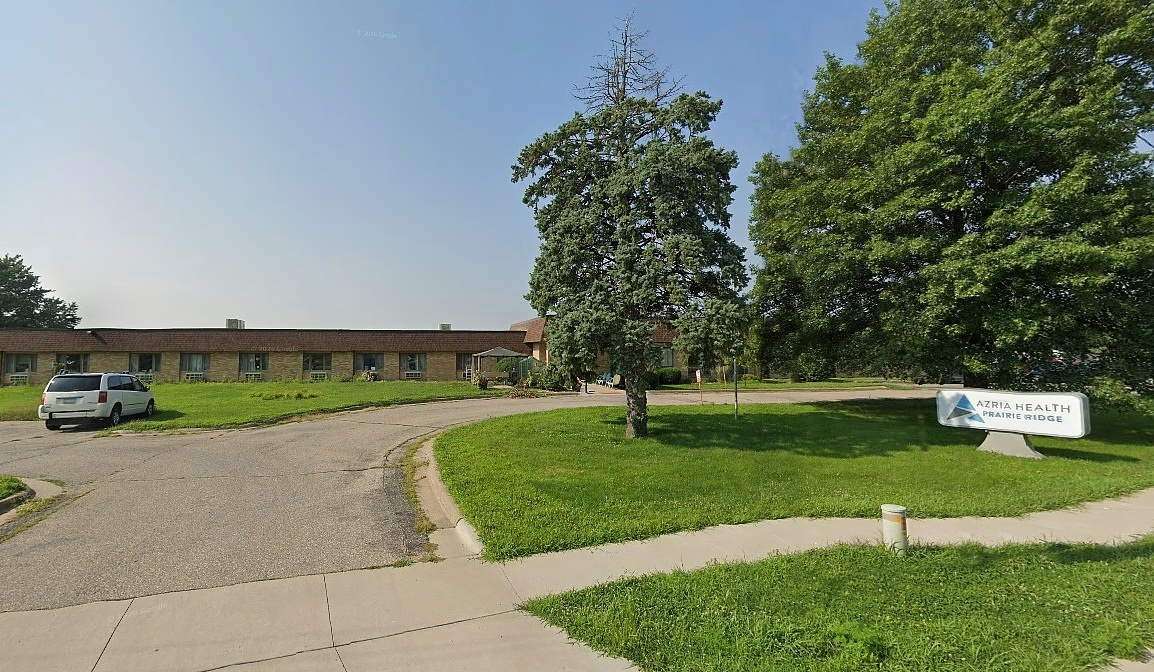
A caregiver at an Iowa nursing home was fired after expressing concern with her employer’s alleged refusal to purchase supplies for residents, an Iowa judge has found.
State records show Renee Arnold worked for the Azria Health Prairie Ridge nursing home in Mediapolis from June 1990 through December 2025, when she was fired. She subsequently applied for unemployment benefits, which the home challenged, leading to a recent hearing before Administrative Law Judge Jasmina Sarajlija.


In her findings of fact in the case, Sarajlija concluded that Arnold had been told by the home’s administrator, Ashley Ames, that she was “not to tell staff that corporate would not let her order supplies because they were over budget.” In August 2025, Arnold was given a written warning after she allegedly responded to an aide’s request for briefs for a resident by stating, “Placed the order, they will be here on Wednesday. That’s the best I can do.”
Arnold received another warning days later when she allegedly failed to properly report an incident of a resident choking and an incident involving a resident-on-resident altercation. She was fired in December 2025.
Based on hearing testimony, Sarajlija concluded that when Arnold placed an order for supplies, “she would receive communication from corporate that her order was over the allotted budget. For instance, claimant would order seven boxes of Saltine crackers and corporate would reduce her order to five boxes due to the imposed corporate budget.”
Arnold “routinely” talked to Ames about the issue, Sarajlija found, and Ames would then speak to corporate. “However, the budget issue went unresolved,” Sarajlija found. “As recently as two weeks before her discharge, claimant talked to her supervisor that the system was not working and that she had on occasion used her own money to purchase some supplies.”
In ruling that Arnold was entitled to unemployment benefits, Sarajlija stated that she found Arnold’s “version of events to be more credible than the employer’s recollection of those events,” noting that Azria Health “did not present a witness with direct knowledge of the situation to dispute (Arnold’s) testimony.”
Sarajlija concluded that Arnold “spoke to her supervisor, repeatedly, to keep her informed of the challenges when trying to order enough supplies while corporate stopped or reduced the order due to budget caps.”
Iowa Capital Dispatch was unable to reach Arnold for comment.
Other Iowans whose unemployment cases recently went before a judge include:
— Candy Canida, a registered nurse who worked for River Hills Village care center in Keokuk from November 2025 through early December 2025 when she was fired. According to the findings of the judge in her unemployment case, Canida was in training, job-shadowing another registered nurse, on Nov. 28, 2025, when she gave a resident the wrong medication and failed to catch the error. On Dec. 1, 2025, she gave a different resident of the home the wrong medication according to state records.
Canida alleged the nurse she was job-shadowing had gathered the medications and directed her as to which resident to give the drugs – an allegation the facility denied. The judge in the case found Canida’s testimony more persuasive than that of the employer and awarded her unemployment benefits.
— Austin Taylor, who, from April 2025 through December 2025 worked as a technician for a medical-equipment provider in Des Moines called AdaptHealth. According to the findings of the judge in Taylor’s unemployment case, Taylor was working on Dec. 18, 2025, when he went to a hospice facility where the staff reported Taylor appeared to be impaired and they did not feel it was safe to leave him alone with patients. Later that day, two AdaptHealth employees informed Taylor’s supervisor, Kellie Phipps, that Taylor was acting strange, and was pacing, sweating, making strange mouth gestures and pulling his hair.
According to the judge’s findings, Phipps later reported that when she then spoke to Taylor in her office, he was “amped up,” sweating profusely, could not sit still, and his eyes were darting back and forth. Phipps reported that Taylor agreed he needed to seek immediate medical attention, but refused to let her drive him to the hospital for testing. Taylor then ran from the office, got into his car and drove away, prompting Phipps to notify the police, according to state records. Taylor was then fired for violating the company’s policies related to drug-testing in cases of reasonable suspicion of impairment. He was denied unemployment benefits.
— Jeremey Gettemy, who, from December 2025 through mid-January 2026, worked as a full-time addiction technician for Bridges of Iowa, an addiction rehabilitation center in Des Moines. As part of his job, Gettemy worked at the Polk County Jail. Bridges of Iowa alleged Gettemy had several issues related to attendance such as showing up for work late or not showing up at all. The organization also alleged Gettemy lied about the death of his father, who was still alive when Gettemy sought time off for bereavement. His employer also alleged Gettemy had difficulty collecting the correct amounts of urine from individuals to conduct testing and had trouble maintaining client confidentiality. He was denied unemployment benefits.