





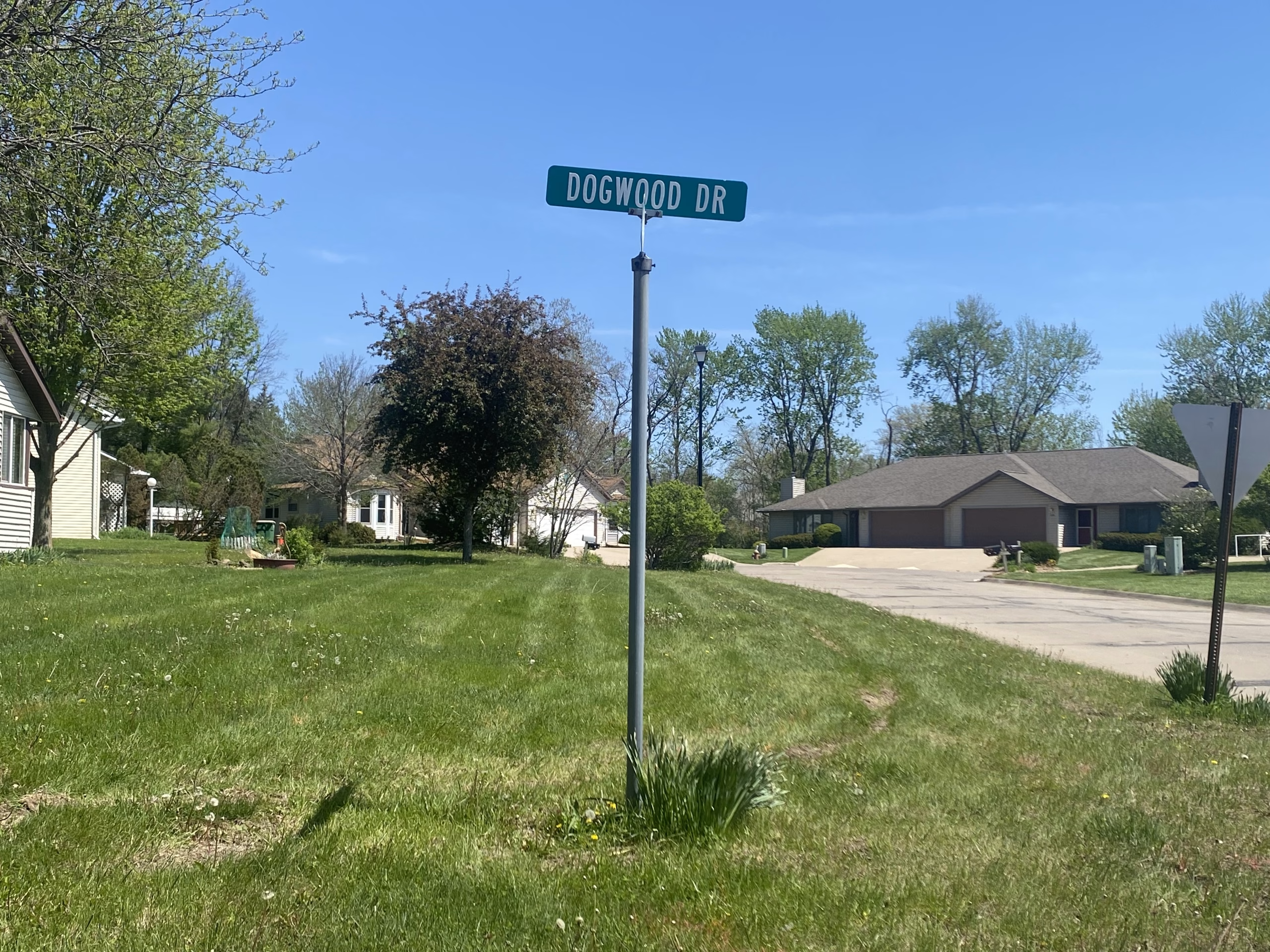
The Jefferson County Board of Supervisors discussed a proposal Monday, April 20th that would use a portion of the county’s opioid settlement funds to help establish transitional housing for individuals in recovery — but raised significant questions about location, liability, oversight, and regional responsibility before agreeing to hear more at a future meeting.
The discussion was led by Supervisor Susie Drish, who has attended three separate meetings with a representative from Elevate Housing Foundation, a Waterloo-based organization, over the past several months. Each meeting has brought a different proposal for how Jefferson County’s opioid funds could be used.


“About three meetings ago, an individual from Elevate, or representing Elevate in Waterloo, Iowa, came to visit with us with this idea to use Jefferson County opioid funds to consider a house on West Jefferson — not a house, an old church that was for sale on West Jefferson,” Drish told her fellow supervisors. “The figure was $50,000. What that would do would be remodel the basement of that church for residents to stay there. These would be people coming out of facilities, coming out of treatment.”
The second meeting brought a different proposal — a house in Vedic City at a significantly higher price point. Drish said afterwards that this proposal was likely off the table, but the previous first proposal and the following one are still in consideration. The third meeting, held on Tuesday, April 14th, introduced yet another option: a five-bedroom house on Dogwood Drive priced at $318,000, with an estimated $15,000 per bedroom to remodel, capable of housing up to 15 individuals. The residents would be people in the recovery process, transitioning out of treatment or incarceration, and working toward re-entering the workforce. Elevate had already obtained a repair estimate for the property.
Drish said she came away from that third meeting with several concerns. “It was a little unclear to me who would be there watching them,” she said. “I questioned the fact that Dogwood Drive is pretty close to the middle school. And Dogwood Drive has a lot of better housing in it. I didn’t know what the residents would think.”
Dogwood Drive sits just blocks from both Fairfield Middle School and Pence Elementary School. Supervisor Joe Ledger echoed Drish’s concern directly. “My concern is this last proposal you talked about — too close to a school,” Ledger said. “I had no idea who was going to be there and stuff, and I’d be concerned about it being too close to a school.”
Drish also raised a broader question about why Jefferson County is being asked to shoulder the financial burden alone for what has been described as a regional initiative. “They advertised this as a regional thing,” she said. “My question is, if it’s regional, why is Jefferson County being proposed to do it? Why not ask Henry County, Washington County, Wapello County, Keokuk County for a little bit of their opioid money? If this is the way you want to go.” She added that she felt others involved in the regional conversation should perhaps be present at the next meeting as well.
Jefferson County currently has approximately $250,000 in unencumbered opioid settlement funds available. The county would not own the property under any of the proposed arrangements — it would be providing funds to Elevate. Supervisor Lee Dimmitt raised the question of county liability, and Drish noted that Assistant County Attorney Elizabeth Estey, who was present at an earlier discussion, suggested that any contract should include a provision requiring the organization to return the funds if the arrangement falls through. Drish noted from personal experience that situations like this in other communities have sometimes resulted in the funding entity receiving money back but then being responsible for repairing damage to the property.
“It wouldn’t be ours — it would be theirs,” Drish said. “But we’re giving somebody money.”
Drish also noted that Elevate mentioned working with The Well in Fairfield to help residents find employment, and that residents would be provided transportation to employers.
Jefferson County Public Health Director Chris Estle, who was in attendance, raised an additional concern about city zoning. “When you’re talking about Dogwood Drive, I don’t know if it’s zoned appropriately — it’d be considered a business, would it not?” Estle said. “I think that the discussion should be had with the city prior to any purchase. Somebody needs to double-check to see if it’s appropriate to have that private single-family dwelling operate as a business.”
Drish confirmed that zoning had come up in her meeting with Elevate as well, and said she had also asked whether the city might contribute financially if the project moved forward. “I did ask if maybe the city might have a little cash if we were headed this way,” she said.
Drish also referenced a house on East Burlington as a cautionary example of how similar situations can become complicated, though she did not go into specific detail at the meeting.
Despite the concerns, all three supervisors expressed a willingness to keep the conversation going and learn more before drawing any conclusions. Ledger said he was in favor of doing whatever the county can to help people in recovery. Dimmitt agreed, noting there are other options worth exploring. “I think it’s a good idea to have conversation,” Dimmitt said.
During the discussion, Supervisor Dimmitt brought up the concept of a crisis stabilization house, noting that some facilities operate on a ten-day model — meaning if a resident cannot stabilize within ten days, they are moved to a different facility. Drish responded that she did not believe Elevate’s proposal had gotten that specific in its planning yet, suggesting the model for the Dogwood Drive house was less defined in terms of length of stay and structure.
The discussion also touched on a personal note when Drish shared that she has a nephew who struggled with addiction but has since recovered and is now doing well. She said the journey was long and difficult — far more than a ten-day window. “It took a long time to get there, not just ten days,” she said. The personal reflection underscored the sincerity behind the board’s cautious approach — not a reluctance to help, but a desire to do it right.
Drish closed the discussion by emphasizing the sensitivity of the subject and the importance of being thorough before making any decisions. “I just want to help everybody,” she said. “But I also feel that getting to the young — whatever we do to help the younger kids, maybe could help us on the back side.” She also cautioned that the public would likely have strong feelings once they became aware of the proposal. “Because people don’t really listen to us or our meetings, and so when they finally hear about it, you know, it could be sensitive,” she said. “I just think we need to really look at this because the public has been very concerned.”
The full board agreed to attend the next meeting with the Elevate representative, which has been scheduled for Tuesday, May 12th at 9:00 a.m.
Photo by A.J. Roe.