





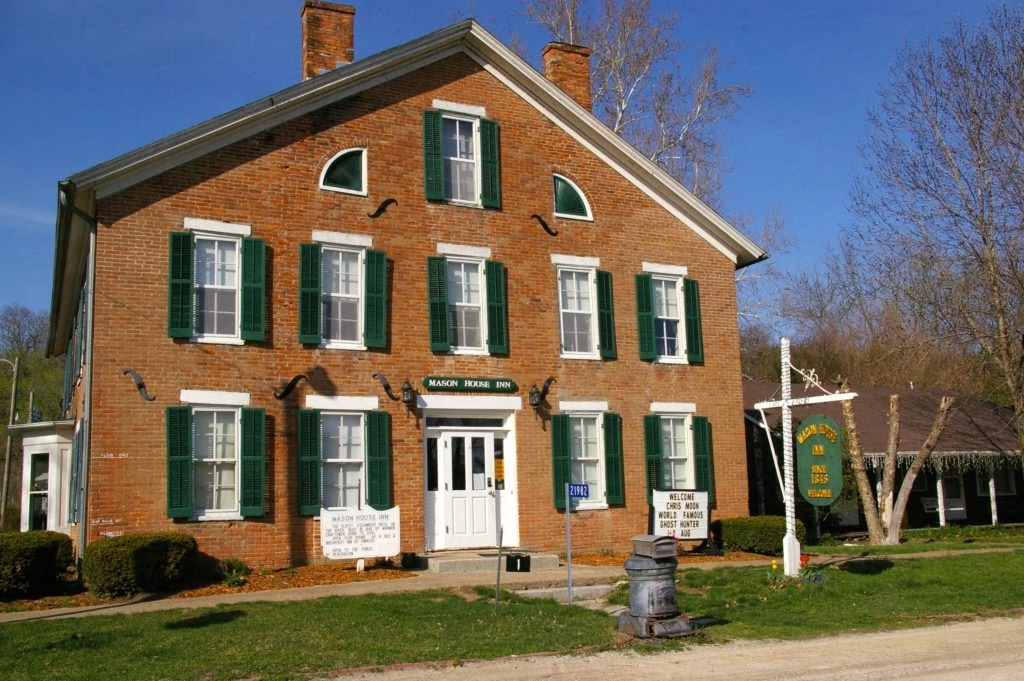
Nestled along the scenic banks of the Des Moines River, Bentonsport is one of Van Buren County’s earliest settlements and a true gem of Southeast Iowa. This historic village is home to the Mason House Inn, an antique hotel built in 1846 by skilled Mormon craftsmen traveling from Nauvoo, Illinois. Originally serving as a bustling stop for steamboat passengers, the inn has a storied past, having taken on various roles over the years, including operating as a hospital and functioning as a stop on the Underground Railroad. In addition to its rich history, the Mason House Inn is also known for its haunted reputation, drawing the interest of ghost hunters and paranormal enthusiasts alike.
The village of Bentonsport, named in honor of Missouri Senator Thomas Hart Benton, was platted in March 1836 by Francis Church, Charles O. Sanford, and Giles O. Sullivan. Sullivan settled in the area in December 1834, establishing a double log cabin at the foot of Sullivan (now Walnut) Street, with his cousin Shapley P. Ross joining him in 1835. The growth of the village continued with the first addition laid out in 1837 by John Bending, Charles O. Sanford, and H. P. Graves, followed by a resurvey for the Bentonsport Association in 1839. Across the river, South Bentonsport was platted in 1837 by Isaac Reed and Henry Smith, later renamed Vernon in 1852 after the establishment of a post office.


Despite losing the county seat election to Keosauqua in September 1838, Bentonsport’s growth remained unimpeded. The territorial legislature of Iowa authorized the first lock and dam in 1839, which prompted the establishment of two grist mills, two ferries, and a sawmill. In 1852, the Green brothers built the first paper mill in Iowa at Bentonsport, supplying local newspapers and even shipping paper to Des Moines. This period also saw the emergence of several newspapers, including the Vernon Democratic Mirror (1855-1857) and The Valley Weekly (1858). Bentonsport also became known for its pottery businesses; James Clark reportedly established a pottery in South Bentonsport before joining the ’49ers in the California gold fields. By 1850, potters like James Johnston and Isaac Boyer were listed in the census, with Robert M. Dickson later purchasing the site of Dickson’s Pottery, which became the best-known pottery in the county.
The arrival of the Keokuk, Fort Des Moines and Minnesota Railroad in 1857 marked a significant turning point for Bentonsport. However, the financial panic of that year halted construction, leading the village to issue “Bentonsport Script,” a currency redeemable for U.S. dollars that facilitated trade between local farmers and merchants. Bentonsport’s heyday as a steamboat port ended when the railroad was completed to Des Moines in August 1866, and the river was declared non-navigable in 1870. This change led to the neglect of dams and locks, with the failure of the dam at Bentonsport in 1879 and the opening of the Bentonsport bridge in 1883, which remains the oldest wagon bridge of its type on the Des Moines River.
Over the years, neglect, fires, and floods took a toll on Bentonsport’s mills and buildings, leading to a scarcity of frame structures today. In an effort to preserve its history, a National Historic District was established in Bentonsport in 1972. The Mason House, originally known as the Ashland House, was built in the late 1840s during the westward trek of the Mormons. It served steamboat passengers and other travelers under various owners until Lewis J. Mason assumed control after the Panic of 1857, changing its name to the Phoenix Hotel, and later to the Mason House. Notably, its barn reportedly sheltered runaway slaves as part of the Underground Railroad, further cementing its significance in the region’s history.
Today, the Mason House Inn is not only a destination for those interested in history but also for those intrigued by the paranormal. Guests and staff have reported strange occurrences, including unexplained noises, cold spots, and sightings of apparitions, adding an eerie charm to its historic allure.