




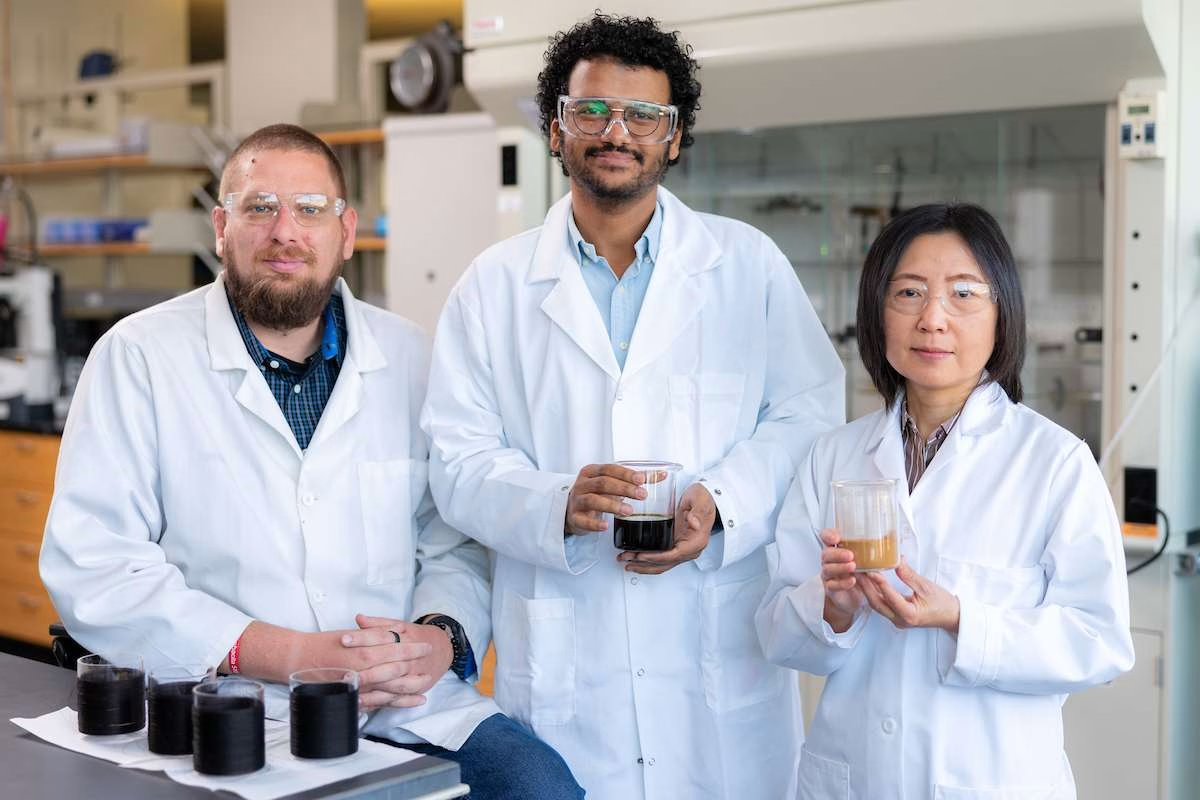
As American politicians and industries look to bring manufacturing to U.S. soil, Iowa State University researchers and their partners are working to scale a method of carbon fiber development using cheap, readily available materials.
ISU mechanical engineering professor and Bioeconomy Institute associate director Xianglan Bai, joined by other bioeconomy institute leaders and researchers, has received a four-year, $2 million grant from the U.S. National Science Foundation to bring carbon fiber made from waste products from the lab to commercial markets.


The study into bio-based carbon fiber began more than 60 years ago by Japanese researchers, Bai said, and her own work in the area has spanned more than a decade. However, new methods of development established by Bai’s team and the addition of bio-oil from a different ISU-connected group is allowing the researchers to create high-quality carbon fiber at a lower cost.
“Everyone knows carbon fiber is a good material, but a lot of people cannot use it because the cost is too high,” Bai said. “If we can offer very cheap carbon fiber and enlarged production, then people will adopt carbon fiber in the application that originally they couldn’t dare to use the stuff.”
Softwood kraft lignin — a component of plants that waterproofs cell walls and keeps them strong — is good for protecting the plants against environmental damage, Bai said. It’s not as useful for product applications despite its high carbon content, she said, because it’s difficult to break down. It’s also a byproduct of the paper and pulp industry, used as boiler fluid to recover chemicals from pulp.
This is the polymer that Bai, and others, have focused on in their research when it comes to carbon fiber production. She said her team needed to “bridge the chemistry and the material science,” and did so in one way through “thermo-mechanochemistry,” where they heat lignin and put it under tension to cause changes in its material structure.
Bai said there are several patents or patent-pending projects that have come from her team’s study of lignin carbon fiber development. Another component unique to ISU’s work is a type of bio-oil also patented by ISU and developed by Rise Energy, an Ames-based startup company run by leaders in the university’s bioeconomy institute.
“Right now, we are trying to create the carbon fiber that is lower than $5 per pound, because … our precursors are all bio-based and all the byproducts are low cost, and the byproducts basically have very limited use, and then our process is also very simple,” Bai said.

Rise Energy co-founder and bioeconomy institute engineer and faculty member Tannon Daugaard said his company takes waste from agriculture and other areas and converts it into bio-oil and bio-char, which can act as a fertilizer. The addition of bio-oil to the lignin shortens the time it needs to stabilize, and now the team is trying to figure out if any feedstock can work for the bio-oil they’re using or if specific kinds must be used.
Carbon fiber has applications in all kinds of industries, the researchers said, from agriculture to automotive, aerospace and infrastructure. Both Bai and Daugaard say they hope that by the end of the grant period, they’ll have the resources to establish manufacturing plants for bio-oil and bio-based carbon fiber production.
“Much like the Bioeconomy Institute has that collaboration, that network, all of those sources exist in Iowa, right, so it’s the feedstock to the final use of the product and the manufacturing along the way,” Daugaard said. “So we want to have that infrastructure here in Iowa.”
While in-state infrastructure is Daugaard’s hope, other partners in the project also hope to bring those kinds of benefits to their own states. Latis Materials, an advanced materials manufacturing company in Maine, is acting as “industry adviser” to the ISU team and is focused on customer and funding research, as well as figuring out the details of scaling the new carbon fiber production.
Will Salisbury, co-founder of Latis Materials and co-principal investigator for the grant-funded project, said his company is working to reproduce what the ISU researchers developed to gather scalable data and use it to develop a full-scale, continuous system for carbon fiber production.
Companies in the fields of agriculture, fuel storage and outdoor products have expressed interest in the new type of carbon fiber, Salisbury said, and his goal is to generate enough material for them to use in prototype parts. He hopes they would then sign a contract to buy a certain amount of the material, giving them a stronger start in getting financed to build a real factory.
“I think it has huge potential, you know, bringing jobs back into forested communities like Maine, like where we are, but also in the Pacific Northwest and in the Southeast, and even into Canada and northern Europe too,” Salisbury said.