





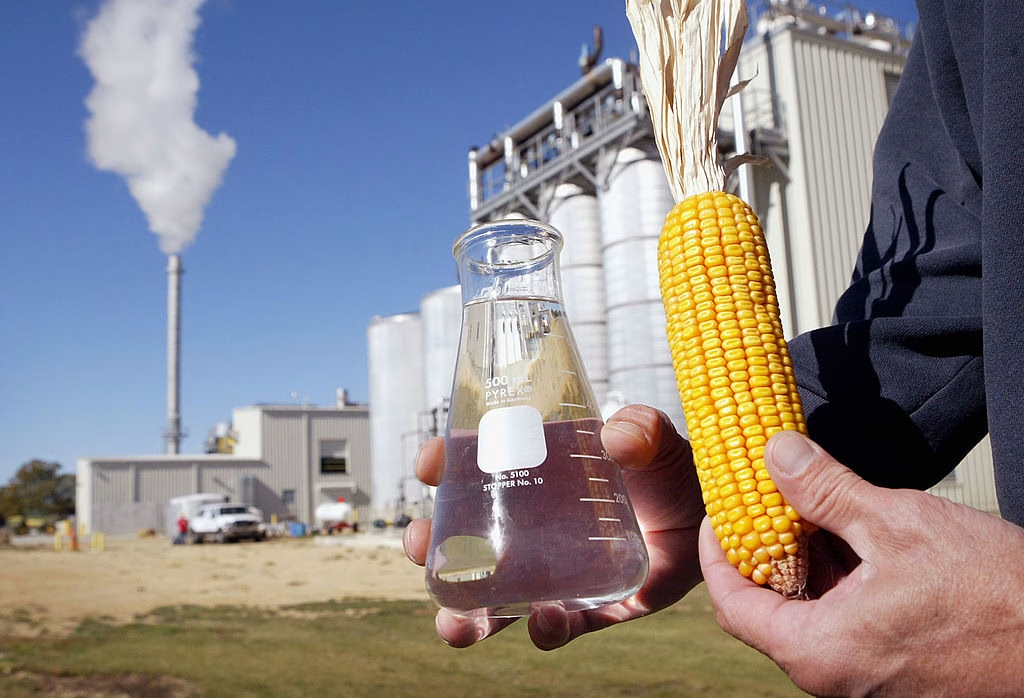
Iowa produced 4.6 billion gallons of ethanol in 2025 — a figure consistent with the past two years and one that Iowa Renewable Fuels Association says could be higher if Iowa had access to carbon sequestration technologies.
The call for carbon capture and sequestration comes from the Iowa Renewable Fuels Association at the start of Iowa’s 2026 legislative session, where debate around property rights and carbon sequestration pipelines are set to be top priority.


A proposed carbon sequestration pipeline from Summit Carbon Solutions would connect to Iowa ethanol plants and transport their sequestered carbon dioxide to an underground storage site. This would allow ethanol plants to participate in the ultra-low carbon ethanol industry to produce things like sustainable aviation fuel and marine fuel, but the project has been contested in legal and legislative settings by landowners who feel the pipeline is not a public use worthy of the power of eminent domain.
Under eminent domain, unwilling landowners can be forced to accept easements on their property at a price set by a county commission for projects considered in the public interest.
Nationally, the U.S. produced 16.4 billion gallons of ethanol in 2025, according to the national Renewable Fuels Association. IRFA pointed out in a news release that while national ethanol production has increased annually over the past five years, Iowa production has remained “stagnant” at 4.6 billion gallons annually since 2023.
While Iowa remains the top ethanol producing state in the country, in 2025 the Hawkeye State produced 28% of the nation’s ethanol supply, which is less than the share it produced in 2023 and 2024 when Iowa accounted for roughly 30% of the national share, according to the association.
Figures from the U.S. Department of Agriculture show that increased ethanol production in the country has been driven primarily by a rise in ethanol exports. In March 2025, fuel ethanol demand for the month was equivalent to about 465 million bushels of corn, which was a 60-million bushel increase in monthly demand from 10 years prior.
Iowa Renewable Fuels Association Executive Director Monte Shaw said Iowa is “behind in the race” as other states work to take advantage of incentives and market benefits of ultra-low carbon ethanol.
“Investment dollars flow to areas with a perceived competitive advantage,” Shaw said in a news release. “The states attracting significant investment have one thing in common – the ability to sequester carbon either locally or via pipeline infrastructure.”
In addition to expanded markets, low carbon ethanol fuel producers and CO2 transportation pipelines are eligible for federal tax credits known as 45Z and 45Q.
According to the association, if all 4.6 billion gallons of Iowa ethanol utilized carbon sequestration technology, it could bring $3 billion to the state via 45Z tax credits.
Iowa ethanol advocates have also said the start of a carbon sequestration pipeline in Nebraska would cause Iowa to lose its “crown” as the top ethanol producing state, because business would shift to the more lucrative, ultra low-carbon ethanol producing facilities.
According to the U.S. Energy Information Administration, Iowa continues to have a significant lead over other states in ethanol production capacity with nearly double the number of plants in Nebraska.
“There is no reason why Iowa plants won’t grow in the near future if we maintain their access to the tools and technologies to compete,” Shaw said.
Lawmakers passed a bill last year that restricted carbon sequestration pipelines’ abilities to utilize eminent domain in the state, but the bill was vetoed by Gov. Kim Reynolds.
Landowners opposing the pipeline project plan to lobby, beginning Tuesday, for similar legislation this year to limit the project’s ability to take land for its construction against landowner wishes.
The Summit pipeline has also been affected by a ban on eminent domain for CO2 pipelines through South Dakota. Recent filings from the company indicate it may change paths, pending state approval, to avoid crossing through South Dakota.
Shaw said emerging ethanol markets are “demanding” ultra-low carbon ethanol.
“Iowa needs carbon capture and sequestration (CCS) and conservation-smart agriculture practices to be attractive,” Shaw said. “IRFA will continue to support legislation that enhances landowner rights, streamlines the permitting process, and maintains a viable path forward for CCS. Our future depends on it.”