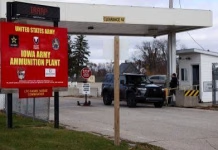





The director of the federal Bureau of Alcohol, Tobacco, Firearms and Explosives says experts in his agency were called in last March to evaluate the Army’s stockpile of lead azide at the Iowa Army Ammunition Plant in Middletown.
Robert Cekada, the first ATF agent to serve as the agency’s director, said the U.S. military began using lead azide almost 100 years ago, but transitioned to other explosives about 15 years ago because lead azide is difficult to store and transport. “What we’ve learned is about in 2009 the nation’s stockpile was moved here to the Iowa Army Ammunition Plant. That stockpile contained approximately 10,000 pounds,” Cekada said. “Some of that lead azide was already 60+ years old.”


The lead azide in Middletown was placed in two bunkers, which the military calls magazines. It’s surrounded by sawdust inside burlap bags and stored in containers surrounded by a mixture of water and ethanol to maintain a consistent temperature of at least 50 degrees. It prevents the liquid lead azide from crystalizing. Cekada said experts confirmed this spring that the material was crystalizing and teams haven’t been able to add the water and ethanol necessary to try to stablize it.
“Just removing the lid from one of those containers could cause a detonation of that barrel and a sympathetic detonation of every barrel inside either one of those magazines,” Cekada said.
That kind of an explosion would endanger the technicians trying to maintain the lead azide, but also the surrounding community according to Cekada. He said the fluctuation of temperatures this fall could trigger more lead azide to crystalize. “The fact that we haven’t been able to add that ethanol, now portions of lead azide are exposed to the air in the barrels,” Cekada said. “…Without that ethanol mixture at the level it should be, it’s just a matter of time when we have an uncontrolled detonation. It’s not a matter of if. It’s a matter of when.”
FEMA has sent emergency alerts to cell phones in the area surrounding the Iowa Army Ammunition Plant in Middletown, advising evacuations within at least a five mile zone.