




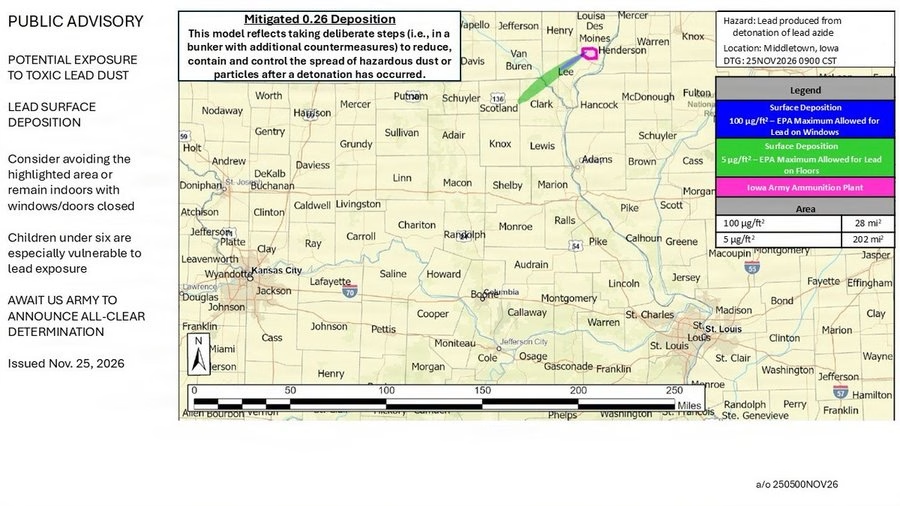
Military officials say two huge walls of water have been installed to try to capture some of the lead that will be released during this morning’s controlled detonation of a stockpile of unstable explosives in southeast Iowa.
Army Colonel Aaron Teller, the commander of a Colorado-based unit that deals with the disposal of ammunition and other explosive devices, is among a group of military officials who spoke at a news conferece in Middletown yesterday. His team installed a system Monday night that will release foam into the two bunkers where the lead azide is stored. “It’s specifically designed to dissipate blast and capture particulate,” Teller said.


He’s been evaluating the situation at the Iowa Army Ammunition Plant since March. “We wanted to prevent having to do a high-order detonation because there is risk associated with that,” Teller said. “However, we were never able to find a viable alternative.”
Teller’s team has installed wooden doors on the two bunkers where the unstable material was placed in 2009. “We want those doors to blow off,” Teller said. “I’ve got a vent opening in the protective works. Our design is to vent it into three miles of uninhabited installation, on the Iowa Army Ammunition Plant.”
1977 was the last time the military detonated a significant amount of lead azide. It happened in the open, in Colorado. “75% of the lead particulate remained at the incident site, so without doing anything whatsoever only 25% of the lead particulate went into the atmosphere,” Teller said. “So we believe we can significantly reduce that last 25% with the mitigation strategy that we’ve enplaced.”
The Iowa Army Ammunition Plant in southeast Iowa was chosen as the military’s national storage site for lead azide, which is no longer used by the military to trigger explosions. Officials confirm some of the lead azide that will be blown up is over 80 years old. Adam Telle, the Acting Secretary of the Army, said he’s ordered the Army to an inventory of every storage facility, “to ensure something like this never happens again.”
The Army says 9 a.m. today is their target time for the detonation, but the time could be moved if weather conditions change. Dozens of people have been collecting soil samples in the area to compare lead levels in samples taken afterwards. Andy Nelson, director of the Army’s Corps of Engineers “Construction Engineering Research Laboratory,” has been involved in developing the maps showing where the plume of dust from the explosion are likely to travel. “We will also create and develop a post-event model and that post-event model will be calibrated by our on-the-ground measurements,” Nelson said, “so we will have a higher confidence in what actually occurred.”
Federal officials advised people who live near the Iowa Army Ammunition Plant in Middletown to evacuate yesterday and FEMA will notify them when it’s safe to return. FEMA is providing temporary shelter to those who need it through Friday.
Lead is toxic and can hinder brain development in young children. While there are no immediate symptoms of lead exposure in humans, it can lead to long term damage to the kidneys, heart, blood vessels and the reproductive system.