





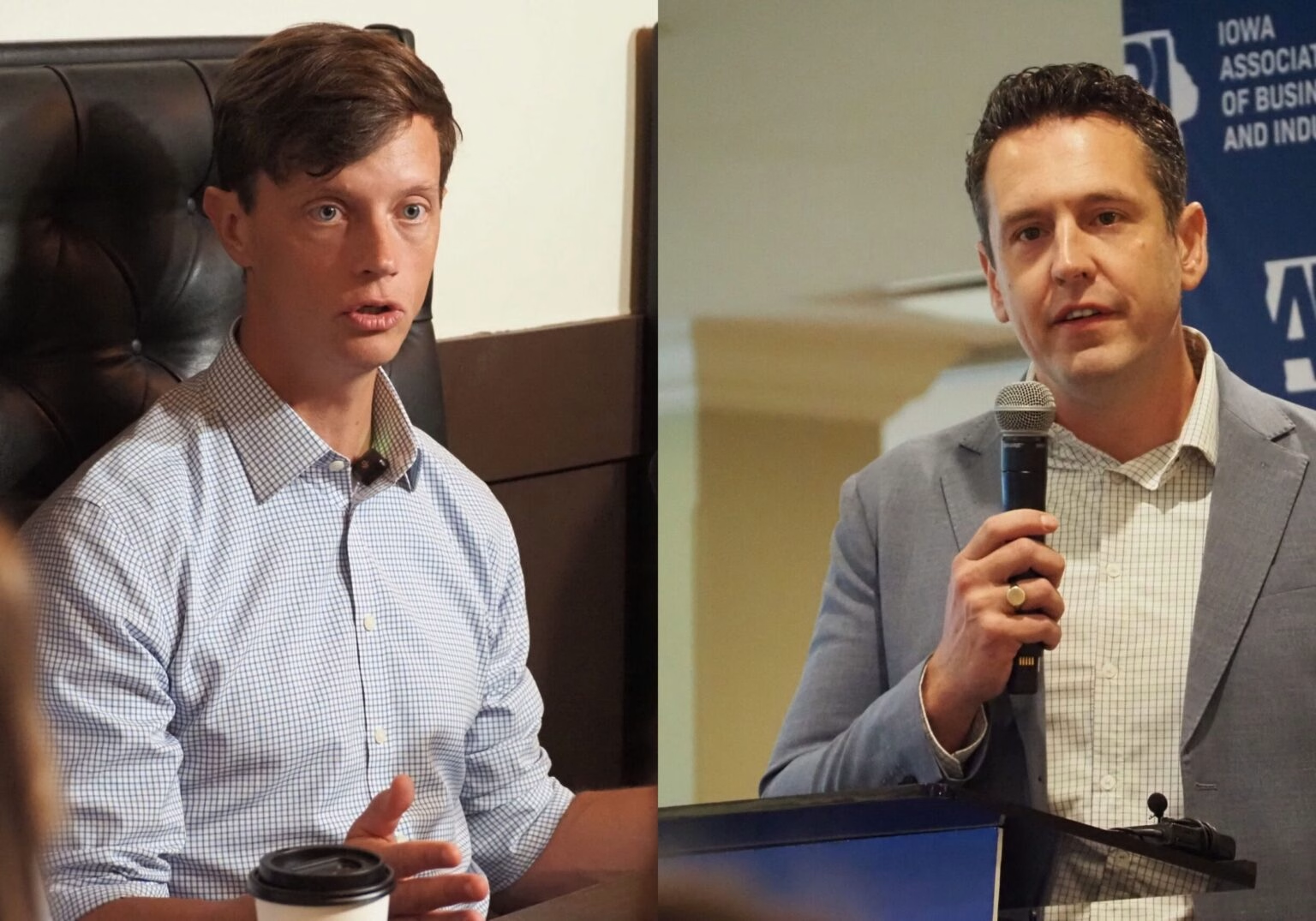
Democrat Rob Sand and Republican Zach Lahn accused each other of lying about their residency and family wealth Tuesday while answering questions on the state budget and education during the first 2026 Iowa gubernatorial debate.
The debate, hosted by KWQC, was held by at St. Ambrose University in Davenport. It is the first of multiple debates scheduled between Sand and Lahn in the weeks before the Nov. 3, 2026 general election.


Moderators presented the two candidates a series of questions on issues including Iowa’s economy, education system and high cancer rates. While Sand and Lahn shared some of their plans to tackle these issues if elected governor, much of the time was spent arguing over talking points brought up on the campaign trail through criticisms and political advertisements.
Lahn, a businessman who owns a farm in Belle Plaine, spent a significant amount of time in the debate saying Sand was falsely presenting him as not an Iowa resident, and claimed his opponent was attacking his family and children by making this issue prominent in the gubernatorial campaign.
Since becoming the GOP nominee in a contentious June gubernatorial primary, Lahn has faced scrutiny over his state residency. According to the Kansas Reflector, he registered to vote in Iowa in 2024 and met the state’s two-year residency requirement for his 2026 Iowa gubernatorial run, but previously lived in and was a registered voter in Kansas, where he worked on a private pre-K through 12th-grade school named Wonder. The Des Moines Register reported in April he regularly flew his personal airplane between Iowa and Kansas because he had a blended family with some children based out of Wichita, Kansas. He told the Register, “but if I’m elected governor, it would be a different arrangement, and we’d work it out. Because, you know, we’d be in Iowa as much as humanly possible.”
After Lahn claimed the first year Sand was state auditor, he “overspent his budget, had to get bailed out by the governor,” Sand retorted that, “I don’t know how the Kansas State Auditor’s Office works, but we are funded in large part by payment from our clients at the local level. … My predecessor burned through the state’s accounts in the auditor’s office, and we righted that within our first year.”
While moderators attempted to refocus candidates on the initial question asked — about public school funding and the state’s Education Savings Account program providing public funds for private school tuition and associated costs — Lahn argued he should get the opportunity to respond directly to Sand’s comments about his residency.
The Republican said the claim that he is a Kansas resident was “a central lie of Rob Sand’s campaign.” He also said he believed the position of Iowa governor was a “full-time job, and I’m here for it.”
“I’m gonna tell you this right now, this issue is about one thing. It’s about my children. That’s it,” Lahn said. “I have a blended family, and they split time. And I’m gonna tell you right now, I am not going to be intimidated on this. I will spend whatever effort necessary to defend my children from people who’d like to exploit them like you. And my promise to the voters of Iowa, I will also defend your children from people who’d like to exploit them like Rob Sand. I won’t put up with it.”
More debates this week
This week, “Iowa Press” will host two debates on Iowa PBS. Republican Ashley Hinson and Democrat Josh Turek square off for a U.S. Senate debate on Wednesday, Oct. 7. Republican Joe Mitchell and Democrat Lindsay James, candidates for the 2nd Congressional District seat, will debate on Oct. 8. Both debates will take place at 7 p.m.
Earlier Tuesday, Kansas Gov. Laura Kelly, a Democrat, released a video calling for Lahn to “come back to Kansas.”
“Generally, I support Kansans,” Kelly said in the video. “I was even proud to see Zach Lahn voted here in ’18, ’20, and ‘22. I hope he voted for me in the Kansas governor’s race. But in the Iowa governor’s race, I’m supporting the Iowan. Zach, there are no hard feelings, but it is time to come back to Kansas. As they say, there’s no place like home.”
Lahn claimed Sand also traveled frequently, citing properties owned by the family of his wife, Christine Lauridsen Sand, who is the CEO of the Lauridsen Group, Inc., a business that operates six food and health products companies. The Republican candidate claimed Sand regularly “traveled to Aspen, Colorado, to their $77 million mansion there,” referencing a Wall Street Journal article stating the mansion was sold by an LLC “linked to the headquarters of the Lauridsen Group,” alongside a “multimillion dollar home in Northwest Iowa.”
These residential properties are not owned by Sand, but by family members of his wife. He did not directly respond to these claims by Lahn during the debate — the only statement he made about the Lauridsen Group, Inc. was in response to a statement from Lahn who claimed Sand’s in-laws helped fund his campaign using money that “in part, came from selling high nitrate fertilizer.”
“My in-laws’ business doesn’t sell nitrate fertilizer,” Sand said.
Though there was significant back and forth about campaign attacks during the debate, the candidates also answered questions on issues like the $1.4 billion in tax incentives approved by state lawmakers during a special legislative session and signed into law by Gov. Kim Reynolds Friday for a proposed $15 billion steel mill project in Lee County.
Sand said if the project comes to Iowa, it will play a positive role in improving Iowa’s economy — but he said there are legitimate reasons why some Iowans are concerned about the tax incentive package. He pointed to similar propositions like Wisconsin providing tax incentives for the company Foxconn despite not ultimately building the initial proposed project. He also brought up problems Mesabi Metallics, the company proposing to build the Iowa steel mill, have faced in opening an iron ore mine in Nashwauk, Minnesota.
“I think what’s most important here is making sure that this deal is rock solid and actually going to work for Iowans,” Sand said. “We want to make sure, for example, that what happened in Minnesota doesn’t happen here. We don’t want to see a lot of upfront incentives. Instead, we should make sure that this company is making the investments, improving the infrastructure in Iowa — actually building here — and after meeting benchmarks, then seeing incentives come in after that to make sure that actually something is being provided to Iowans.”
Republicans supporting the law passed during special session said the increased tax incentives to Mesabi Metallics available through the state’s Major Economic Growth Attraction (MEGA) program are contingent on the project’s completion. The law states the 10% tax credit, remitted over the course of a decade, will not be issued to a business until the business begins operations, or until “a designated portion of the project” has been placed in service, and until at least half of created jobs — which must meet a qualifying wage threshold — associated with the project or a designated portion have been added to the payroll.
Sand added, “this is encouraging, and hopefully, we see it out, and hopefully, it becomes real.”
Lahn expressed less skepticism about the project, saying it represents a vital opportunity for southeast Iowa, an area he said was “an economically depressed part of the state.”
“We talking about thousands of new jobs, we’re talking about billions of dollars in investments,” Lahn said. “And my role as governor is to be the chief negotiator for the state, the person that’s going to bring these businesses in.”
While Lahn has emphasized supporting local Iowa businesses and workers during his campaign, he said he believed the project by Mesabi Metallics — a Minnesota company owned by the India-based Essar Group — was “one of those opportunities that’s transformational to the state” that a governor must advocate for.
“We can’t sit on the fence, we can’t sit on the sideline, we have to prioritize economic growth in the state,” Lahn said. “But the bigger issue here with economic growth is that we have to be prioritizing our rural communities as well, which this project does. It gives the opportunity for rural growth. We’ll see hospitals reopen in the state, we’ll see more houses being built, we’ll see people coming here.”
There are three more gubernatorial debates scheduled. Sand and Lahn will debate Wednesday, Oct. 14, at 7 p.m. in Sioux City hosted by KTIV-TV4; on Wednesday, Oct. 21 in Des Moines for an “Iowa Press” debate and Tuesday, Oct. 27 at 6:30 p.m. on Cedar Rapids, hosted by KCRG-TV9 / The Gazette.