




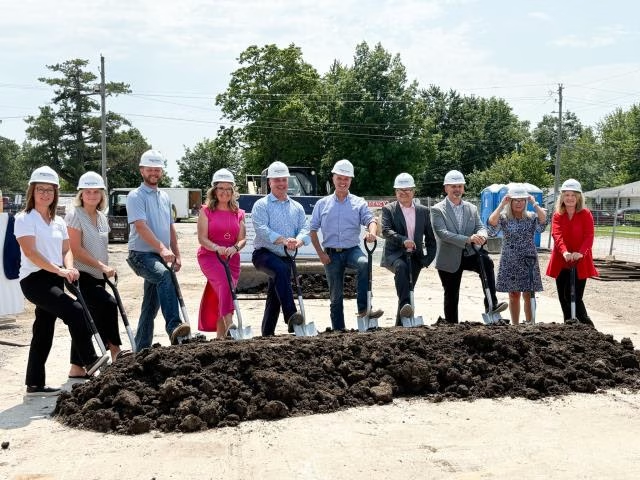
Representative Zach Nunn (IA-03) today joined Wayne County Hospital CEO Daren Relph, hospital leaders, and health care officials to break ground on a new dialysis center made possible by a more than $2 million federal investment he secured in 2024.
“We fought to secure this investment because no Iowan should have to drive seventy-five miles, three days a week, just to get the dialysis care they depend on,” said Rep. Nunn. “Doubling this center from five stations to ten means those on the waiting list today can get the care they need close to home. This is exactly the kind of commonsense investment the federal government should make — one that does the most good for the most people.”


Rep. Nunn secured the $2,011,000 investment through the FY2024 appropriations process. Wayne County Hospital operates the only dialysis center serving the surrounding six-county region, but its current facility is too small to meet growing demand. The new center will double the hospital’s capacity and let more patients receive life-saving care close to home.
Following the groundbreaking, Rep. Nunn hosted a roundtable with local providers on strengthening rural hospitals, expanding access to care, fighting cancer, protecting telehealth, and training the next generation of Iowa’s doctors and nurses in the rural communities they serve.
“Today’s discussion proves that the best ideas for fixing health care don’t come out of Washington; they come from the nurses, doctors, and rural hospital leaders who are caring for patients every day,” continued Rep. Nunn. “The $50 billion we secured for rural health care — including $209 million for Iowa — was designed to support hospitals like Wayne County. You can see it working right here in Corydon: a new radiation oncology center, funding to recruit the physicians this community needs, and a four-county cancer network that serves patients close to home.”
During the roundtable, Rep. Nunn also highlighted more than $37 million he helped secure for Wayne County Hospital through Iowa’s Healthy Hometowns Initiative to strengthen cancer care in southern Iowa. The funding flows from the Rural Health Transformation Program, which delivered $209 million to rural health care across Iowa this year. Wayne County Hospital secured three grants through Healthy Hometowns: $120,000 for physician recruitment, $5 million to stand up a radiation oncology center, and $31.9 million for the Combat Cancer Health Hub — a hub-and-spoke cancer network Wayne County is leading across a four-county region with Decatur, Clarke, and Lucas.
Rep. Nunn also heard from local doctors, nurses, and Wayne County Hospital officials about workforce shortages and barriers facing rural patients. The discussion focused on Rep. Nunn’s Train More Primary Care Doctors Act and Train More Nurses Act to strengthen the pipeline of health care professionals, as well as his bipartisan efforts to protect telehealth access for rural communities.
Hospital leaders welcomed the investments as critical steps toward meeting growing demand and ensuring southern Iowa can get high-quality care close to home.
“The $209 million Congressman Nunn helped secure for Iowa did not stop in Des Moines. It moved through the state as Healthy Hometowns grants, and three of them landed here in Wayne County — $120,000 for physician recruitment, $5 million to stand up radiation oncology, and $31.9 million for the cancer hub-and-spoke network we are leading with Decatur, Clarke, and Lucas,” said Daren Relph, Chief Executive Officer, Wayne County Hospital. “For a hospital our size, those are not line items. They are a cancer program, a recruiting pipeline, and a network that keeps patients close to home. That is what a federal appropriation looks like when it actually reaches the far end of the district. And it is not the only way he showed up here — the $2,011,000 he carried through the appropriations process is why we are breaking ground on a new dialysis center.”
“The nursing shortage in rural Iowa is not a shortage of people who want to serve. We have students ready. What we do not have is enough faculty to teach them, and that bottleneck is nearly invisible from outside a small hospital,” said Kevin Tilley, Chief Nursing Officer, Wayne County Hospital. “Congressman Nunn’s Train More Nurses Act goes straight at it — nurse faculty in underserved areas, a pathway for experienced bedside nurses to move into teaching, and a real ladder from LPN to RN. We are grateful he is leading on this, and Wayne County Hospital is ready to help make sure the work ahead reflects what rural hospitals are actually living.”
“I have been on the medical staff at Wayne County Hospital longer than anyone here, and I have hosted students nearly the whole time. Here is what that teaches you: people practice where they train. If a student never sets foot in a rural hospital, we are not on the list when they choose where to go,” said Amy Wood, Longest-Serving Member of the Medical Staff, Wayne County Hospital. “Congressman Nunn’s work to expand training pathways for doctors, nurses, and physician assistants matters to us because it decides who is standing in our exam rooms ten years from now. We would welcome the chance to be a training site for rural Iowa.”
“We run five dialysis stations for fifteen patients, and eleven more people are on a waiting list. The nearest other unit is seventy-five miles away. Dialysis is not something you postpone — it is three days a week for the rest of your life, and a missed session is an emergency,” said Jill Tueth, Secretary, Board of Trustees, Wayne County Hospital. “So those eleven neighbors are making a long drive or they are going without. Congressman Nunn secured the funding that doubles us to ten stations. When we put a shovel in the ground, that is eleven people and their families who stop having to choose.”
“I have chaired this board for more than twenty years, and in that time it has never been short on nerve. What we have been short on is the capital to act on any reasonable timeline,” said Darrell Cook, Chair, Board of Trustees, Wayne County Hospital. “Congressman Nunn changed that equation for Wayne County. Projects this board would have spent a decade working toward are going up now, and people in this county will get care close to home that they would otherwise have driven hours for. That is not a check written to a hospital. That is a decade given back to a community.”