




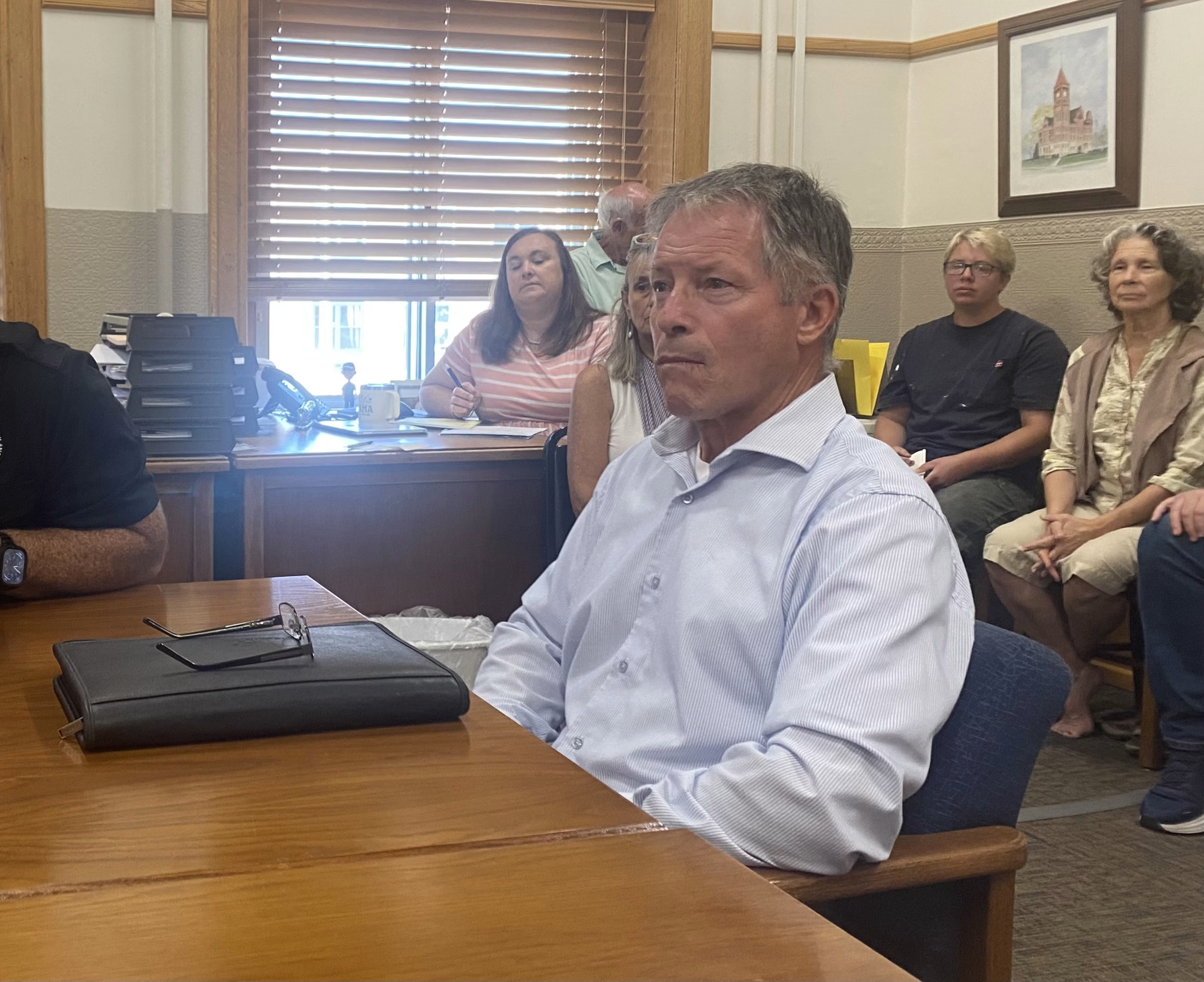
Residents along Pleasant Plain Road packed the Jefferson County Board of Supervisors meeting on Monday, July 20th, voicing frustration over the ongoing condition of the road following a troubled chip seal project that began in June 2025. County officials defended their efforts, acknowledged mistakes, and heard pointed concerns about safety — while stressing that budget constraints leave the county with limited options.
Road Funding and Budget Constraints


County Engineer DeWayne Heintz opened the regular meeting with a broad update on road conditions and funding across Jefferson County before the discussion turned to Pleasant Plain Road.
On the Packwood Road project, Heintz reported that the county received formal approval for a grant from Region 15, getting it a quarter of the way to the $8 million total project cost. “It’s $2 million, and the whole project will be $8 million,” he said. The county plans to resubmit for a Miller-Meeks Community Project Improvement Grant and if unsuccessful will piece the project together through the Farm to Market Fund. “At an $8 million total cost, and only getting $1 million a year in Farm to Market money, it’s going to take us a little while to get that $6 million,” Heintz said. “If we can get the Miller-Meeks Community Project Grant, that will speed up that process considerably, but we’ll deal with what we have and make do with what we got.”
The county also received $25,000 of the $50,000 it had hoped for from the SIDCA board for tanker cars, with paperwork expected to appear on next week’s agenda.
Heintz gave context for the county’s tight road budget, noting that a $6 million bond fund taken out years ago — used to improve Germanville Road, Pleasant Plain Road, and Brookville Road — takes just short of $500,000 per year away from the road budget, with payments continuing until 2033. He also noted the county is essentially a captive audience when it comes to contractors. “We have basically two entities that we can do business with — and that’s L.L. Pelling and Norris Asphalt,” Heintz added. “They bid on the projects, we’re required to bid those projects out. They’re usually the only bidders. We don’t have people coming down here that do it cheaper.”
He referenced retired Buchanan County Engineer Brian Keierleber’s analysis as a frame of reference. “He ran the numbers for Buchanan County, and $80 million is what it would take to get his county road system up to snuff,” Heintz said. “That’s not there. We’ve got a lot of roads to take care of and a lot of people that live out in the rural areas that need rock on their roads. They need their snow plowed. The pavements are the expensive part of our system. We have to maintain them. But we have to find a way to maintain them that doesn’t negatively impact the rest of the county as well.”
On Germanville Road, Heintz said the county plans to use a stone interlayer to reestablish the crown and then apply a double chip seal, skipping the sand seal used on 110th Street. “We’ll skip the sand seal like we put on 110th just because it’s too weather-sensitive, as we’ve discovered, much to our dismay,” he said. “But that will provide a serviceable road for residents in that part of the county. I would love to be able to say we’re going to do mill and fills or patch and overlay — and we just don’t have the money for it. And we’re going to have less.”
On a brighter note, Heintz said a dirt and rock pile that had been stored in Libertyville following the completion of the Libertyville Road project will begin moving to 110th Street later in the week, as crews mobilize equipment to install guardrail blisters for that project.
The county also approved a project funding agreement for the reconstruction of a bridge carrying Stockport Road over Cedar Creek. Heintz said the project will take all of next year and will closely resemble the Libertyville Road Bridge project at approximately 225 feet. The bridge will be closed entirely during construction, with a five-mile gravel detour in place. The project was made possible in part because a grant covered the cost of the Libertyville Road Bridge, leaving enough bridge funds to take the Stockport Road Bridge from a 19-foot width to a full two-way bridge. “I know everybody loves detours,” Heintz said.
Pleasant Plain Road: What the County Has Done
Before public comments began, Heintz walked the board through the county’s efforts on Pleasant Plain Road and acknowledged the road’s troubled history plainly.
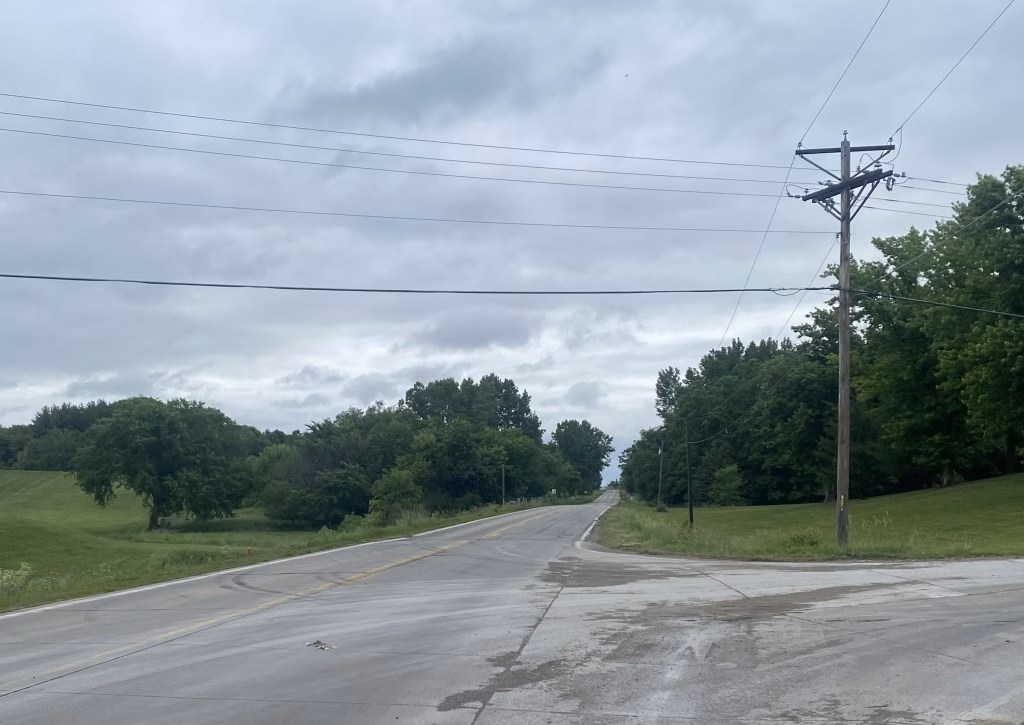
He explained that the section of Pleasant Plain Road from 167th Street south to the city was completed in 2011, while the section from 167th Street north was redone in 2019 — making the southern stretch about 10 years older and the logical place to start when the road began showing signs of deterioration. The road began showing wheel-path cracking and transverse joint cracking, prompting the county to act. “The idea is to get a layer of binder, bitumen, asphalt oil onto that surface to help fill in all those little micro cracks that are developing in that asphalt pavement caused by Iowa’s weather — the wind, the rain, the cold weather — and protect that and seal it off so it doesn’t deteriorate further,” Heintz said. “My mistake was to try and make that not look like a chip seal by putting another layer over the top of it. Had I left it alone with just a chip seal it wouldn’t have been black, but we wouldn’t have had the issues that we had.”
Heintz was candid that if the county had done Pleasant Plain Road before 110th Street, it would be the 110th Street residents in the room complaining instead. “We chose to do that first just to get those folks out of the dust,” he said. “Not realizing that we would have the issues we had with the rainstorms that came through.”
Heintz stressed that chip sealing is a surface treatment designed to extend the life of an asphalt pavement from 20 years to upwards of 50 — but acknowledged the process is not always smooth and that the county’s recent experiments with a different formula have had mixed results.
“You do have the issues with chip seal having some thrown rock and some bleeding,” Heintz said. “We tried something different on 110th, Pleasant Plain Road, and over in Lockridge with varying degrees of success. Because of the weather conditions, what we did on 110th worked fairly well. Pleasant Plain Road we ended up, as you guys are aware, with a rainstorm that saturated the material and made a holy mess. And we’re still trying to fix it. We’re getting close, but it’s not a smooth process, it’s not a pretty process. But it’s dealing with what we have and trying to make it better.”
He also addressed the Lockridge project, where the original design came in almost double the estimate. “Over in Lockridge, we’d originally designed that project for a sub-drain and overlay along with shoulders, and the project came in almost double what our estimate was. It would have cost the city of Lockridge $90,000, and I think it would have cost the county almost a million. What we ended up doing there cost the county $400,000, so it saved Lockridge $90,000 and saved the county $600,000. But it isn’t a complete solution, and it needs ongoing maintenance. It’s not what anybody wants, but it’s what fits in our budget. We have 175 miles of pavement to maintain, and an overlay every 20 years just is not in the fiscal cards. We’ll keep applying for grants, and we’ll keep working to maintain a safe road system.”
The county has tried multiple approaches to manage the road safely during repair work, including lowering the speed limit to 45 miles per hour. “In the past, we’ve tried using flaggers and using stop lights, and I think the traveling public is pretty well over that project,” Heintz said. “They were not honoring the stop lights, so we put flaggers on with the stop lights, and the flaggers were getting a lot of verbal abuse from the traveling public, so we decided to try a slow-moving vehicle mobile setup, and it worked to some extent, but it wasn’t as successful as we hoped it would be, and it resulted in an accident.” The most recent sand application appears to have helped seal off the bleeding pavement, but Heintz warned that if temperatures reach the high 90s or close to 100 degrees again this summer, he will have no choice but to close segments of the road entirely. “I’ll have to keep an eye on the forecast and notify Cambridge that we’ll be closing segments of the road completely to traffic while our crews are working out there for the safety of the traveling public and the safety of our crews,” he said.
Dimmitt added broader context on the county’s financial constraints. “When we did that overlay in 2011, it was a million dollars. I know people are tired of hearing it, but today that same overlay would cost us over four million. It’s just not there, it’s not feasible for us to do that. It’s nobody’s fault, it’s just a simple statement of fact.”
Supervisor Drish said she drove the road three times the previous Thursday to assess conditions firsthand and noted that even traveling at 43 miles per hour, several people passed her. “I found the road to be very drivable, but then I wasn’t driving it the night before when all the dust and the sand and the rocks were coming up,” she said. “I realize this has been an ongoing headache for everybody in the room.” She acknowledged the county’s efforts have not gone as planned but said she believes the county is genuinely trying. “I think we’re trying to get this right. Probably there were issues and speed bumps along the way — no pun intended. I’m very concerned with safety. I don’t think anybody in the room wants a non-safe road, but I do believe we’re trying. We don’t have all the funds to do it the right way. I wish we did.”
Public Comments
Supervisor Drish acknowledged the room’s purpose before public comments began. “Raise your hand if you’re here for Pleasant Plain Road,” she said, surveying the packed room. More than half of the room had a raised hand.
Phil Myers, who lives on Pleasant Plain Road at the end of the section that was redone, was the first to speak. He questioned why that particular section was chosen for the chip seal given the heavy volume of Cambridge and farm-to-market traffic. Heintz explained the southern stretch was about 10 years older than the northern section and had been showing wheel-path cracking, making it the logical place to start. Myers also pressed Heintz on the timeline for a permanent fix, and Heintz was direct: there is no set schedule. “I anticipate we’re going to have another bout of warm weather sometime in August because it’s Iowa,” Heintz said. “When we do that, we will shut down sections of the road, notify you in advance, and do it under a closed road so we don’t have traffic. I won’t promise you perfect, but I promise you we’ll do the best we can.”
Myers also raised concerns about what happened when crews were sweeping excess loose material off the road surface after the chip seal. “As far as the material that you were brooming back off of the surface — and I wish we had a video of it — the sprayers won’t even get over it. The tractors won’t get over it on the shoulder because there’s two inches of loose material,” Myers said. “So then the next thing you know these big farm equipment is taking up more than just a lane.” Heintz said he was not sure why farm equipment would not move to the shoulder, noting that he drives on the shoulder himself every single day to check conditions. “One wheel on the shoulder, one wheel on the pavement just to see how it rides. I do the same thing on my way home as long as there’s not anybody behind me,” he said. “So if the ag tractors aren’t moving over, that’s on them. I’m sorry, we can’t control that.” Myers also pointed out a specific section of shoulder that still has an unresolved dip — a contractor was supposed to return and fix it but called two weeks after the chip seal was done asking if the county still wanted the work completed. Heintz acknowledged it.
Jodi Stoltz said her daughter got married the weekend just after the initial chip seal was applied in June 2025, and family members traveling the road back to Virginia had materials embedded in their vehicles and received no reimbursement from the county despite following up. Dimmitt said the county would look into ensuring she was reimbursed. Stoltz went on to address safety, noting that she has videos on her phone of the dust conditions that she said people could barely see through. “The main thing is the safety. It’s dangerous right now, and people are not driving the speed limit. There have been many close calls. It needs to be controlled a little bit better when they’re working on it.” She added that she and others who live on the road have been respecting the road crews and following the rules — waiting their turn and not passing — but that not everyone is doing the same. “The ones of us who live there have been respecting them and waiting our turn. But now that they keep coming out working on it, it’s still an issue, and it’s still dangerous.” She also noted that her property taxes should count for something. “We moved out there with the road conditions the way they were when we bought a home. And now it feels like we’re not driving on the road.”
Dimmitt said he called Jefferson County Sheriff Bart Richmond on Thursday morning to ask if deputies could be sent to the road. “Sometimes the presence — not necessarily having to write a ticket, but just the presence — if somebody sees them, they slow down,” he said. “Our road crews have a right to feel safe as well when they’re out there working.” A review of Jefferson County Sheriff’s Office and Fairfield Police Department logs from Friday through Sunday shows no traffic stops were made on Pleasant Plain Road during that period.
Pam Deutsch, who grew up on Pleasant Plain Road, said the road was in good condition before the chip seal and now reminds her of her childhood when it was gravel. “We’re bringing prospective financial professionals, and Cambridge is bringing all this revenue to town on a gravel road,” she said. “It just looks bad. I’d like to know how much we spent fixing the mistake.” Heintz said he would bring that figure to the board the following week.
Diane Van Winkle said she had to turn her headlights on to drive through the dust last week and warned that the road becomes slippery when wet. “You hydroplane, and it’s not a safe road when it rains,” she said. “The Pleasant Plain Road is dangerous.”
Dimmitt asked Heintz whether the county could access a DOT safety grant to help address the situation. Heintz said the options are fairly limited — paved shoulders and centerline rumble strips — but said he would look into whether anything else might qualify.
Supervisor Joe Ledger closed the discussion by asking for patience and understanding. “How many people in this room have never made a mistake?” Ledger asked. “We made a mistake there, and we’re trying to correct it. Everybody who has made a mistake, they try to do the right thing. People just need to understand. It’s disheartening the way things have gone, the way people have treated our county employees. I’m sorry, but I wouldn’t put up with it. We’re trying to do something that will make everybody happy, but apparently there are some people we can’t make happy.”
A Pleasant Plain resident pushed back on Ledger’s comments, saying she was also frustrated by what felt like contradictory messages from the county — earlier in the meeting officials had suggested the road was almost done, yet when pressed on a timeline, Heintz acknowledged there was no set schedule. “I’m a little offended that you are upset that people are upset,” she said. “If you drove that road every day a couple times a day like others, I think you would understand as well. It really, from my perspective, seems like it’s been a really long time since this has been going on.” Ledger responded that he was simply asking for respect toward county employees who had been verbally abused while working on the road. She acknowledged the abuse was wrong but said the frustration stems from how long the situation has continued. Heintz explained that mother nature is ultimately in control of the timeline. “If we have 85 degree weather from now through the end of the year, then we wouldn’t have to touch it,” he said. “If we get another hot spell, we may have to touch it. It really depends on how the pavement performs. I can’t tell you any more than that. I’m sorry.”
Supervisors urged residents to return if they have further concerns, and said the next steps for Pleasant Plain Road will largely depend on what Iowa’s weather brings — with the county closely monitoring conditions and ready to act if another stretch of high heat forces them back out onto the road.