




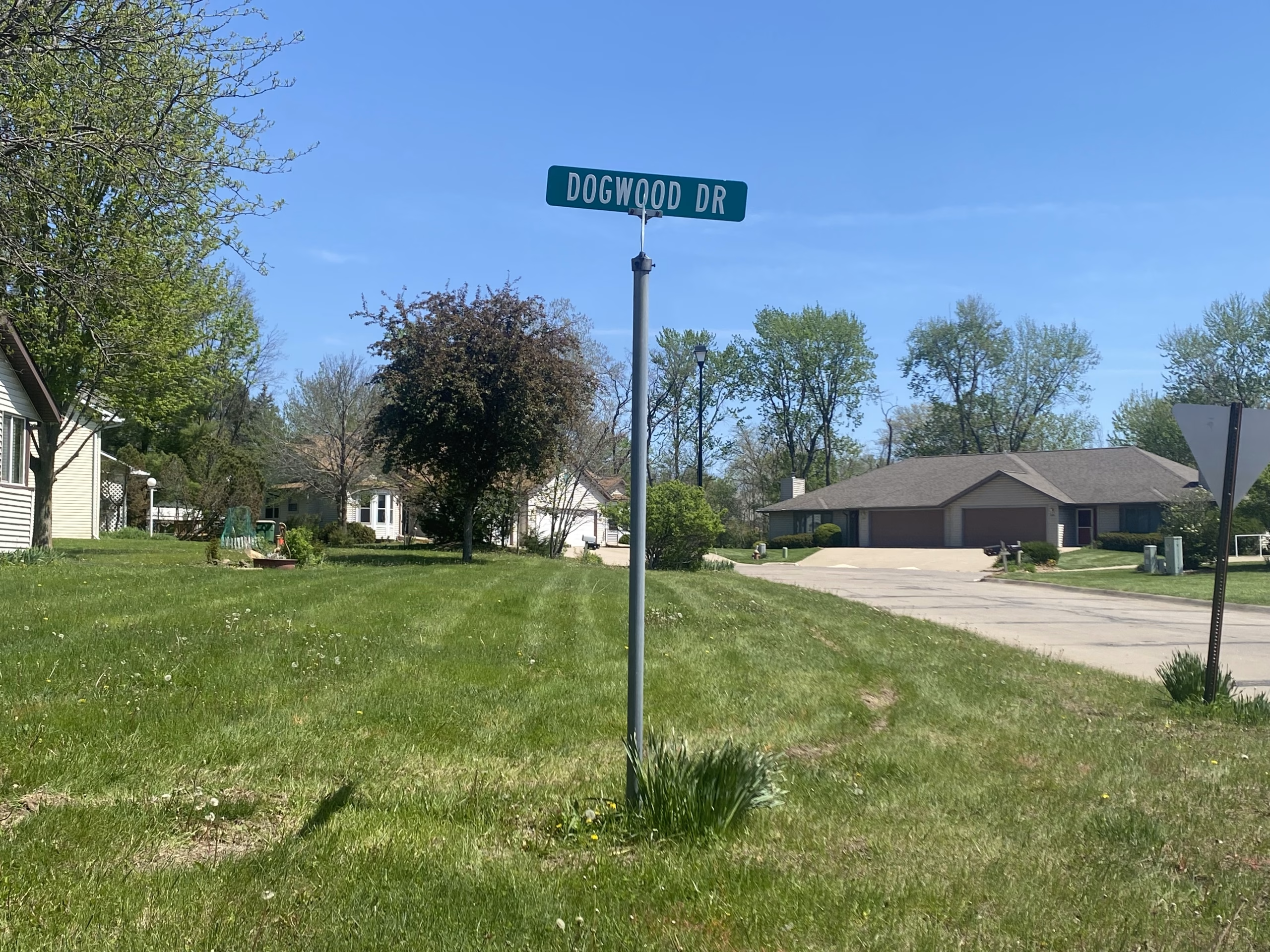
The proposal to use Jefferson County opioid settlement funds to establish a recovery house on Dogwood Drive in Fairfield appears to be off the table — at least for now — after the organization behind it withdrew its application following news coverage of the plan. Dogwood Drive residents packed the Jefferson County Board of Supervisors meeting Monday, April 27th to express their concerns, and were met with supervisors who largely agreed with them.
Supervisor Susie Drish opened the discussion by asking to move the opioid topic to the top of the agenda, noting the audience that had gathered. “I’m pretty sure that’s why we have the audience today,” she said. Drish then informed the crowd that the proposal had been formally withdrawn. “Last Friday, Elizabeth and I both got an email from the lady that had been coming to visit us,” Drish said. “At this time, they are withdrawing their application this month, at this time. I don’t for sure know what that means, other than they’re not going to do it now.”


Background
As reported following the April 20th meeting, the proposal came from Elevate Housing Foundation, a Waterloo-based organization that had been meeting with the county’s opioid committee over a period of several months with different proposals for how Jefferson County’s approximately $250,000 in unencumbered opioid settlement funds might be used. The most recent proposal involved a five-bedroom house on Dogwood Drive priced at $318,000, with an estimated $15,000 per bedroom in remodeling costs, intended to house up to 15 individuals transitioning out of treatment or incarceration. The proposal drew questions from all three supervisors about location, liability, oversight, and regional fairness before the board agreed to keep the conversation going at a future meeting.
Drish explained the sequence of events that led to the withdrawal. “Three meetings ago, a young lady came to visit with the opioid committee about this idea,” she said. “They were looking at a church on West Jefferson at that point. Then the second meeting, they were looking at a place in Vedic City. Sitting at the third meeting, which was the last meeting we had, they were looking at this house on Dogwood. That’s really as far as it got.” Drish added that the withdrawal came as a direct result of the news coverage the proposal received after the April 20th meeting. “Due to the news coverage, they have decided to withdraw at this time,” she said.
Drish acknowledged being personally supportive of helping people in recovery but said she has come to believe the opioid funds might be better used upstream. “I personally think with the opioid funds, it would be much better served trying to get younger kids before they become addicts,” she said.
Residents Speak Out
Tom Voorhees, a Dogwood Drive resident, was among those who came to speak and had pointed questions for the board. He noted that a Tenco house had already been placed on Dogwood Drive without neighbors being consulted, and said he was troubled that the Elevate proposal had advanced as far as it did without any outreach to the surrounding neighborhood. Tenco Industries is a nonprofit organization that provides employment and services for individuals with disabilities, and the Tenco house on Dogwood Drive is a residential facility connected to that operation.
“I’m concerned because we now have a Tenco house that’s on Dogwood Drive and none of the neighbors, none of the people around that were ever canvassed and asked their opinion as to whether or not they were in favor,” Voorhees said. “Obviously, this situation has gone to the point of finances, how much it’s going to cost for the house, how much it’s going to cost to repair the bedrooms, how much it’s going to impact the city in of itself. And we, the neighbors, have not been notified as well. Isn’t that considered a business? And we’re zoned residential?”
Another resident echoed the frustration, noting the neighborhood had been down this road before. “The Tenco house, some of us stood up against and it still happened. We really weren’t notified anything about that,” the resident said, underscoring a sense among neighbors that the community has repeatedly been left out of decisions that directly affect their street.
Voorhees also questioned the process for how city notifications work in situations like this, asking whether the city was responsible for alerting neighboring residents. Supervisor Lee Dimmitt said he did not know what the city’s specific policy requires in such cases. “I don’t know if there’s a requirement to do that,” Dimmitt said. “I don’t know what the city’s policy is.”
Voorhees also raised concerns about quality-of-life issues already being experienced with the existing Tenco house, including traffic, noise, and cigarette smoke. “Nobody’s done anything about the traffic right now. It’s the people that work there coming and going and they don’t necessarily respect the speed limits,” Voorhees said. “They take breaks, they’re smoking cigarettes out on the porch, they’re listening to their loud radio. There’s people on either side that don’t even want to open their windows to get any air in their house because of the noise and the smoke and the activity that’s coming and going all the time. It’s a residential neighborhood. We shouldn’t have that sort of thing in a residential neighborhood.”
Another resident offered a more personal perspective on why the location concerned her. “It’s a family area,” she said. “An area that’s filled with kids on scooters and bikes and close to two schools and has 400 trick-or-treaters every Halloween. And if you’re like me, you’ve had an ankle replaced, a shoulder replaced, and there’s Oxy in your cupboard because the doctor prescribed it and you maybe didn’t take it. Do I have to worry about locking my doors when I’m out in the yard because somebody might come in the back of the house and look through my medicine cabinet?”
Supervisor Joe Ledger acknowledged the residents’ concerns and agreed the process should have involved the city earlier. “It should have went to city council before anything else,” Ledger said. He suggested residents contact their elected city council representatives to ensure they are aware of the situation and to advocate for notification requirements in the future. “I suggest you contact your elected council. You can go to the city council or have a conversation with them,” he said. Ledger also offered what he called a devil’s advocate perspective on the courtesy side of the issue, noting he was not in favor of the proposal but raising a broader point. “Anytime somebody’s going to buy a house and put a house up for sale, they go talk to the neighbor before this person buys the house — just out of courtesy,” he said. “If you were going to buy a house in a neighborhood, you would go around and talk to all the neighbors, make sure they would accept you before you bought the house.”
Voorhees agreed and said the neighborhood simply wanted to be consulted before something like this moves forward. “Nobody here is prejudiced against helping those in need,” he said. “But we should be consulted.”
County Officials Weigh In
Supervisor Dimmitt was direct in expressing his opposition to the Dogwood Drive location specifically, citing zoning concerns, proximity to schools, property values, and the potential for residents with criminal histories to be living near an elementary school and a middle school.
“The location is just wrong,” Dimmitt said. “I don’t think any of us sitting here ever really gave it much serious thought as far as ever appropriating funds for that purpose.” He elaborated on the zoning issues, saying that converting a single-family dwelling into a facility housing 15 residents would effectively make it a multi-residential commercial venture requiring a variance. “If I was on planning and zoning, I would think that we’re taking a single family dwelling and we’re converting it to a multi-residential,” Dimmitt said. “And then on top of that, the number we heard was for 15 residents. I don’t know how that would cluster regarding the zoning.” He added that property values were also a concern.
Dimmitt also raised the proximity to schools repeatedly throughout the discussion. “Next to a school — that’s a big deal in my eyes. Two schools. Middle school and Pence,” he said. “I would hope that everybody would be able to recover. But the reality of the situation is that’s not always the case. And what kind of traffic are you going to potentially have there? One individual slips or whatever the case may be. It’s not a good fit.” When a neighbor called him about the proposal, Dimmitt said his position was unambiguous. “It’s a hard no,” he said.
Assistant Jefferson County Attorney Ed Kelly added another dimension to the location concerns, noting that many individuals coming out of halfway houses have prior criminal records that legally prohibit them from living within a certain distance of a school. “Many of the people that come out of halfway houses will have a criminal history and some prior crimes forbid being within a certain area close to a school,” Kelly said. “Which that would be another item you should probably bring up. It makes that place less suitable.”
On the broader zoning question, Kelly advised residents to stay vigilant and consult legal counsel if needed. “The zoning rules should be read carefully,” he said. “There are niches in those when you read it. Do keep your guard up.” He also referenced a case from the late 1970s or early 1980s in which a neighborhood attempted to stop a nursing home from being built in a residential area, noting that despite legal efforts, the project complied with zoning rules and moved forward — a cautionary example of why zoning laws matter and why residents should understand their rights early.
Dimmitt noted that the city does have a representative on the opioid committee and was therefore aware at some level that a request was being considered. However, he said the proposal never advanced far enough to trigger any formal city involvement. “There was a possibility of the request, but it didn’t get to the point where they had to make a decision regarding planning and zoning and the rest of it,” he said. He also pointed out that even if the county had been inclined to fund the project, the amount available would not have covered the full cost. “If we would have appropriated the funds, they would have had to have found the dollar somewhere else. The amount of funds that we could appropriate would not have been enough to cover the cost,” he said.
Dimmitt also addressed why he personally had never been on board with the Dogwood Drive proposal, referencing his role at Jackson Point housing. “I, along with Shawn Morrissey and Gina Edwards, we oversee Jackson Point. And there was talk about putting folks there. And that absolutely would not work because some of our residents have special needs,” he said. “I don’t think any of us sitting here ever really gave it much serious thought as far as ever appropriating funds for that purpose. The location is just wrong.”
Drish pushed back gently on any suggestion that the supervisors had been driving the proposal. “Please don’t think it was us, the Supervisors, that wanted to put that down,” she told one resident. “It kind of morphed on its own from the people who wanted it.” She also credited the press coverage with getting the word out to the community, saying she was glad the story was reported. “I’m glad A.J. was here because that’s how the word got out because you need to know what’s going on,” she said.
Both Drish and Dimmitt shared personal experiences that informed their cautious approach to the broader issue of addiction recovery. Drish noted that she has seen firsthand how long the recovery process can take. “I know how hard it is to get somebody that’s been in trouble with whatever, specifically drugs, to look better. It takes years. It doesn’t just take going to one halfway house or one center,” she said. “To think somebody could wave a magic wand and do this one time and make it work, I’ve really never seen that.” Dimmitt said he lost a nephew to addiction after the man had been released from prison. “I lost a nephew who actually was in prison for a year. And he wasn’t out very long,” he said. “I agree, it’s just — being next to a school, even that in and of itself is problematic.”
Voorhees closed his remarks by asking the board to recommend that the city adopt a policy requiring neighborhood notification before any similar proposal is considered in the future. “We should be notified before anything goes through,” he said. “We actually should be notified. It’s going to be in my neighborhood.” Dimmitt directed residents to the city’s planning and zoning process, saying that if anything similar were to come forward again, it would likely need to go through planning and zoning before reaching the city council. “If you want to make sure that you have your eyes open for anything on the agenda for planning and zoning in that nature,” he advised.
As of Monday’s meeting, no vote on the use of opioid funds for any housing proposal has taken place. The next regularly scheduled opioid committee meeting remains on the calendar for Tuesday, May 12th at 9:00 a.m., though the Elevate proposal is no longer on the table.