


Listen to Introduction below:
Nearly two decades after the death of 19-year-old Cecil Travis Gaddy, his family is still searching for answers surrounding what they believe was not a tragic accident, but a homicide hidden by fire.


Cecil Gaddy lived independently despite being paralyzed from the waist down following a devastating rollover crash as a teenager. Known for his determination, he worked as a farm hand, repaired small engines, taught himself to play guitar, and frequently helped others with computer problems. Friends and family say he was proud of his independence and meticulous about caring for his home at 315 E. Shaw Street in Osceola.
In the weeks leading up to his death, that independence appeared to be under threat. Gaddy told his sister, Alicia Gaddy, that people he considered “friends” were pressuring him to allow a methamphetamine lab to be set up inside his home. He told her he refused, cut them off financially, and stopped giving them access to his prescribed pain medication. He also told her he was afraid.
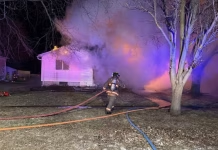
Less than a week later, on Saturday, January 31, 2004, Osceola fire crews responded to a report of a house fire at Gaddy’s residence. Inside a back bedroom, responders found Gaddy deceased, lying face down on his bed.
Investigators initially ruled the death an accident caused by the fire. However, findings from the State Fire Marshal’s Office raised immediate and troubling questions.
The fire was determined to have started on a living room sofa, yet Gaddy’s body was found in a bedroom. More concerning, Gaddy’s wheelchair — essential for any movement — was discovered outside the home, sitting in approximately eight inches of snow, several feet from a house equipped with a wheelchair ramp.
Fire Marshal Investigator David Linkletter documented the wheelchair’s location and noted the deep snow surrounding the home. Family members questioned how Gaddy, paralyzed from the waist down, could have exited the house without his wheelchair, crossed a snow-covered yard, and reentered the home. They also questioned why the wheelchair would be left outside if someone had taken him out and later returned him.
The death certificate listed Gaddy’s immediate cause of death as “total body burns,” with no mention of smoke inhalation. The estimated interval between onset and death was recorded as “minutes.” Autopsy findings were reportedly not available at the time the cause of death was certified.
Despite these inconsistencies, Clarke County authorities classified the death as accidental the same day, and no criminal investigation was pursued. Officials later acknowledged they were never able to determine the cause of the fire.
In a 2011 interview with Channel 13, Osceola Police Chief Marty Duffus — who was not with the department at the time of the incident — said the wheelchair’s location raised the same questions for him but noted that too much time had passed to recover meaningful evidence unless new information surfaced.
Alicia Gaddy told reporters she raised concerns of arson from the moment she arrived at the scene. She described the individuals who frequented her brother’s home as exploitative and said Cecil felt isolated and taken advantage of in the final weeks of his life.
The State Fire Marshal’s Office confirmed it spent approximately three months investigating the fire. A spokesperson later said the case could be reopened if new, credible information comes forward. The lead investigator reportedly struggled to explain the wheelchair’s presence in the front yard.
Today, the home where Cecil Gaddy died no longer stands. The lot sits empty, serving as storage for a pair of boats — a quiet reminder of a life lost and questions left unanswered.
Cecil Travis Gaddy was born April 8, 1984, in Des Moines and raised in Murray, Iowa. He attended church in Murray and cherished time spent with his niece and nephews. Family members describe him as kind, talented, and deeply loyal to those he loved.
Anyone with information regarding the death of Cecil Travis Gaddy is urged to contact the Iowa Division of Criminal Investigation or the Iowa State Fire Marshal’s Office. His family continues to hope that one day, the truth about what happened inside that house will finally come to light.