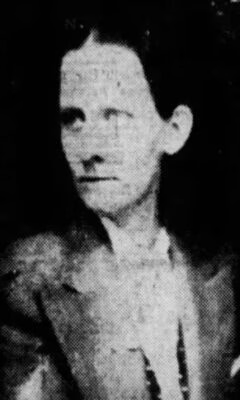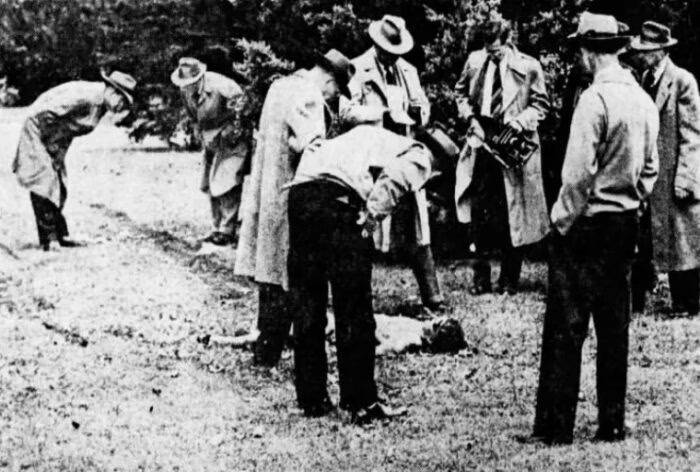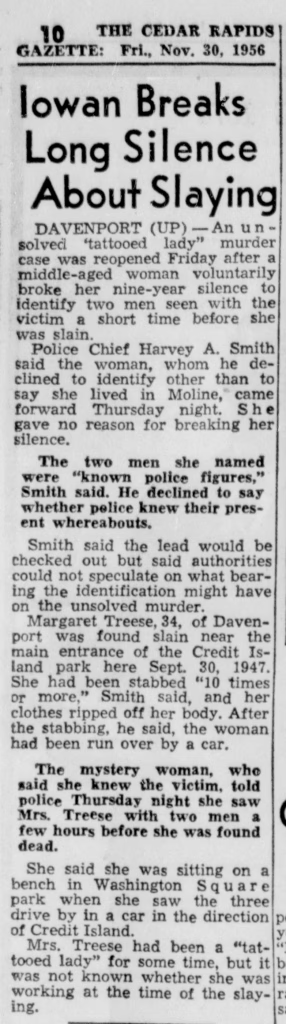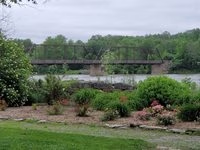






On the morning of September 30, 1947, the quiet routine at Credit Island Park in Davenport, Iowa, was shattered by a gruesome discovery. Two city park employees, Howard Whitlock and Orville Crow, arrived for work shortly before 8 a.m. when they found the body of a woman near the park’s main entrance. The victim was later identified as 34-year-old Margaret Beatrice “Peggy” Treese, a war widow who had been living in Davenport for several months.
Treese’s nude and badly mutilated body was found lying face up, with pieces of her clothing scattered around the scene. Near her body, investigators found a battered photograph of a young child—a haunting reminder of the life she once lived.


According to the coroner’s report, Treese had suffered multiple stab wounds to the chest, and her body had been run over several times by a vehicle. News reports at the time varied, with different publications citing anywhere from 10 to 19 stab wounds. The brutality of the murder shocked the community and drew national attention.
What made the case stand out even more were the tattoos that covered Treese’s body, leading the press to call it “The Tattoo Murder Case.” Her tattoos told pieces of her life story—some personal, some mysterious. Among them were the name “Stanley” with the words “true love” beneath it, a large cross reading “Rock of Ages,” and a snake with bared fangs. There were also markings that resembled a Social Security number and inscriptions such as “Bill and Ezzie.”
Police Chief Reed Phillips identified Treese through a man named Clarence Saunders, who said he had last seen her the night before her death. Saunders told investigators that he and Treese had shared a hotel room, but that she went out later with other men. He also mentioned that Treese had been working part-time in a local laundry since moving to Davenport in May.
Records from West Virginia revealed that Treese had been widowed during World War II when her first husband, Elmer G. Treese, was killed in action. She later married Stanley Dombkiewicz in 1945, though the marriage ended shortly after due to personal conflicts. Dombkiewicz confirmed to authorities that his name was among those tattooed on her body.
Investigators traced Treese’s last known movements to several taverns along Davenport’s skid row, where she was seen drinking heavily on the night of September 29. Around 12:30 a.m., witnesses reported seeing her leave one of the taverns with three unidentified men. She was never seen alive again.
Over the years, police interviewed hundreds of people, and more than a dozen individuals came forward to confess—but every confession turned out to be false. In 1951, a man named William Alfred Brinkley claimed involvement in Treese’s death, but inconsistencies in his story quickly ruled him out.
Nearly a decade after the murder, a woman from Moline, Illinois, came forward with new information. She told police she had seen Treese in a car with two men—both “known police figures”—heading toward Credit Island shortly before the murder. Despite this lead, the case went cold once again, and no arrests were ever made.
Margaret Beatrice Martin Treese was born on February 7, 1913, in Steubenville, Ohio, and raised in a large family with six siblings. Her life took her from Ohio to West Virginia and eventually to Iowa, where it ended in tragedy.
She was laid to rest on October 3, 1947, in New Cumberland Cemetery in Hancock County, West Virginia.
More than 75 years later, the murder of Margaret “Peggy” Treese remains one of Davenport’s oldest unsolved cases—a mystery forever marked by the inked symbols on her skin and the silence that followed her death.