



A Des Moines attorney is fighting the state’s efforts to revoke her law license for a series of alleged ethics violations.
Last July, the Grievance Commission of the Iowa Supreme Court recommended the court revoke the law license of attorney Valerie Cramer. The commission alleged Cramer had accused “judges and court reporters and the rest of the judiciary of the worst kind of corruption,” and had intentionally misled the courts and other counsel while “taking advantage of vulnerable and unsophisticated clients.”


The panel alleged Cramer was “a danger to the public,” lacked a basic understanding of the law and was “basically fleecing” her clients through inflated legal bills while peddling an “outlandish conspiracy theory” about the judiciary.
The commission also alleged Cramer “does not have mental-capacity issues that might explain or excuse her behavior,” suggesting her actions were “entirely intentional and calculated,” and that her conduct was “layered with an utter lack of remorse or contrition.”
Cramer, who has been licensed to practice law in Iowa since 2003, has told the Iowa Capital Dispatch the commission’s findings are untrue, but has declined to elaborate.
The disciplinary case stems from a complaint filed by the Iowa Supreme Court Attorney Disciplinary Board in November 2024. That complaint, which became public last year after the Grievance Commission issued its findings in the matter, alleges numerous ethics violations related to Cramer’s competence, client trust accounts, billing for legal work, and false representations made to the court.
The disciplinary board has also questioned legal fees Cramer charged to clients, noting that she claimed to have spent several hours preparing and filing a series of single-page Iowa State Bar Association forms; to have spent almost half an hour reading a form that consisted of a single sentence; and to have spent 1.25 hours reading a single-paragraph motion.
At a hearing on Cramer’s requests for payment of the fees, a probate judge allegedly remarked, “Honestly, I am horrified by this billing situation, and I don’t say that lightly. I really don’t. This was a simple estate. With one complicated matter.”
Panel calls actions ‘abhorrent’ and ‘reprehensible’
After a probate judge called Cramer’s fee-related filings in a case “extremely troubling” and lacking credibility, Cramer filed an appeal and asserted that she had PTSD, and that the judge’s alleged yelling, scowling, raging and screaming had scared her. She also accused the judge of having his court reporter change the transcript of the proceedings.
The commission also cited Cramer’s actions in a probate case in which her client was an 18-year-old woman administering the estate of her grandmother who had raised her. The commission said it was “particularly bizarre” that Cramer refused to withdraw as the teen’s legal counsel, even after the young woman had hired a new attorney who appeared in court on her behalf.
Cramer “was going against her client’s wishes in order to pursue a self-serving agenda — collection of more attorneys’ fees,” the commission concluded. “When (Cramer) actively fought against her dismissal as counsel, her motive was a purely selfish one — her ongoing attempt to collect inflated fees.”
The commission called Cramer’s actions in that case “abhorrent” and “reprehensible,” adding that it was concerned that in her probate cases, Cramer “was basically fleecing these limited estates of all their assets and leaving the beneficiaries with next to nothing.”
The commission said it had no choice but to conclude that Cramer’s “preposterous” conspiracy theories about the judiciary and her “disparagement of the judiciary and its staff, her lying to attorney colleagues, and her attacks against her clients were all done on purpose.”
Last August, Cramer appealed the commission’s findings and recommendation of a license revocation, reasserting allegations of judicial bias and hostility that, she argued, had disrupted her law practice, denied her clients representation, and triggered disciplinary action.
“There is no evidence of pervasive ethical breaches or ongoing risk to the public,” she argued in court filings. “No client suffered harm, no funds were misappropriated, and no clear and convincing evidence established intentional dishonesty.”
The commission challenged that appeal, alleging Cramer had billed clients for time spent on a hearing she didn’t attend, had falsified exhibits, and had falsely claimed to be a certified public accountant. “These are just a few examples in a record frankly brimming with evidence of Cramer’s dishonesty and knowingly false statements,” the commission stated.
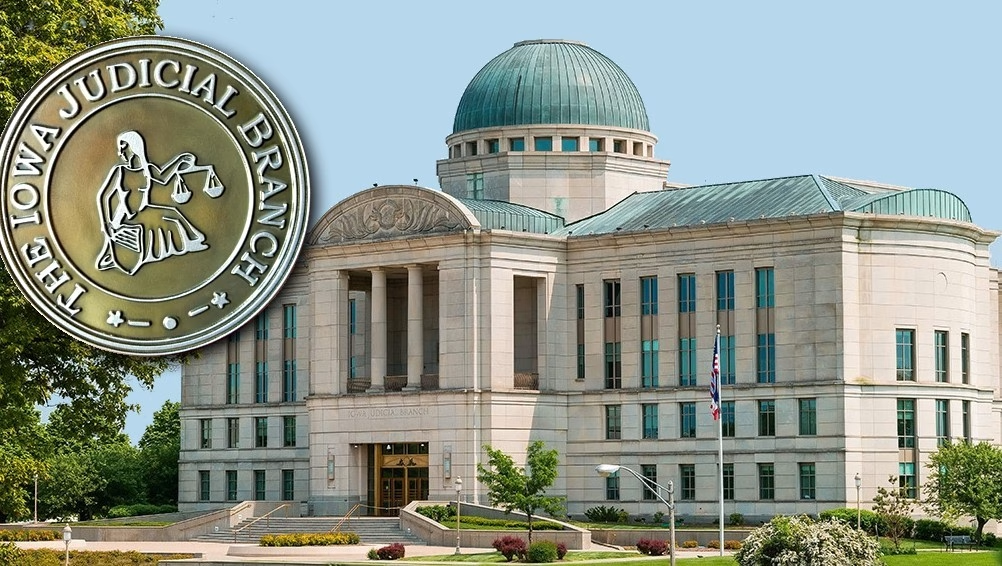
The Iowa Supreme Court heard oral arguments in the matter on Jan. 20, 2026. The court has yet to issue a decision on the commission’s recommendation of a license revocation.