



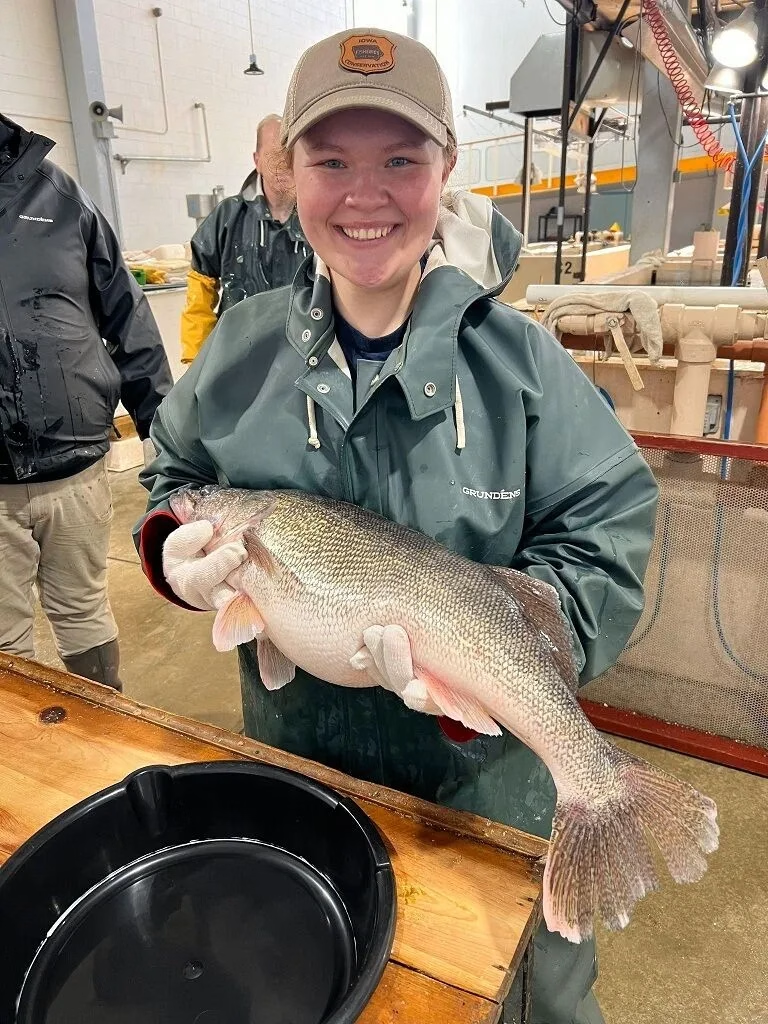
The Iowa Department of Natural Resources’ Rathbun Fish Hatchery plays an important role in maintaining and improving fishing opportunities throughout the state. Managed by Annika, the facility is the largest fish hatchery in Iowa and one of the largest Walleye hatcheries in the nation.
The Rathbun Fish Hatchery regularly produces and distributes six species of fish across Iowa: Walleye, Muskellunge, Paddlefish, Channel Catfish, Bluegill and Largemouth Bass.


Annika holds a Bachelor of Science degree in Fisheries and Water Resources, with a focus in Aquaculture, from the University of Wisconsin-Stevens Point. She has worked for the Iowa DNR for two years. Before becoming hatchery manager, she served on the Iowa DNR Fish Culture Research Team, where she worked to improve fish culture techniques throughout the hatchery system.
Her career has focused on raising fish for sportfish restoration and researching innovative aquaculture practices.
Behind the Scenes of Walleye Production
Producing Walleye at the Rathbun Fish Hatchery is a detailed and time-consuming process that begins with collecting spawning fish from Rathbun Lake.
Iowa DNR staff use gillnets to collect male and female Walleye and transport them to the hatchery. Once there, staff carefully check the females to determine whether they are ready to release their eggs.
When the females are ripe, hatchery employees gently express the eggs into a pan. Milt, previously collected from male fish, is then added along with water to begin fertilization.
The addition of water opens a fertilization window lasting approximately three minutes. During that time, staff gently agitate the mixture to help the sperm fertilize the eggs.
Following fertilization, the eggs undergo a process known as “mudding.” Staff place the eggs into a specialty mud solution to reduce their natural stickiness. This is important because fish eggs are naturally adhesive, allowing them to attach to rocks and vegetation in their natural environment.
The eggs are then placed in mesh trays with fresh, flowing water for approximately four hours. This process, called water hardening, allows the eggs to absorb water, expand and become more rigid, helping protect developing embryos from minor handling damage.
After water hardening, the eggs are transferred into incubators, where they continue developing in fresh, flowing water for approximately two weeks before hatching.
From Eggs to Stocked Fish
Once the eggs hatch, they produce tiny fish known as fry. At this early larval stage, Walleye measure approximately 8 to 9 millimeters in length.
In 2025, the Rathbun Fish Hatchery stocked 67.4 million Walleye fry throughout Iowa.
The hatchery also retained 662,500 fry to raise to larger sizes. These fish were intended to be stocked as fingerlings in May and advanced fingerlings in October and November.
The work taking place at Rathbun Fish Hatchery helps support Iowa’s fisheries and provides opportunities for anglers across the state. From collecting spawning fish to raising millions of young Walleye, the hatchery’s efforts are an important part of maintaining healthy fish populations and supporting recreational fishing in Iowa.