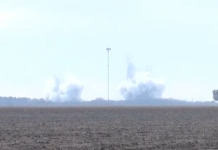





The military detonated nearly five tons of unstable hazardous material at the Iowa Army Ammunition Plant in southeast Iowa shortly after nine o’clock this morning.
Two hours later Major General Eric Shirley, commander of the operation, said it appears the soil, water and foam infrastructure recently built around the two bunkers contained the lead azide threat.”I would characterize the controlled detonation as exceeding expectations,” Shirley said. “…I believe absolutely that we reduced as close to zero as is absolutely humanly possible the risk to health and safety of the people of Middletown and the extended communities throughout Iowa.”


Shirley spoke during a five-minute video briefing organized by the Army. Shirley indicated there were no secondary explosions and there was no infrastructure damage in or around the Iowa Army Ammunition Plant campus. “The mister systems that were employed continued to operate throughout the detonation,” he said. “There was some visible signature. I attribute most of that to the aqueous foam that we applied. Over 3600 gallons of that material was delivered by fire trucks.”
Robert Cekada, director of the Bureau of Alcohol, Tobacco, Firearms and Explosives, said the detonation was well executed. “I absolutely can confirm that those mitigation efforts and the design plan…ensured that the blast drove the explosion into the ground and followed a blast shadow that was designed to go down the right path to minimize any sort of dispersion of lead into the atmosphere,” he said, “100% as planned.”
Observers outside the Iowa Army Ammunition Plant this morning heard — and some felt — two blasts, then two white plumes that looked like smoke rose hundreds of feet in the air. The EPA’s administrator told CNN air sensors had not detected any elevated levels of lead in the area. Cameron Hamilton, the head of FEMA, said more soil, air and water tests will be conducted in the coming days and weeks. “Stay tuned with your local public health officials and please stay tuned for more guidance and feedback from us,” he said.
Some of the lead azide that was destroyed today was over 80 years old. The material had been stockpiled in southeast Iowa since 2009.
A southeast Iowa farmer who lives about 30 miles from today’s blast site was sheltering in place with his family sheltered in place this morning. Jeff Ellis raises corn and soybeans near Donnellson. “Couldn’t see anything. There was no visual of any kind,” Ellis said. “You did hear a light rumble that almost sounded like thunder there that was the blast going off. Pretty unamazing I guess I would say.”
Ellis told Brownfield Ag News that EPA sampling crews were in his area before the detonation taking soil, air and water samples, but he hasn’t decided whether to conduct additional soil testing on his farm. “If the EPA and these agencies come up and say: ‘Nothing’s been detected, there’s nothing to worry about,’ I’m probably not going to pay for the lead-in-the-soil test.”
Ellis said someone should be held responsible for the mistakes that led to today’s detonation. “Why would something like that be stored this long and not be managed or taken care of a long time before right now?” he asked. “That’s a little irritating that they even have to put the public in this kind of a situation to worry about it.”
Governor Kim Reynolds issued a written statement this morning and referred to EPA’s “zero detection of airborne lead in the region.” She called it “the best-case scenario for residents of Middletown and surrounding communities.” The governor also commended the military for executing what she called a “flawless detonation.”
Governor-elect Rob Sand issued a statement, too, saying he’s “grateful to the experts on the ground who did all they could to make the detonation as safe as possible,” but Sand called the lead-up to today’s operation “chaotic” and he said Iowans deserve to know “how and why this situation (with lead azide stored at the Iowa Army Ammunition Plant) became what it did.”