



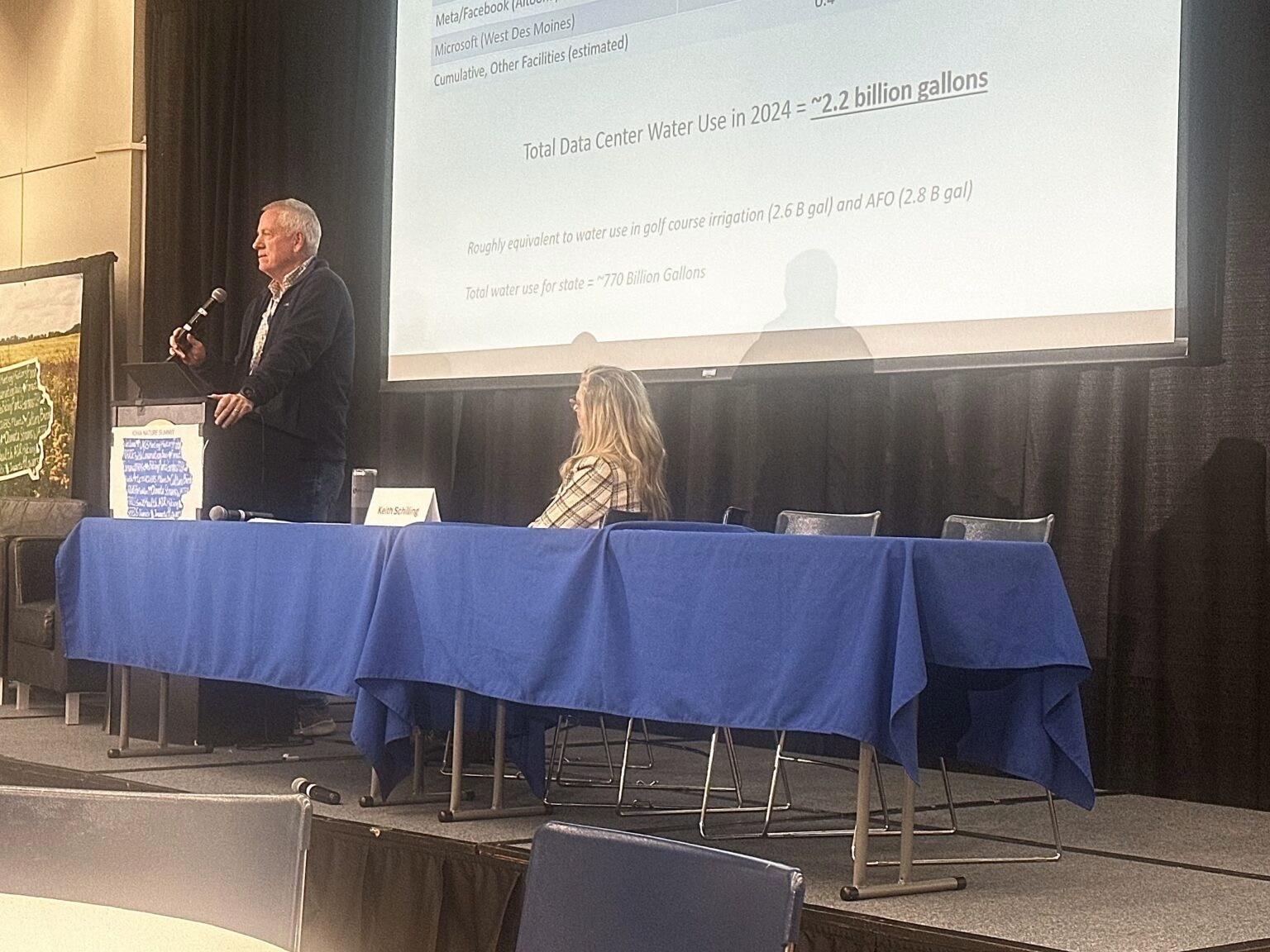
Data centers in Iowa currently have not had a huge impact on the state’s groundwater, but Iowa’s state geologist said Wednesday a more comprehensive groundwater monitoring network will be necessary if the state plans to have sustainable groundwater management while continuing to attract data centers and large users.
Iowa State Geologist Keith Schilling said the state currently has about 50 “very poorly distributed” groundwater monitoring wells. He said more wells, placed at strategic locations, would give the state baseline levels to help inform decisions on, and later evaluate the impact of, large water users like data centers.


“If we’re going to, again, be a state that encourages sustainable groundwater use for things like data centers or other large-scale users, what we need to do is get serious about getting a groundwater monitoring well network built,” Schilling said at the Iowa Nature Summit Wednesday.
Water use has been one of the top concerns among Iowans when it comes to data centers. As servers run at data centers to power things like artificial intelligence and online infrastructure, they generate heat. Part of the continuous operations at a data center includes cooling equipment.
According to Schilling, the cooling process accounts for 30% to 40% of a typical facility’s total energy consumption.
He explained most data centers have either open- or closed-loop systems. Open-loop systems commonly use evaporative technology, where they move water past their servers, the water absorbs the heat and a large portion of it ends up in the air via evaporation. A closed-loop system uses water, or a coolant like antifreeze, that is run through a heat exchanger and is able to stay within the system.
Schilling said he has seen instances where data centers describe their cooling systems as “closed loop” even though they are using evaporative technology.
Water sometimes comes from nearby rivers or ground wells, depending on the project. The Google data center operating in Council Bluffs withdrew 1.3 billion gallons of water in 2023, according to an environmental report from the company. Schilling said while that “sounds like a lot,” wells near the facility are the kinds of wells that are quickly replenished by the Missouri River.
“But note that groundwater is not available at high enough capacity in many areas of the state for this sort of intensive development,” Schilling said.
Other areas, like southern Iowa, have more confined water systems that are less easily recharged.
While many deep aquifers have lots of water, that water can be “tens of thousands, if not a million years old” meaning tapping the well is like a “one-time use” of that water.
“We’ve got to be really careful about using a deep aquifer like that for something like a data center or even ethanol plants,” Schilling said. “… That water is not coming back. It’s gone. It will never be seen again.”
A groundwater monitoring program
Schilling, who works with the Iowa Geological Survey, said researchers have come up with a plan for 92 groundwater monitoring wells, either in bedrock or sand gravel areas. This deployment, he said, would cost about $3 million and would occur over several years.
He said the wells would allow groundwater levels to be monitored over time, which would give counties or cities that are considering permitting a data center a better understanding of their groundwater resources and whether they could support a large user.
Iowa’s current monitoring network, of fewer than 50 wells, is significantly smaller than surrounding states that have several hundred groundwater monitoring wells, Schilling explained.
Iowa House lawmakers put forward a bill in the past legislative session to retrofit existing private wells, in a partnership with the geological survey and Iowa Department of Natural Resources, to expand groundwater well monitoring. The bill advanced to an appropriations committee but not to the full body.
“The best time to plant a tree was 50 years ago — or how about a monitoring well network?” Schilling said. “The time is now to start doing that because we’re going to have a lot of these issues start creeping up over the next handful of years, and we need to be ready to go.”