




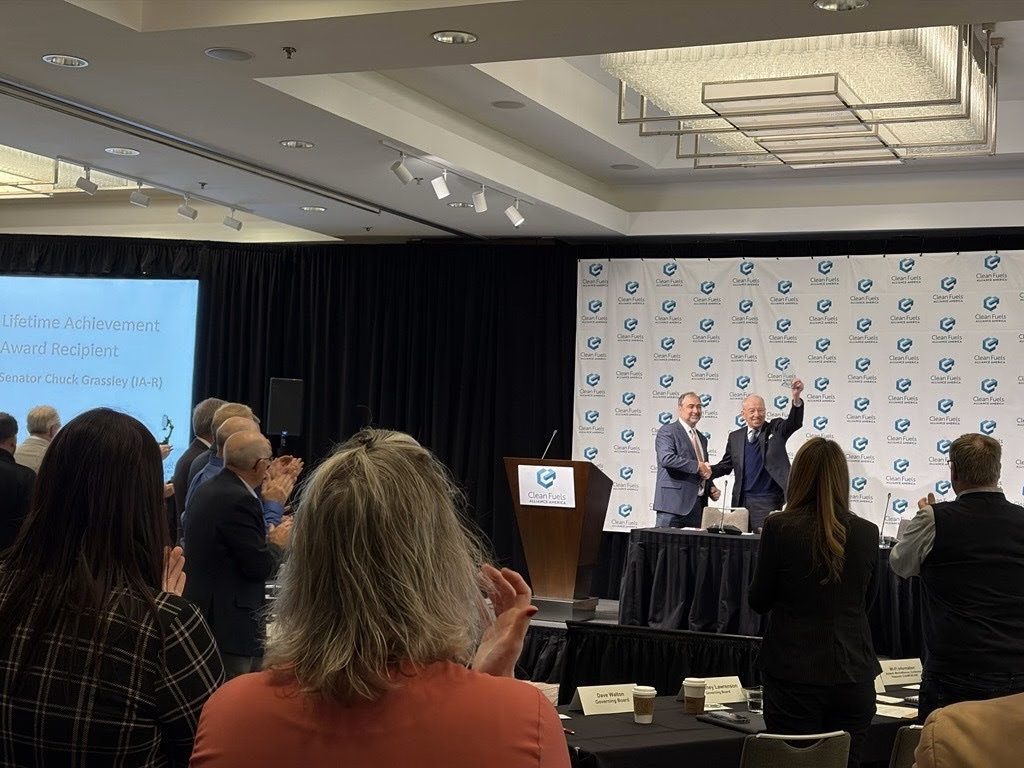
Sen. Chuck Grassley (R-Iowa), a lifelong corn and soybean farmer, accepted a Lifetime Achievement Award from Clean Fuels Alliance America for his work to expand market opportunities for biodiesel. Grassley is a former chairman and current member of the Senate Finance Committee.
“It’s quite an honor to be recognized for my leadership on behalf of American agriculture and biomass-based diesel. I’m proud of the success we’ve had over decades expanding market opportunities through tax policy and EPA volume obligations to maximize the outputs per bushel and keep up with innovation,” Grassley said. “I’ve long recognized the fight for renewable fuels is a boost for family farmers and rural communities. Iowans know this senator will never back down on issues important to rural America.”


“No single individual has done more to bring about supportive policies for the biodiesel and renewable diesel industry than Senator Grassley. I’m not overstating his impact when I say his leadership is why the industry grew from less than 100 million gallons in 2004 to over 5 billion gallons today,” said Kurt Kovarik, Vice President, Federal Affairs, Clean Fuels Alliance America.
Grassley delivered the following remarks upon receipt of the Lifetime Achievement Award:
I’m honored to be presented with a Lifetime Achievement Award recognizing my work expanding market opportunities for biomass-based diesel.
Farmers, of course, are independent-minded, hard workers that prefer markets over government assistance for their products.
That mindset is why I’ve championed tax and energy policies geared toward leveling the playing field between conventional fossil fuels and farm grown renewable fuels.
Since I spearheaded enactments of the first biodiesel tax credit in 2004 and the Renewable Fuel Standard (RFS) in 2005, the market for biofuels has grown by leaps and bounds.
According to Iowa State University, the production and sales of biodiesel tripled from 25 million gallons to 75 million gallons in the year following the enactment of the biodiesel tax credit. Following enactment of the RFS, production more than tripled between 2005 and 2006, reaching 250 million gallons.
This year, total biomass-based diesel production will exceed five billion gallons.
To ensure continued growth of the industry, I continue to ride herd for stable and predictable renewable fuel policies.
The Clean Fuels Production Credit, which has replaced the original biodiesel tax credit, was extended through 2029 by the Working Families Tax Cuts Act.
While I know the industry would have preferred a longer extension, many of you may recall years of fighting for a single year or two extensions – frequently on a retroactive basis.
The RFS has been a consistent market for farmers, a boon to rural communities and has fostered national energy security.
Last year’s Set 2 rule from the EPA created record renewable volume obligations under the RFS.
I look forward to protecting these levels through the ongoing reallocation rule and building on them in the Set 3 rule.
As farmers face headwinds from trade disruptions and high input costs, federal biofuels policies are growing critical markets for farmers.