



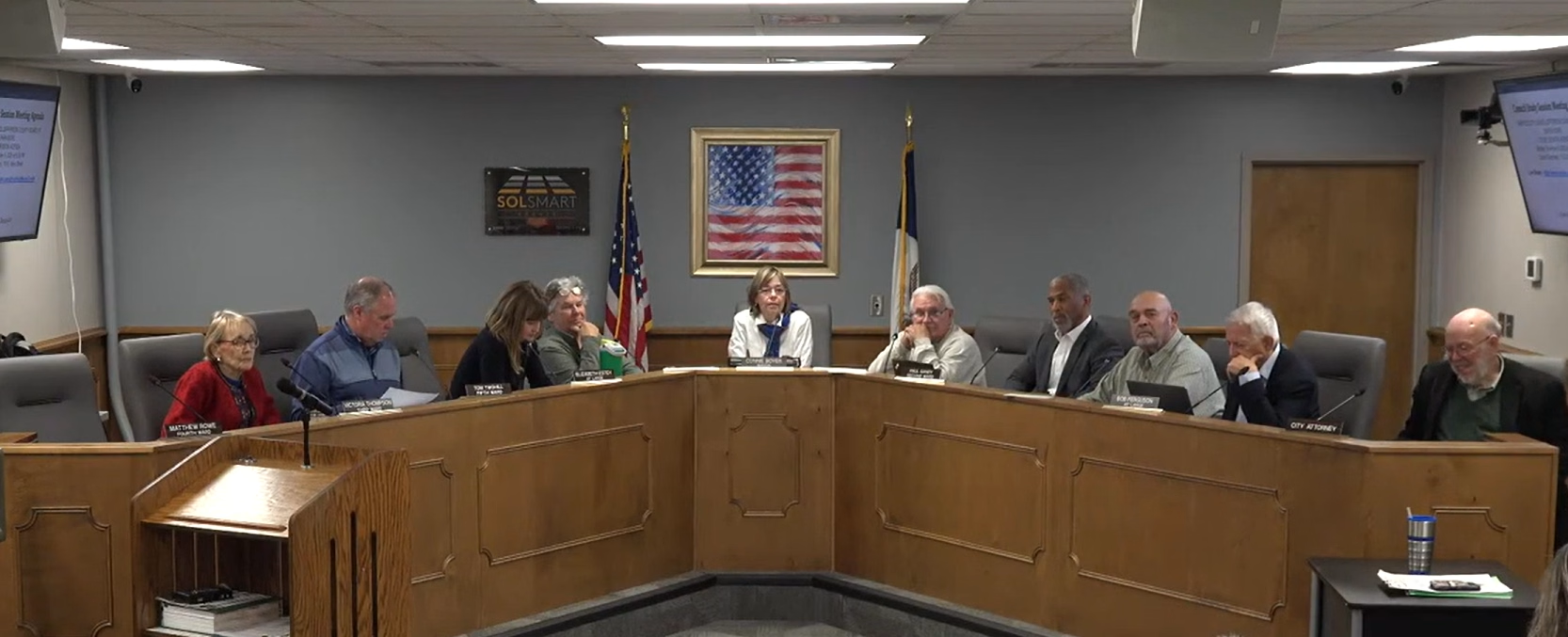
The Fairfield City Council and Jefferson County Board of Supervisors met jointly Monday evening on November 9th to discuss the dog issues happening in both the city and county, and they brought up building a shared animal impound facility — a move both bodies said could solve a long-running problem neither has been able to address on its own.
Community Service Officer Adam Melcher proposed the idea, which would place a small building — roughly 20-by-20 feet with four to eight dog runs — at the county roads department on North 8th Street on the northern edge of Fairfield. The site would have access to city sewer and water, reducing construction costs significantly. Melcher said connecting to city utilities would eliminate the need for a separate septic system, which would otherwise be required even for animal waste if the facility were built elsewhere in the county.


“I feel like the city and the county both have an equally persuasive problem that it’s not going to go away on its own,” Melcher said. “It seems like every year, year and a half we address it and then hope it goes away on its own, but it doesn’t.”
Melcher said he had spoken with Mayor Connie Boyer and City Administrator Doug Reinert about the concept before bringing it to the joint session. He estimated the facility could cost $20,000 to $40,000. He said cameras and automatic waterers could minimize staffing needs, noting state law requires only one daily check for food and water. The design would also include a state-mandated quarantine stall for dogs suspected of rabies exposure, which Iowa requires for a 10-day hold.
Melcher said the North 8th Street location would work well for both jurisdictions — centrally located and accessible to city and county officers alike. He noted noise would likely not be a major issue given the location as well.
A Problem Without a Solution
The lack of any such facility has left the city and county with few options when problem dogs are picked up. Melcher said he reached out to several neighboring counties, the local vet clinic, and multiple private shelters — and was turned away across the board. The Animal Rescue League of Iowa helped handle a 36-dog case in the county previously, but quoted roughly $1,000 per animal and declined to assist with four dogs in the most recent incident.
Shelters in Bloomfield and Fort Madison were mentioned as options, but City Attorney John Morrissey noted both have very limited capacity and rarely say yes. Private boarding facilities, Melcher explained, are licensed separately from stray animal facilities under state law — meaning a business that boards dogs legally cannot take in strays, and vice versa.
“We’re armless in a game of arms,” Melcher said. “Without having the ability to collect and hold and enforce, we’re just spinning our wheels.”
Melcher said the problem isn’t unique to Fairfield — it’s a nationwide issue. He noted that the first thing to go when people run out of money is care for animals they don’t have to have, and that dogs are expensive.
Melcher said the facility would not be intended for every dog that gets loose — a Pomeranian that slips out and runs home isn’t the scenario they’re trying to solve. It’s for persistent situations, like four dogs that kept running through neighborhoods and that no agency would take.
“I don’t think every Pomeranian that gets out and runs back home needs to be addressed,” Melcher said. “But if we have situations, we need to have an out.”
Boyer noted that dogs in packs can become more dangerous than a single loose animal, and that by the time police respond to a complaint the dogs may already be gone. She added that community peer pressure toward irresponsible owners also needs to be part of the solution. Melcher agreed, saying most loose dogs aren’t aggressive so much as rambunctious — but an 80-pound dog that knocks over a 5-year-old is still a problem.
Who Picks Up the Dog?
Council member Tom Twohill asked who would actually be responsible for transporting animals to the facility. Melcher said whichever officer — city or county — encounters the dog would handle transport, which is part of why the central location matters. Catch poles are inexpensive, and many loose dogs are not aggressive enough to require specialized equipment.
Council member Elizabeth Estey asked about accountability when ownership can’t be determined. Melcher said most dogs can eventually be tracked back to an owner through investigation, but that in some cases it becomes a police matter. Morrissey said the city’s existing ordinance doesn’t require much action after the hold period expires — euthanasia is typically the outcome for untagged, unvaccinated, or unclaimed dogs.
Costs and Enforcement
Council members pressed on how the city and county could recover costs from dog owners. Melcher said state code allows storage fees to be charged to owners who come to retrieve their animals, and citations of $150 or more can also be issued. Morrissey noted that fines can be placed as liens on a property, and that the city has previously obtained a $7,000 restitution judgment in a large-scale animal case.
If an owner shows up and refuses to pay, Morrissey said the city still has leverage — it knows who owns the dog, can issue the citation, and can pursue the lien. If the dog is never claimed, the city’s options after the state-mandated seven-day hold include euthanasia by a veterinarian or placement with a shelter willing to take the animal.
Morrissey noted the city’s existing ordinance already includes impounding powers, vicious animal classifications, and a provision for an animal control review board. He said the county, which currently has no dog licensing ordinance, might consider adopting at least some of those provisions, noting licensing can carry additional requirements that give authorities more tools when dealing with problem animals. He added that the city has usually prevailed when impounding powers have been challenged in court.
What About Cats?
Supervisor Joe Ledger raised the question of stray cats during the discussion. Melcher said shelters are generally more willing to take cats than dogs, and that community members who trap feral cats and get them fixed help keep the population in check. Cat complaints come up occasionally but are far less urgent than dog problems.
Morrissey noted, however, that cats shouldn’t be dismissed entirely. When the city adopted its roughly 10-page animal control ordinance 14 years ago, about a third of the audience that night wanted to talk about cats — including a suggestion for a cat leash law. The city didn’t go that far, but Morrissey recalled a past case in which a house was found to have around 28 cats, some dying in cupboards, with no place to take them either.
“Cats are going to show up once in a while in just exactly the same big numbers problem that we have with dogs,” Morrissey said. “I think sooner or later we’ll have another one of those big cases that everybody’s kind of bothered about.”
Moving Forward
Melcher acknowledged the facility wouldn’t solve every problem.
“This would not necessarily maybe solve all of our issues, but it’d be a dang good step in the right direction,” Melcher said.
Supervisors Joe Ledger and Susie Drish both expressed support for exploring the concept further. Drish said she wanted to be clear that the fault lies with irresponsible owners, not the dogs themselves.
“I think something like this as a joint venture would be really good,” Drish added.
Ledger said he was personally interested in moving forward.
“I know there is a problem out there and personally I’d be interested in moving forward and see what we can come up with,” Ledger said.
No formal action was taken. The meeting was described as exploratory — a chance for both bodies to gauge interest before committing to anything. Boyer asked Ledger and Melcher to tour the North 8th Street site together to get a better feel for what space is available. Both sides agreed to come back to the table at a future meeting once the supervisors have had a chance to discuss it further.