




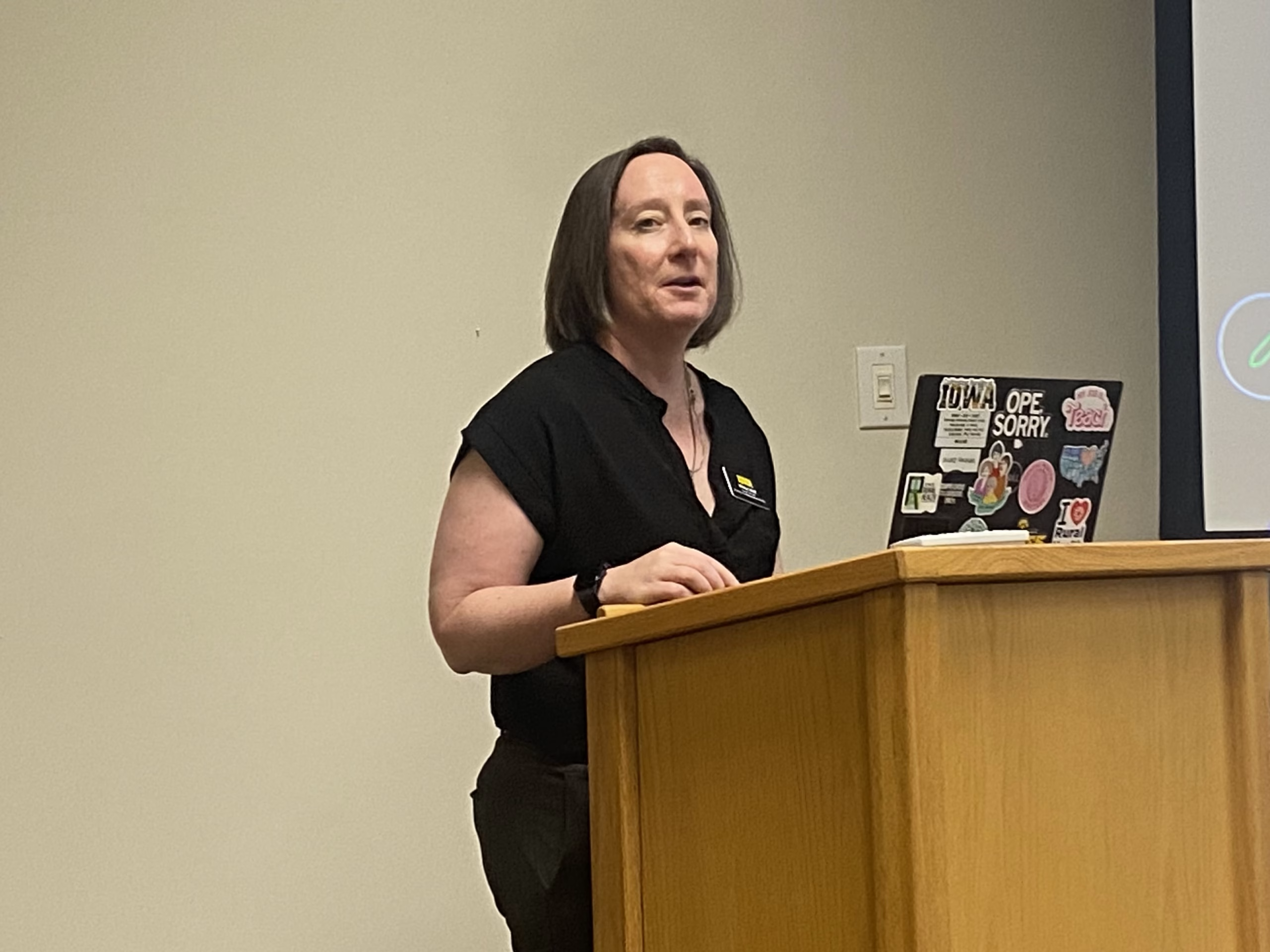
Jefferson County became the 61st of Iowa’s 99 counties to receive a county-specific cancer data presentation Monday evening, May 11th, as Whitney Zahnd, PhD, Assistant Professor at the University of Iowa College of Public Health, shared findings from the Iowa Cancer Registry’s 99 Counties Project at the Fairfield Public Library.
The event was organized by Jefferson County Public Health Administrator Chris Estle, who opened the evening with a candid acknowledgment of the topic’s weight. “It’s something that we probably don’t really want to talk about, but it’s something that we definitely need to talk about,” Estle said. “We’re all in it together. We all have family members that have been impacted by cancer, and when you look at the rates that are going to be shared tonight, it’s very staggering. And we know we need to do something as a state.” After the presentation, Estle added that while the subject is difficult, the availability of community-specific data is essential. “I’m very thankful to have the information and the data available to share with our community partners.”


Zahnd, whose research focuses on rural health and cancer access, leads the 99 Counties Project — a public health initiative aimed at enhancing cancer education and community engagement across all of Iowa’s 99 counties. The project is funded in part by the National Cancer Institute and involves partners including the Iowa Cancer Registry, the Iowa Cancer Consortium, the Iowa Rural Health Association, the Holden Comprehensive Cancer Center, and the Iowa Department of Health and Human Services. Jefferson County was county number 61 of the 99, with the project roughly two-thirds complete statewide.
Zahnd opened by reminding attendees of the human dimension behind the statistics. “We’re sharing some numbers here today, but we also recognize behind each of those numbers is somebody who’s had a very challenging experience,” she said. The presentation drew an audience of community members, health care providers, and local officials, several of whom took part in an extended question-and-answer session.
Iowa’s Cancer Landscape
Before presenting Jefferson County-specific data, Zahnd placed the local picture in its statewide and national context. Iowa currently holds the second highest rate of new cancers in the entire country — a distinction that emerged around 2013, when Iowa’s rates began climbing while national rates flattened or declined. Iowa’s cancer incidence rate is now approximately 14% higher than the U.S. rate, and the gap has continued to widen in recent years.
On cancer deaths, however, the picture is more encouraging. Iowa ranks 23rd in the country for cancer mortality, with death rates only slightly above the national average and declining steadily over time, thanks in large part to advances in early detection and treatment. More than half of Iowa’s 99 counties — 59 of them — have cancer incidence rates above the national average, with only one county tracking below it and the rest, including Jefferson County, sitting at roughly the same level as the national rate.
Zahnd was careful to explain that cancer has no single cause. “It is a combination of different genetic, lifestyle, and environmental risk factors that change the function of cells,” she said, outlining four broad categories: lifestyle factors such as tobacco use, alcohol consumption, diet, and physical inactivity; genetic factors including family history and random DNA mutations; environmental factors such as chemical exposure and radiation; and other factors including aging, viruses like HPV and Hepatitis B, and chronic inflammation. She also noted that there can be 20 to 30 years between exposure to a risk factor and the development of cancer, which makes connections between cause and disease more difficult to establish. “It’s not one single cause,” she said. “Risk factors work together to increase risk.”
Cancer in Jefferson County — The Big Picture
Jefferson County sees approximately 117 new cancer diagnoses per year and about 36 cancer deaths annually. The county’s overall cancer incidence rate ranks 79th of 99 counties and is statistically similar to the national average — a distinction Zahnd noted is actually relatively uncommon across Iowa. “You’re one of the counties that is about the same as the national rate, which is unique, I guess, because we have so many, unfortunately, that are above the national rate,” she said. The county’s mortality rate similarly ranks 77th of 99 counties, also in line with national averages.
Cancer incidence rates in Jefferson County are typically higher in men than in women, consistent with statewide and national patterns. The age-adjusted incidence rate for males is 496.1 per 100,000, compared to 465.3 for females, with a combined rate of 474.9 per 100,000.
The Top Five Cancers in Jefferson County
1. Female Breast Cancer
Female breast cancer is the leading cancer diagnosis in Jefferson County, with about 16 new cases per year and fewer than six deaths annually. Jefferson County’s age-adjusted incidence rate of 132.2 per 100,000 is statistically similar to the statewide rate of 137.3 and the national rate of 131.4, ranking 49th of 98 counties.
Breast cancer screening rates in Jefferson County are reasonably strong — 79% of women over age 50 are up to date with their mammograms, slightly above the national rate of 77% and close to the statewide rate of 80%.
One area of concern is that 34% of breast cancer cases in Jefferson County are diagnosed at a late stage — slightly higher than the statewide figure of 31% and the national figure of 33%. Early-stage diagnosis means easier treatment and higher survival rates, making regular screening critical.
2. Prostate Cancer
Prostate cancer ranks second, with about 17 new cases per year and fewer than six deaths. Jefferson County’s age-adjusted incidence rate of 110.9 per 100,000 is similar to the statewide rate of 129.5 and the national rate of 116.5, ranking 79th of 98 counties. About 75% of prostate cancer cases are diagnosed at an early stage, consistent with statewide and national figures.
3. Lung Cancer
Lung cancer ranks third, with about 11 new cases and 6 deaths per year. Jefferson County’s age-adjusted lung cancer incidence rate of 42.9 per 100,000 is notably lower than the statewide rate of 60.0, and statistically similar to the national rate of 52.4 — ranking 92nd of 99 counties statewide, one of the county’s better standings in the top five. Zahnd credited this partly to Jefferson County’s relatively low smoking rate of 11.9%, well below the statewide average of 14.7%.
Despite the comparatively lower incidence rate, 78% of lung cancers in Jefferson County are diagnosed at a late stage — on par with statewide and national figures and underscoring the critical importance of early screening. Only about 18% of high-risk Iowans statewide are currently screened for lung cancer, a rate Zahnd attributed in part to the recommendation being newer and the eligibility criteria being narrower than for other cancer screenings.
Zahnd highlighted radon as the second leading cause of lung cancer overall, and the leading cause among non-smokers. Smokers who are also exposed to radon face 10 to 20 times the lung cancer risk of those who have never smoked — a stark example of how multiple risk factors compound one another.
4. Colorectal Cancer
Colorectal cancer is the fourth leading type in Jefferson County, with about 10 new cases and fewer than six deaths annually. Jefferson County’s incidence rate of 39.9 per 100,000 is similar to the statewide rate of 40.3 and the national rate of 36.6, ranking 64th of 97 counties.
Screening rates are adequate but with room for improvement — about 67% of Jefferson County adults ages 45 to 75 are up to date with colorectal cancer screening, slightly below the statewide rate of 69% and the national rate of 66%, and well below Iowa’s Cancer Plan goal of 80% by 2027.
The figure that stood out most to Zahnd, however, was stage at diagnosis. A striking 78% of colorectal cancer cases in Jefferson County are diagnosed at a late stage — noticeably higher than the statewide figure of 60% and the national figure of 63%.
“I don’t want to over-interpret that as being a consistent pattern,” Zahnd said. “But that is something that numerically jumped out to me — that higher percent of late-stage, especially when the screening rate was pretty similar. So it wasn’t a matter of people maybe not getting screened.” She noted that in smaller counties, one or two years with a higher percentage of late-stage diagnoses can skew the overall figure, and the data may not reflect a long-term trend. Still, she said it is something worth paying attention to.
5. Melanoma
Melanoma rounds out the top five, with about seven new cases per year and fewer than six deaths. Jefferson County’s incidence rate of 30.0 per 100,000 is similar to the statewide rate of 32.8 and the national rate of 23.1, ranking 54th of 82 counties for which a rate could be calculated.
One of the brighter findings in the county’s data: only 11% of melanoma cases are diagnosed at a late stage — better than the statewide figure of around 14 to 15% and the national figure.
Approximately 92% of melanoma cases are attributable to UV exposure. Just one indoor tanning session increases melanoma risk by 20%, and using a tanning bed before age 35 raises that risk by 75%. Iowa is currently one of the few states without any law restricting minors’ use of commercial tanning beds — 44 states have such laws, and 20 ban tanning bed use by minors entirely.
HPV Vaccination and Other Risk Factors
Zahnd devoted significant attention to HPV vaccination, noting that Iowa has the highest rate of oropharyngeal cancer — mouth and throat cancer — in the entire country, a type closely linked to HPV infection. HPV can also cause cancers of the cervix, anus, rectum, penis, vulva, and vagina. The vaccine is safe, effective, and provides lasting protection, and is recommended at age 11 or 12 when immune response is strongest and before potential HPV exposure.
Jefferson County’s HPV vaccination completion rate among adolescents ages 13 to 15 stands at just 41% — well below the statewide rate of 54% and the national rate of 57%, and far short of Iowa’s Cancer Plan goal of 80% by 2027.
On broader lifestyle risk factors, Jefferson County’s obesity rate is 39.6%, above both the statewide rate of 37.8% and the national rate of 32.8%. About one in four residents — 25.9% — reported no leisure-time physical activity, slightly above the statewide and national averages. Binge drinking in Jefferson County is at 17.2%, lower than the statewide rate of 20.5% and the national rate of 15.1%. Smoking, as noted, is below the state average at 11.9%.
Zahnd noted that roughly 40% of cancers in the U.S. are attributable to modifiable risk factors — things like smoking, alcohol, diet, physical inactivity, and infections — meaning there is real opportunity for prevention at both the individual and policy level.
Questions from the Audience
The presentation was followed by a lively question-and-answer session. One attendee asked about secondhand smoke, noting that many residents grew up in households where others smoked without smoking themselves. Zahnd confirmed this is a recognized risk factor and offered to follow up with specific data.
Another attendee asked about the role of genetics. Zahnd said research suggests roughly 10 to 20% of cancers are related to genetic factors, but noted the picture is more nuanced. “People with a family history are more likely to develop cancer, but there’s also the aspect that behaviors and exposures are likely to be very similar amongst family members,” she said. “The 30 to 40% attributable to modifiable risk factors can also overlap with what family members share.”
Someone raised the question of whether the 2013 spike in Iowa’s cancer rates had a known cause. Zahnd was candid that there is no single explanation. “It’s a combination of factors from 20-plus years before that,” she said. “It’s partly smoking, partly our environment, partly UV radiation — it’s a combination of factors that distinguish us from some other states. I know it’s not a satisfactory answer, but it’s just the reality of how complicated cancer is.”
Questions also came up around vaping, particularly among younger Iowans. Zahnd said the products are still too new to fully understand the long-term cancer implications, but that the anticipated risk is lower than traditional cigarettes because vaping is not combustible. Her greater concern is vaping as a potential gateway to tobacco use. “If somebody starts vaping when they’re young, are they going to be more likely to transition into smoking later on?” she said. “That’s the other concern.”
One attendee asked about the accessibility of cancer screening in rural areas and whether late-stage diagnoses could increase as rural health care access continues to decline. Zahnd acknowledged there are no specific projections linking health care access directly to cancer outcomes, but said the concern is well-founded. “There’s a lot of concerns around workforce, sustainability of hospitals, particularly in rural areas — making sure those can stay open to have a nearby source of cancer care or screening,” she said. Two River Hills Community Health Center clinics in southeast Iowa recently closed in Centerville and Richland.
Resources for Jefferson County Residents
Several programs and resources are available to help Jefferson County residents reduce their cancer risk and access screening.
A community member noted that an in-person cancer support group meets at the Fairfield Public Library every first Thursday from 3 to 5 p.m. — with the second Thursday in July as the exception — and encouraged anyone affected by cancer to attend.
The Care for Yourself — Breast and Cervical Cancer Program provides free screenings to eligible Iowans ages 21 to 64 who meet income requirements. Coordinators are available Monday through Friday, 8 a.m. to 4 p.m. at 866-339-7909.
The Iowa Cancer Plan, developed by the Iowa Comprehensive Cancer Control Program and the Iowa Cancer Consortium, serves as a statewide blueprint for cancer prevention and control across five areas: health equity, prevention and risk reduction, early detection and screening, diagnosis and treatment, and survivorship and end-of-life care. Organizations looking to address cancer in their communities can use the plan as a ready-made framework.
The American Cancer Society’s Cancer Risk360 tool at acscancerrisk360.cancer.org allows individuals to assess their own personal cancer risk based on lifestyle and other factors.
Residents concerned about a potential cancer cluster in their area can contact the Iowa Cancer Registry at ICR-CancerConcerns@uiowa.edu. The registry can examine whether cancer rates in a specific area exceed what would be expected and compare findings to similar communities.
Slides from Monday’s presentation with additional information is posted at iowacancerregistry.org/99.
Zahnd closed by urging attendees not to view the evening as an endpoint. “This is only the first step,” she said. “You all know your community — you know Fairfield and Jefferson County better than any of us at the University. We want to share this information and partner with you to know what’s going to be most effective, what your community needs, and what’s going to work.”