

Jefferson County Supervisor Lee Dimmitt is sounding the alarm about pending state legislation that would dramatically reshape Early Childhood Iowa (ECI), warning that rural counties will bear the brunt of changes that could eliminate critical scholarships and reduce local control.
“The area of the state that is going to be the most seriously impacted is the area of the state that can least afford the impact, and that’s rural Iowa. That’s us,” Dimmitt said in a recent interview.


Two Bills Advance Through Legislature
Two pieces of legislation—House Study Bill 623 and Senate Study Bill 3111—survived the legislature’s first “funnel” deadline on February 20th and remain under consideration. Both bills propose significant changes to Iowa’s early childhood services system, though the proposals have been substantially modified from their original form after pushback from local boards and advocates.
The House Health and Human Services Committee passed HSB 623 on February 17th by an 11-10 vote, which Dimmitt believes likely followed party lines. The Senate advanced SSB 3111 through subcommittee on February 12th, though state officials indicated the language was “a work in progress” and would be further amended.
Original Proposal Called for Complete Overhaul
The original versions of both bills called for eliminating the current ECI system entirely—including its 34 local area boards—and replacing it with a new Early Childhood and Family Services (ECFS) system organized into seven districts aligned with the state’s Behavioral Health Services regions.
“The restructure, if you will, that’s being considered at the legislative level at the state level will eliminate that as we know it in its entirety,” Dimmitt said. “And along with that restructure, at least as it’s being explained to us, is eliminating those scholarships both in terms of preschool and in terms of transportation, which is a big deal.”
What Early Childhood Iowa Does
Early Childhood Iowa encompasses a wide range of services for young children and families across the state.
“We have a ton of budgets, but obviously it deals with services provided to young children,” Dimmitt explained. “Part of that comes through public health, comes through teaching parents.”
One of the program’s most significant functions involves supporting daycare providers.
“One of the things that we deal with extensively is daycares—trying to help daycares get funded, providing scholarships for preschool students for those families who qualify, scholarships for transportation for those families who qualify,” Dimmitt said. “We also train daycare workers, and there’s just a variety of circumstances or issues that we deal with.”
Philadelphia Consultant Draws Criticism
Dimmitt expressed particular frustration with the state’s decision to hire an out-of-state consulting firm to review Iowa’s health and human services programs.
“I think the state legislature in general has blinders on. It makes no sense to me that you would hire a company as a consultant out of Philadelphia, Pennsylvania, to review and look at all of your circumstances regarding your health and human services program who’s never been in rural Iowa to determine how that program should look, how it should be structured and operated,” he said.
Modified Proposals Still Raise Concerns
After the initial backlash, state Health and Human Services officials modified their approach. Under the amended proposals, ECI local boards would remain in place and continue coordinating services within their designated areas. The state board would also be retained.
However, the legislation would transfer control of the “School Ready Fund”—which currently funds family support services and parent education programs for children ages 0-5—to HHS authority and oversight.
State officials say this change would allow Iowa to draw down more federal funding through the Family First Act by ensuring home visitation programs use “evidence-based” models. Critics argue the change would shift focus from early childhood (ages 0-5) to a broader population of at-risk minors (ages 0-19), diluting resources for early intervention.
Jefferson County’s ECI Program
Jefferson County’s ECI program serves a three-county area including Jefferson, Keokuk, and Iowa counties. Dimmitt said he can’t speak to how other ECI units across the state function, but praised the local operation under longtime director Tammy Wetjen-Kesterson and her staff.
“I just know that ours, under Tammy—and Tammy’s been doing it for decades—functions very, very well, and she’s on top of it. She is very passionate about what she does, as is her staff, and she’s very efficient,” Dimmitt said.
He acknowledged uncertainty about whether local directors like Tammy would retain their positions under the new structure.
“I’m not saying that they won’t keep her in the operation. I don’t know. We just don’t know what that looks like,” he said.
The state is currently considering creating districts rather than maintaining the current structure. Dimmitt expressed concern about the comparison process.
“The legislature is looking at districts, which they are in a lot of areas, not just here, and ultimately your smaller counties are going to get compared with larger counties,” he said. “I also think that takes away a lot of local control.”
Scholarship Elimination Threatens Access
Dimmitt emphasized that scholarship elimination would have far-reaching consequences for low-income families and local daycare providers, creating a potential crisis for early childhood education access in rural areas.
The scholarships currently bridge a critical gap for families who cannot afford preschool tuition but whose children would benefit significantly from early education programs.
“Those children that qualify for scholarships cannot attend preschool because they can’t afford to pay for it,” Dimmitt said bluntly. “And if they can’t afford to pay for it, are the daycares and the other preschool providers going to step up?”
The question isn’t rhetorical—it represents a genuine uncertainty about how the community will respond if state funding disappears. Dimmitt questioned whether organizations like SEIDA would look at their programs to help fund preschool for families losing scholarships, noting he doesn’t know the answers and doubts many organizations have the financial capacity to fill such a large gap.
The numbers reveal the scope of the potential loss. According to Dimmitt, the ECI program has provided approximately 323 preschool scholarships and 120 transportation scholarships across the three-county area—though not all in a single year.
Those figures represent hundreds of children who currently access early education only because of scholarship support. Without that funding, many families would face an impossible choice: pay for preschool they cannot afford or forgo early education entirely.
“It will impact Little Achievers, it’ll impact Community Child Care. Any daycare at all is going to feel the impact of this, or at least the children that, like I say, are on scholarships,” Dimmitt said.
The impact extends beyond families to the daycare and preschool providers themselves. Many of these facilities have built their enrollment numbers and business models around the availability of scholarships for qualifying families. The ripple effects could destabilize providers who serve both scholarship and non-scholarship students, potentially reducing overall capacity in the community.
While preschool tuition represents the most obvious financial barrier, Dimmitt emphasized that transportation scholarships are equally critical—particularly in rural areas where families may live miles from the nearest provider.
Long-Term Consequences
Dimmitt’s concern is that rural Iowa children—already facing educational challenges compared to urban and suburban peers—would fall further behind if they lose access to preschool programs.
“Any daycare at all is going to feel the impact of this, or at least the children,” he repeated, emphasizing that while providers face business challenges, the children themselves would bear the greatest cost.
Lessons from Mental Health Consolidation
Dimmitt pointed to Iowa’s past mental health system consolidation as a warning about the unintended consequences of regional restructuring, particularly for rural communities. He explained that when the state expanded regions from eight counties to 19-county districts and later closed mental health hospitals in Southern Iowa, including facilities serving Jefferson County and Clarinda, local access to care declined significantly. The elimination of psychiatric bed space — already scarce in rural areas — was worsened when federal policy changes cut a 32-bed facility in Ottumwa to 16 beds, prompting its full closure and resulting in the loss of all 32 local beds.
Residents were then forced to travel farther north for treatment, creating hardships for patients and families, especially those with limited transportation. Dimmitt warned that similar consolidation efforts, even if intended to improve efficiency or reduce costs, often centralize services in larger population centers, reduce local control, and ultimately limit access for rural residents — which can negatively impact outcomes.
State’s Track Record in Rural Iowa
Dimmitt’s frustration stems from what he sees as a pattern of state policy decisions that consistently disadvantage rural areas.
“I think personally there’s very little regard given to rural Iowa,” he said. “I think the state legislature in general has blinders on.”
The mental health bed closures, the transition to larger regional districts, and now the proposed ECI restructuring all follow similar trajectories: promises of maintained services through consolidation, followed by practical barriers that reduce rural access.
Implementation Timeline
While no final legislation has passed, Dimmitt expects any approved changes would likely take effect July 1, 2027, rather than this year.
“I think ultimately the changes that will be made will be decided in this legislative session, but probably won’t take effect until July 1 of 2027 would be my guess,” he said. “There’s no legislation that’s actually passed yet. I don’t know that for sure, but what’s being discussed, that would be the transition date.”
What’s Next
Both bills remain active as the legislative session continues. The measures have been significantly altered from their original proposals, and state officials have indicated further amendments are expected.
Representative Hans Wilz (R-Ottumwa), who chairs the House subcommittee on the legislation, emphasized that the conversation isn’t over.
“Good policy starts with conversations,” Wilz said at a committee meeting. “These conversations have been had throughout the course of the summer, and throughout the course of this bill, and by no means are they done.”
However, with Republican majorities in both chambers and the bills having survived the first funnel deadline, passage of some form of ECI restructuring appears likely.
Dimmitt remains convinced that rural Iowa will face the greatest challenges from whatever changes emerge.
Editor’s Note: House Study Bill 623 and Senate Study Bill 3111 remain under consideration in the Iowa Legislature. The bills have been substantially modified from their original proposals after input from local ECI boards and advocates.
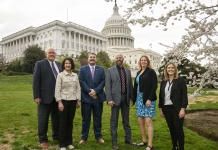
Picture from https://jmpeci.org/