


An Iowa House subcommittee advanced a bill Tuesday allowing people to keep firearms in their cars when picking up and dropping off students at school.
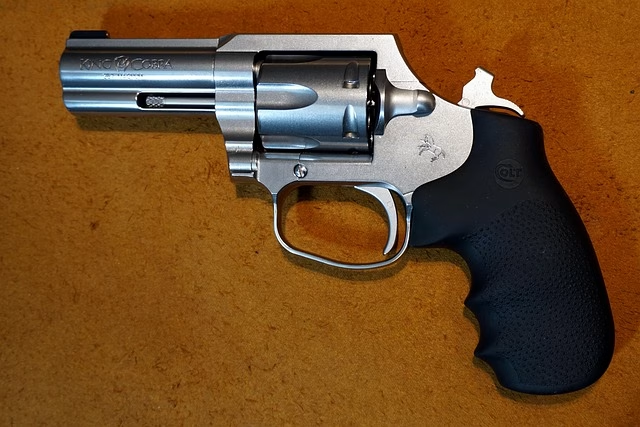
House File 621 would allow individuals with a permit to have firearms in their car on the grounds of a school when they are picking up or dropping off their child. In addition to requiring the person to have a permit to carry weapons — including concealed carry licenses — the bill would require the weapon to remain in the person’s vehicle, and the vehicle to be locked when unattended.



Rep. Jeff Shipley, R-Fairfield, said he believed the measure was important to pass because “a lot of parents in Iowa are unknowingly committing felonies all the time.”
“The way I read the status quo, the current code, is that this is a victimless crime, where you’re turning law-abiding citizens into felons and creating kind of an unworkable arrangement that if someone is wishing to exercise their constitutional Second Amendment rights, that … they’re unable to do so when they’re doing something as ubiquitous as picking up or dropping off a student.”
Richard Rogers with the Iowa Firearms Coalition, Inc. said current Iowa law creates “phony no-gun zones with schools,” as there are not security systems in place to enforce these rules. He said these provisions “provide only the illusion of security,” pointing to the rise in incidents like mass shootings at schools.
“These rules serve only to disarm honest citizens, those whose compliance often forces them to forgo having their normal personal defensive tools available from the time they leave home until they return, no matter long they’re there, how many or what sorts of other places they need to visit.”
Shipley questioned if a person would be committing a felony if they used “their weapon in a defensive manner to respond to a threat” on school grounds, as the measure only relates to the ability of a permitted individual to have their weapon in a vehicle, or have the weapon in a locked vehicle while unattended.
Rogers said courts would interpret the situation based on “extenuating circumstances,” but that the bill’s exception to bans on having firearms on school grounds would not apply in these situations as the person would be taking their weapon outside of their vehicle.
Michelle Johnson with the Iowa Association of School Boards said the organization sees the measure allowing firearms to be in cars in school parking lots when a parent is dropping off or picking up a student seems “fairly uncontroversial.” The measure would not allow individuals to carry firearms within school facilities.
Additionally, the measure changes current administrative rules to allow school vehicles transporting students — like school buses — to allow weapons and ammunition to be carried in a passenger compartments of vehicles. Johnson said this provision addresses a current issue in Iowa law, allowing school districts with trap shooting teams to transport students to competitions and events.
Rep. Heather Matson, D-Ankeny, said she wanted to clarify that the language related to weapons on school vehicles “is actually about trap shooting,” and would not have other impacts. She also said more broadly, she did not support allowing firearms on school property.
“I do find the expression ‘phony no-gun zones’ to be somewhat offensive, especially for those of us who believe strongly in gun-free zones to protect people,” Matson said. “We may have different opinions on whether or not firearms should be allowed in a place, but again, I don’t think that language is particularly helpful.”
Shipley said he had questions about how often people were prosecuted under the current statute — invoking the 2025 arrest of Des Moines Public Schools former Superintendent Ian Roberts, who was arrested by U.S. Immigration and Customs Enforcement agents “in possession of a loaded weapon in a vehicle provided by Des Moines Public Schools.” ICE statements about the incident do not say Roberts was found to be on school grounds when initially approached, and he was located after officers found his vehicle “abandoned near a wooded area.”
But Shipley said overall, he supported passing the measure as a way to prevent “otherwise law-abiding people” from becoming felons.
“Felonies are very serious crimes that deprive you of voting rights, deprive you of the right to own a firearm,” Shipley said. “And that would be an incident where there’s no victim.”
The bill moves next to the House Education Committee.