


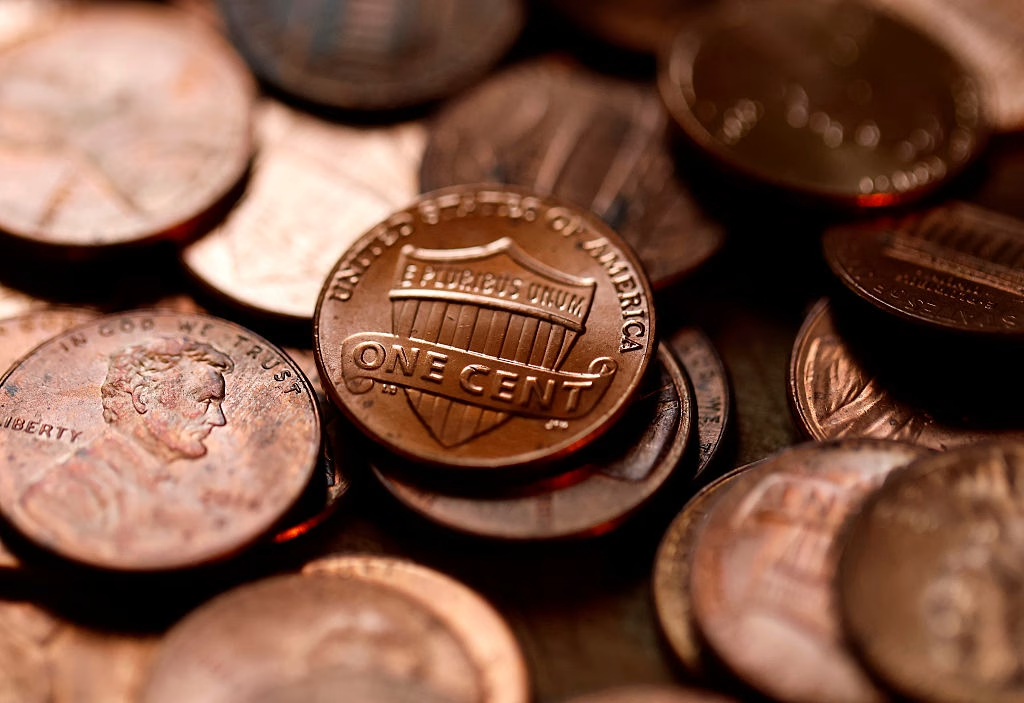
As pennies vanish from the American landscape, many businesses are clamoring for federal guidance on how to handle cash transactions in a penniless world.
Should retailers round up or down? Should they round in favor of the customer? Or in favor of the business?


So far, calls for federal direction have gone unanswered. Some businesses are setting their own policies, but states are now beginning to act amid growing uncertainty.
While the question revolves around only a few cents per transaction, it does raise important consumer protection and legal questions for states to consider. Retailers must weigh threats of potential lawsuits, while policymakers worry about protecting the most vulnerable consumers who rely on cash for everyday purchases.
President Donald Trump in February moved to eliminate the penny from U.S. pocketbooks, citing the high cost of minting them — about 3.7 cents per penny. But even before the coin’s final production run last month, U.S. retailers and banks were reporting widespread penny shortages.
To provide clarity, lawmakers in New York have proposed legislation mirroring Canada’s rounding standard — up or down to the nearest five cents. And officials in Georgia and Utah have issued nonbinding guidance to businesses.
“States do not have the luxury of waiting for the federal government,” said Katherine Tschopp, senior associate at government relations firm MultiState.
Complicating the issue are the growing number of jurisdictions requiring businesses to accept cash — a move aimed at protecting vulnerable consumers who may not have access to credit cards or electronic payment systems.
In November, New York became the ninth state to add such a rule, according to tracking from MultiState. At least eight major cities also require businesses to accept cash.
In the absence of federal action, I think it’s important that the states act to provide clarity — clarity for everybody: clarity for the consumer, as well as the merchant and the state.
– New York Democratic Assemblymember John T. McDonald III
A bipartisan group of federal lawmakers have proposed legislation in the U.S. House and Senate to require all cash transactions be rounded to the nearest five cents, but neither proposal has made it to a floor vote.
The record-breaking federal government shutdown and heated debate on health insurance subsidies have sidelined the penny discussion, Tschopp said. She thinks the federal government will likely determine a national rounding policy — eventually. But in the meantime, she expects more states to weigh in.
New York Democratic Assemblymember John T. McDonald III said he agreed with Trump’s move to phase out the costly production of the penny. But businesses are asking for some kind of guidance now, he said.
“In the absence of federal action, I think it’s important that the states act to provide clarity — clarity for everybody: clarity for the consumer, as well as the merchant and the state,” McDonald told Stateline.
Approaches to rounding
McDonald’s proposed legislation mirrors Canada’s rounding policy following the 2012 elimination of its one-cent coin. His bill calls for so-called symmetrical rounding of after-tax cash purchases to the nearest five-cent mark. Purchases ending with one, two, six or seven cents would be rounded down. And purchases ending in three, four, eight or nine cents would be rounded up.
So, a consumer would get no cash back from a $1.99 purchase. But a retailer would hand over a nickel to someone spending $1.97.
McDonald sits on the National Conference of State Legislature’s State and Local Taxation Task Force that has been examining the penny issue. That task force has recommended symmetrical rounding as the fairest method for merchants and consumers.
McDonald noted that the NCSL group reached a bipartisan consensus on the issue. And he said he’s found no opposition from New York businesses or consumer groups on his bill.
“In this day and age where we seem to have a lot of fractious conversations on other issues, it’d be nice to find something that actually we can all agree on,” he said. “And to have it start with the good old little penny would be a good spot.”
On Wednesday, South Dakota Republican state Sen. Tim Reed urged state lawmakers to start communicating with agencies, retailers and the public over the issue.
A co-chair of the NCSL task force, he said businesses need guidance and consumers may need reassurance. While he acknowledged concerns about “strategic pricing” — in which retailers set prices to push rounding to their advantage — the group’s report characterized that as a “limited risk.”
“Everybody’s thinking, ‘Oh, I’ll get overcharged, or I’ll get undercharged,’” Reed said at an NCSL virtual event about the penny. He said it would be good for people to know that “really this is all going to kind of wash out in the end.”
New York Democratic state Sen. James Sanders Jr. said the cash acceptance law he sponsored earlier this year ensures people without access to smartphones or banking are not excluded from commerce. That law also says customers paying with cash cannot be charged more than other buyers.
“Otherwise, you absolutely have a two-tiered system,” he said, noting that cash is “a lifeline” for working families, older adults, immigrants and small businesses.
Sanders said he would prefer for retailers to round down to the nearest nickel on cash transactions to protect consumers.
“For the large corporations, this could be a difference of hundreds of thousands of dollars if they are steadily rounding up,” he said. While each rounding transaction represents a loss or gain of only a few cents, Sanders said, “multiply that by tens of thousands of people, and you’ve effectively raised the price of your product without any type of sanction.”
Sanders said he plans to introduce legislation on the matter soon, but added that he remains open to McDonald’s current proposal of symmetrical rounding. More than anything, he said, businesses desire some kind of guidance.
“We’re not trying to cheat business. We’re just trying not to be cheated by business,” he said. “The people I’ve been speaking to are honest souls, and they just want to know the right thing to do in a penniless society.”
A rapid change
The U.S. Mint in Philadelphia struck the last penny on Nov. 12, but pennies were already scarce at that time.
By mid-November, more than 100 of the government’s 165 coin distribution sites across the country were without pennies, according to the Retail Industry Leaders Association, which represents major chains including CVS, Target and 7-Eleven.
In a November survey of its members, that organization found six national chains had more than 1,000 stores that had no pennies.
The association said most of its survey respondents were rounding cash transactions to the benefit of customers — always down to the nearest five cents. While it’s fair for shoppers, it’s “costing businesses millions of dollars as small amounts add up across thousands of daily cash transactions.”
While states weigh the issue, the association is pushing for a federal answer.
“We are urging the federal government to quickly address the problem, to allow for uniform adjustments by retailers that operate in a multitude of states,” Austen Jensen, the organization’s senior executive vice president of public affairs, said in a statement to Stateline.
Other groups, including the American Bankers Association, have also pushed for federal action.
“They’re obviously concerned about it and wanting a federal fix,” said Christopher Phillips, a partner at law firm Holland & Knight. “The government fairly abruptly decided they weren’t going to mint any more pennies and these shortages of pennies spread fairly quickly across the country.”
For retailers, the problem is both practical and legal, said Phillips, who represents payment system companies and financial technology firms.
In many of the jurisdictions that require merchants to accept cash, the laws explicitly forbid charging cash customers more — and have a per-transaction fine for violations, raising the possibility of big fees. And Phillips said merchants could face class-action lawsuits for rounding policies in which plaintiffs argue they are charged more than advertised or face unfair or deceptive business practices.
Federal regulations also ban retailers from charging more for purchases made with food stamps, through the Supplemental Nutritional Assistance Program, or SNAP. Cash rounding policies complicate that rule, as some customers would be charged less for certain cash purchases than those using SNAP cards.
“The unintended consequences of these administrative actions, and these laws and how they flow together to create real problems that were certainly never envisioned,” Phillips said.
So far, merchants have come up with their own policies.
Because of the penny shortage, the East Coast convenience store chain Sheetz asked customers to move to cashless payments or round up to support charitable causes. It even offered free beverages for those willing to cash in 100 pennies.
Kwik Trip, which operates convenience stores across the Midwest, in October announced its registers would automatically round down cash transactions to the nearest nickel in favor of customers.
But without a federal standard, the landscape is patchy, Phillips said. Rounding creates a winner and a loser in each cash transaction. Some companies have pushed to standardize their practice across the country, but others will only choose to round down if required.
“Others are like, ‘You know what? This is actual money for us,’” he said. “‘We’re not just going to give it up for the sake of convenience.’”