




An Iowa judge has granted the former operators of Iowa’s troubled Honey Creek Resort a temporary injunction that blocks the state from proceeding with plans to hire a new operator for the south-central Iowa resort.
In his ruling, Polk County District Court Judge Jeffrey Farrell found that the Iowa Department of Administrative Services, despite a lack of justification to shut down the resort, “bullied forward” with its plans and terminated its contractual relationship with resort operators Terry and Beth Henderson of Achieva Enterprises.


The injunction means that DAS’ efforts to end its contract with Achieva is temporarily blocked until further order of the court. The state must now provide Achieva with immediate access to the resort, with all provisions of the company’s contract with DAS remaining in full effect.
Achieva “shall reopen the resort for customer use as soon as reasonably practicable, but at least by March 12, 2026,” Farrell’s order states. “This means that the lodge and cabins shall be open for customers by that date and the golf course shall be open for play by that date, weather permitting.”
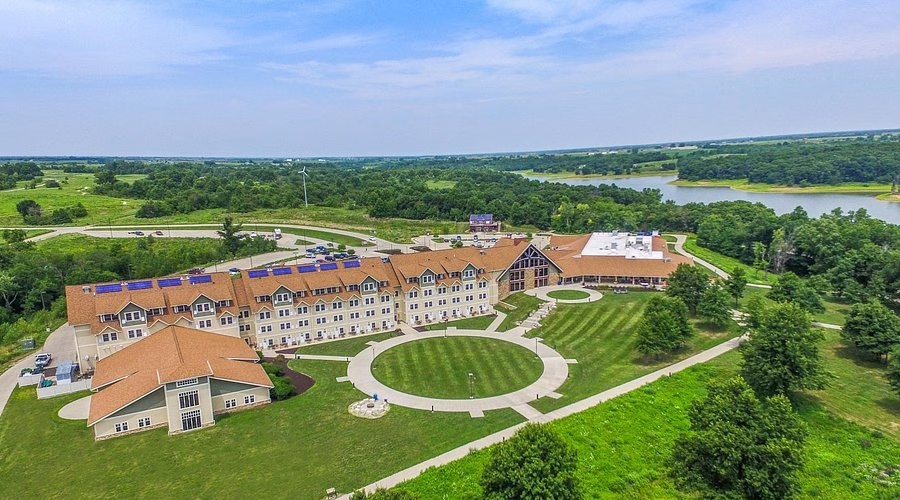
Honey Creek Resort opened in 2008 but has struggled financially ever since. In 2013, the $60 million resort was the recipient of a $33 million state bailout, and after the resort’s initial operator quit the project, DAS hired Achieva to take over management beginning in 2023.
Achieva also ran into trouble, reporting very thin profit margins and ongoing issues with maintenance and infrastructure. According to testimony presented at a Nov. 26, 2025, hearing, the Hendersons invested $1 million of their own money in the resort but did not personally take any money from the company.
Hearing testimony indicated the Hendersons were particularly concerned with the resort’s onsite water park, which reportedly accounted for a half-million dollars in losses annually. The water park suffered regular breakdowns and there was testimony that its rusty water slide, which reportedly led to minor injuries, had become known as “the butt cutter.”
Contentious Zoom call triggers state action
On Oct. 21, 2025, the Hendersons had a Zoom conference call with Mark Campbell, the new director of DAS, and Nathan Reckman, the general counsel and deputy director of DAS.
During that call, which was recorded, Campbell told the Hendersons he had scheduled a company to inspect the water park to see what it would take to rehabilitate it. By all accounts, this angered the Hendersons, who repeatedly stated that no one from the state was listening to their concerns or supporting their proposal to eliminate the water park.
According to Farrell’s ruling, the Hendersons told Campbell repeatedly that if DAS was going to insist on keeping the water park, Achieva would simply shut down the resort.
After the call, DAS contacted the attorney general’s office to initiate plans to terminate the state’s contract with Achieva. On Oct. 29, 2025, eight days after the Zoom call, Campbell called the Hendersons and informed them DAS was terminating their contract, indicating the move was prompted by the Hendersons stating they intended to close the resort and send employees home.
The Hendersons objected, noting the resort was still open and that no efforts had been undertaken to close it, with special events still being planned promoted through the end of the year.
Within hours, DAS officials were at the resort with deputies from the Appanoose County Sheriff’s Office, shutting down operations and erecting concrete barricades to block entry to the property even as golfers were playing rounds nearby.
In November, the Hendersons sued, arguing the state’s actions were unjustified and left Achieva susceptible to irreparable damages. The state argued it did not nothing wrong and that switching operators at the resort was in the public’s best interest.
Judge: DAS’ actions cost 50 people their jobs
In his ruling, Farrell concluded that the evidence shows there was only one true basis for the state’s decision to end its contract with the Hendersons: the Oct. 21 video call in which the Hendersons threatened to shut down the resort. Although DAS cited other contributing factors, such as deficiencies with insurance and financial reports, DAS was aware of those issues “for months and even years” prior to the shutdown and had not given Achieva the opportunity to address them, Farrell stated.
“It is true that the Hendersons’ conduct during the call with Campbell and Reckman went off the rails,” Farrell noted in his ruling. “They very well could have avoided this litigation by keeping their cool and rationally discussing their points with Campbell, who was new to the position, and with Reckman, who was new to working with them. They did not do so. They repeatedly threatened to shut down the resort during the conversation. The state decided to take their words at face value and hold it against them.”
Even so, Farrell ruled, the contract between Achieva and DAS allows for immediate termination without notice only in situations where Achieva terminates or suspends its business.
As of Oct. 29, Achieva was clearly operating the resort, with golfers on the golf course, guests staying at the lodge, and employees working on the property, Farrell stated. Achieva was also booking reservations and had outings planned over Halloween, Thanksgiving and Christmas, Farrell noted.
Despite this, Farrell said, DAS officials went to the resort, told guests they had to leave the next morning, closed the golf course and escorted employees off the grounds. “The state proceeded to shut down the resort with actual knowledge that Achieva had not suspended or terminated its operations,” Farrell stated.
Based on all of that, the judge said, Achieva “has a strong likelihood of success on the merits of its claim that immediate termination (of the contract) was not justified.”
In deciding to issue the injunction Achieva requested, Farrell stated “the resort would have remained open but for the state’s actions, so the state is not in a position to complain about the current lack of revenue or the time it would take Achieva to reopen the resort” should an injunction be issued.
Farrell also concluded “there is a public interest that favors Achieva,” pointing out that DAS’ actions had resulted in 50 people losing their jobs.
“If DAS had chosen to give notice of alleged contract breaches with the 60-day right to cure, those employees may have had notice that they might lose their jobs,” Farrell stated. “That would have allowed them the opportunity to seek out other options while the cure process took place. The state’s action to shut down the business without notice and remove employees who had no blame in the dispute did not serve the public interest.”
In his ruling, Farrell said there were alternatives to DAS shutting down the resort with no notice, such as having Department of Natural Resources employees check on the resort to see if Achieva had made any real efforts to close down the business. “The state instead bullied forward with immediate termination, which caused the closure of the resort and the job loss for its employees,” Farrell stated in his ruling.