




A federal government oversight agency says the program intended to improve resident care at some of the nation’s worst nursing homes “is not working.”
The Special-Focus Facilities program, which is administered by the federal Centers for Medicare and Medicaid Services, identifies homes with serious, recurring quality-of-care issues and then imposes additional oversight on them in an effort to improve resident care.


That program “is not working,” the U.S. Department of Health and Human Services’ Office of Inspector General says in a new report, citing evidence that the homes which successfully graduate from the program exhibit quality-of care deficiencies soon after.
Between 2013 and 2022, the report states, almost two-thirds of the nursing homes that were enrolled in the program improved enough to graduate, “but soon afterward showed the type of quality problems that put them in the SFF program in the first place.”
At any given time, no more than two nursing homes per state appear on CMS’ periodically updated list of Special-Focus Facilities, although the list also includes hundreds of other nursing homes — typically, 10 per state — where ongoing quality-of-care violations have made them eligible for that status.
Once a home is designated a Special-Focus Facility, it receives additional oversight and assistance from the government that’s intended to improve resident care. The other homes that are merely deemed eligible do not receive that assistance. They appear on the list, some for as long as 10 years, and then drop off without ever receiving the federal help.
Conflicting data reported on Iowa nursing homes
CMS data shows several Iowa homes have been enrolled in the program and then closed without graduating. Other Iowa homes have appeared on the list after they have closed.
Among the issues with Iowa nursing homes:
Closed without graduating: The Aspire of Gowrie nursing home had been in the Special-Focus Facilities program for 22 months without graduating before it closed on July 23, 2025.
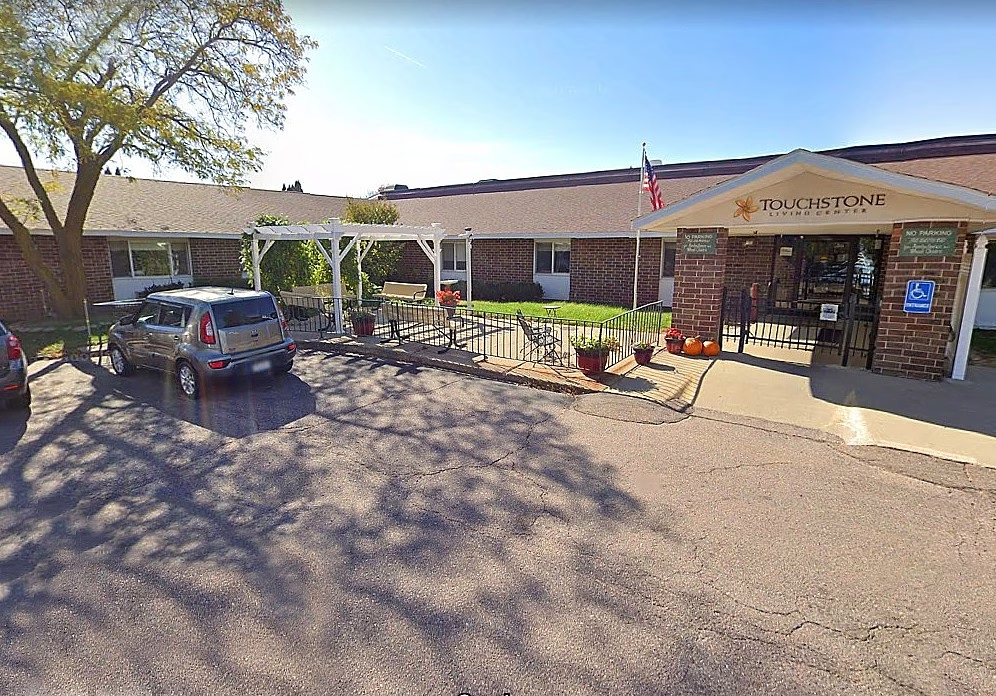
Added to the list after closing: In 2021, the 125-bed Touchstone Healthcare Community in Sioux City graduated from the program after 44 consecutive months on the SFF list. Less than a year later, however, the home was forced to close in the wake of an emergency court ruling that residents there were at risk.
After the facility closed and residents were moved out, Touchstone was inexplicably added back to CMS’ list of homes eligible for designation as a Special-Focus Facility and then was added to the list of homes that had successfully “graduated” from the program.
Incorrect updates: In its most recently published SFF list, dated Sept. 24, 2025, CMS states that Greater Southside Health and Rehabilitation Center of Des Moines has been on the eligibility list for 36 months — although that’s also how long CMS claimed the home had been on the list as of July 30, 2025, suggesting CMS is not properly updating its list.
On and off the list: Although CMS currently indicates a Scott County home, The Ivy at Davenport, has been on the eligibility list for only one month, that’s not correct. After 20 months on the list, and amid recurring health care violations, the home was dropped from the eligibility list for one month in June 2025, before being reinstated a few weeks later. That means The Ivy has actually been on the eligibility list for three consecutive months, or 23 of the past 24 months.
CMS has said its goal is to have all SFFs graduate within two years and suggested it might bar Special-Focus Facilities from collecting Medicare or Medicaid dollars for resident care if they fail to improve over time.
According to the inspector general, 495 of the 645 nursing homes designated as Special-Focus Facilities between 2013 and 2022 have successfully graduated from the program. Of the 429 nursing homes that entered and exited the program over a period of 10 years, 96 spent more than two years in the program.
The OIG says that in Iowa, the average time a nursing home spends in the program before graduating is 19 to 23 months.
Currently, there are 15 nursing homes around the nation that have been enrolled in the SFF program for more than two years without graduating. Five of those 15 homes have been in the program for more than three years.
CMS rejects recommendation related to owners
The OIG says one state inspection agency — the name of the state is not disclosed in the report — suggested that after graduating from the program, “nursing home leadership may pull back on improvements they made” while in the program.
“Another state agency observed that some nursing homes prioritize ‘getting off the list’ quickly instead of implementing sustainable improvements,” the OIG report states.
Industry officials have suggested that CMS incorporate more data on staffing levels — some of which is self-reported by care facilities — and lessen its reliance on inspection results to determine which homes need to improve resident care.
As part of its report, the inspector general has suggested that CMS consider enhanced enforcement action against those facilities that graduate from the program and then fall back into noncompliance.
The report also notes that CMS has rejected a recommendation that nursing home ownership information be considered when identifying Special-Focus Facilities and patterns of poor performance.
The inspector general argues that issues linked to common ownership of different facilities could “lead to a deeper understanding of the root causes” of and poor resident care. CMS says its statutory authority does not allow it to take enforcement action against groups of nursing homes due to their common ownership.