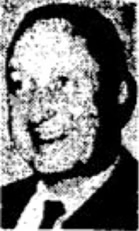






On December 5, 1967, a tragic double homicide occurred at Club 64, an upscale steakhouse in Council Bluffs, Iowa, resulting in the deaths of Officer John L. Stephens, 32, and Paul J. Rayer, 51, the restaurant’s manager. The incident took place shortly after closing as the two men prepared to transport the night’s receipts to the Council Bluffs Savings Bank. Around 7:30 a.m., Nick Elias, a 73-year-old clean-up worker, discovered their bodies when he entered the restaurant through a side door. He found Officer Stephens slumped in a chair and Rayer lying behind a desk, with the key to the unlocked safe still in Rayer’s hand.
Officer Stephens had been shot multiple times—four times in the chest and once in the neck at close range—while Rayer was shot three times: twice in the head and once in the arm. Both men were unprepared for the attack, as they were coatless when discovered, and robbery appeared to be the motive behind the killings, with approximately $1,500 missing from the restaurant’s receipts. Preliminary investigations suggested that two different guns were used in the shooting, possibly a .25-caliber and a .38-caliber, indicating the involvement of two assailants. Despite the absence of forced entry, the crime scene suggested a violent confrontation, with no witnesses coming forward to provide information.


Pottawattamie County Sheriff Roy Wichael led the investigation, which included interviews with around 130 individuals and the deployment of a mobile crime lab. Two weeks after the murders, a reward of $775 was offered for information leading to the arrest of the perpetrators, with contributions from anonymous donors and a local organization. Despite these efforts, the case went cold, and it remained unsolved for decades. In 1987, the investigation was reopened by the Pottawattamie County Sheriff’s Office, led by Michael Kerns, the son of the original detective on the case. However, despite renewed efforts, no solid leads or suspects emerged.
Nearly 40 years after his death, Officer John L. Stephens was honored at the National Law Enforcement Officers Memorial in Washington, D.C., with his name engraved as a testament to his sacrifice in the line of duty. He is survived by his divorced wife, two children, and half-siblings, all of whom continue to seek closure and justice for his untimely death. The community remembers Club 64, which closed in the late 1990s, as a premier dining establishment that held a special place in the hearts of its patrons. The tragic events surrounding its past have left a lasting impression on the local community, reminding them of the dangers faced by law enforcement and the families left behind.