



The Iowa Department of Natural Resources is working to protect the state’s forests and community trees from insects, diseases, invasive species and environmental stressors.
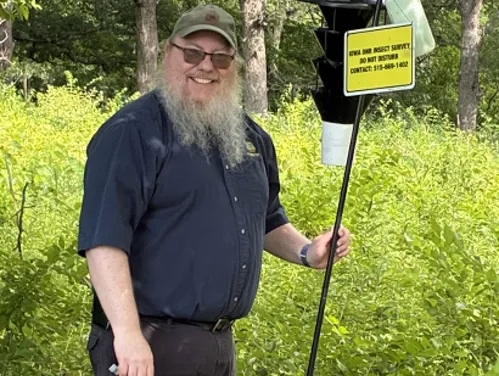
Leading those efforts is Tivon Feeley, Forest Health Program Leader for the Iowa DNR. Feeley’s work involves identifying the causes of tree decline and helping determine how to protect Iowa’s trees for future generations.


Forest health investigations often require a scientific approach similar to detective work. When trees begin to decline, the cause is not always immediately apparent. Scientists examine leaves, bark, roots, insects, weather patterns, site history, maps and laboratory results to determine what may be affecting the trees.
Feeley earned both his bachelor’s and master’s degrees in forestry from Iowa State University. His education included forestry management, forest genetics and forest pest management.
Following his undergraduate studies, he served as a city forester intern in New York City. He later worked as a diagnostician at the Iowa State University Plant Disease Clinic and spent eight years as a forestry extension specialist. He joined the Iowa DNR in 2008 and has served as the Forest Health Program Leader since then.
Monitoring Threats to Iowa’s Trees
The Iowa DNR Forest Health Lab plays an important role in protecting trees throughout the state. The lab identifies insects, evaluates tree disease samples and connects observations from the field with diagnostic evidence.
One major concern has been the emerald ash borer, which is estimated to have impacted more than 50 million trees in Iowa.
Other forest health concerns include oak wilt, spongy moth, Asian longhorned beetle monitoring, thousand cankers disease, bur oak blight, Armillaria root disease, invasive plants, spotted lanternfly monitoring, white oak mortality, drought-related stress and bark and ambrosia beetles associated with declining trees.
Oak wilt is another significant threat. According to U.S. Forest Service data, the disease has contributed to declines of up to 50% in oak trees over the past 35 years.
Helping Students Understand Forest Health
The Iowa DNR encourages students to explore forest health through photographs, insect galleries, monitoring data, maps and laboratory results.
One question students can investigate is why some trees decline while nearby trees remain healthy.
By examining the evidence, students can learn how insects, diseases, drought, soil conditions and other environmental stressors may contribute to tree decline. They can also explore whether insects are causing damage or taking advantage of trees that are already weakened.
These activities provide an opportunity for students to think like forest health scientists while learning about the importance of protecting Iowa’s natural resources.
For more information or questions about the Iowa DNR’s educational resources, contact edinfo@dnr.iowa.gov.
Source: Iowa Department of Natural Resources (Iowa DNR).