




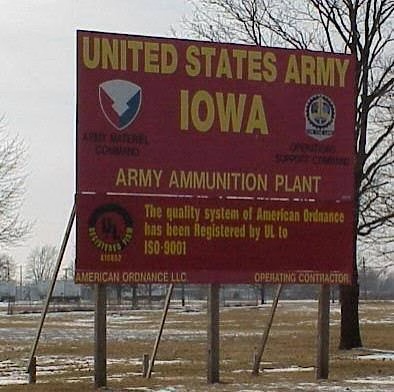
On Nov. 20 at approximately noon, the United States Army will detonate degraded lead azide (Pb(N3)2) at the Iowa Army Ammunition Plant located at 17571 DMC Highway 79, Middletown, IA 52638. This detonation has been planned in coordination with the U.S.
Environmental Protection Agency under the Resource Conservation and Recovery Act. In- place detonation by Explosive Ordnance Disposal experts is the safest way to eliminate the explosive safety hazard. The degraded lead azide has been deemed unsafe for relocation.


Extensive modeling efforts predict that the potential level of lead particles in the air may be elevated. The detonation will result in an air plume with some lead-containing particles which will disperse in the air and deposit on the ground. Lead is toxic to humans and animals. The goal of this advisory is to provide the public with actionable information out of an abundance of caution to minimize lead exposure.
There are two primary pathways of concern:
- Lead exposure by breathing in air after the detonation.
- Lead exposure from dust on surfaces.
The US Army will release two maps; one for airborne exposure to lead dust through
respiration, and one for exposure from lead dust on surfaces. The potential airborne
exposure map is current as of today, but it will change prior to the detonation due to
weather forecast changes. The maps will be updated at this website:
https://www.army.mil/asc#org-iowa-army-ammunition-plant. Members of the public
should check for updates to these maps:
- 48 hours in advance of the detonation.
- 6 hours in advance of the detonation and every hour thereafter until the detonation.
- After the event, the US Army will issue a final estimate of the impacted area.
To minimize potential exposure, members of the public who live or work in the affected
areas should consider taking the following actions on the day of the detonation: - Consider avoiding the affected area.
- If you are inside of the affected areas, avoid outdoor air by staying indoors.
- Keep windows and doors closed.
- If it is safe to do so, set heating and cooling systems to “recirculate” to minimize
outdoor air exposure and maximize indoor air filtration until the plume passes by
your community. - Avoid unnecessary travel through impacted areas.
- After the US Army determines the air exposure period has ended, consider cleaning
indoor and outdoor surfaces such as play surfaces for children and windowsills. - If your car was parked outside, consider washing your car at a car wash to minimize
your contact with potentially exposed surfaces. - Learn more about actions you can take to protect you and your family from potential
- exposures to lead at https://www.epa.gov/lead/actions-reduce-potential-lead-
- exposure and https://www.epa.gov/lead/learn-about-lead.
Deposition of lead-containing dust may occur after the detonation on surfaces within certain areas affected by the detonation plume,
All humans, but especially children, pregnant individuals, older adults, and other sensitive populations should avoid outdoor activities within affected areas. All members of the public who reside or work within this affected area should:
- Remain indoors during the potential exposure period if they cannot evacuate
beforehand; - Close all windows, exterior doors, and other openings during the exposure
period; - Turn off or place heating, ventilation, and air conditioning (HVAC) systems in
recirculation mode, minimize outdoor air intake, and maximize indoor air
filtration during the potential exposure period; and - Avoid travelling through the affected area during the potential exposure period.
- Wet-clean surfaces that may be contacted by children, including outdoor play equipment, toys, tables and chairs, handrails, patios, decks, exterior windowsills, and other high-contact surfaces. Such instructions should include specific cleaning and dust mitigation procedures to address deposited and airborne lead particles which minimizes overall human exposure to lead.