





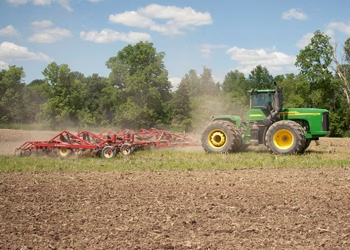
A professor at Iowa State University says higher prices for diesel fuel are expected to impact the bottom line for farmers and ranchers this spring.
Kurt Rosentrater producers can help manage their costs by doing a field-by-field input analysis. “You could do that macro scale, here’s how much I bought this past year, here’s how many acres that I planted, here’s the number of days that I’ve done disking or field cultivation or planting,” he says. “Understanding the dynamics of each of your fields. That’s going to be really helpful.”


He says prices have increased by nearly 40 percent since the Middle East Conflict began. “We’ve got the input prices that are going to impact not just what happens on the farm, but any of the downstream processing and energy prices are also going to ripple through all of agriculture,” he says.
Ben Bellar farms in southeast Kansas and owns a transportation company. He tells Brownfield producers will have to absorb the higher prices. “Rates are lagging in going up. If you do the math right now, and I’m talking myself personally, you’re talking another 30 to 40 to 50 cents a mile to be able to operate with diesel going up $1.50 in some places.”
According to AAA, the current average diesel price is $5.49, compared to $3.76 last month and $3.61 a year ago.