


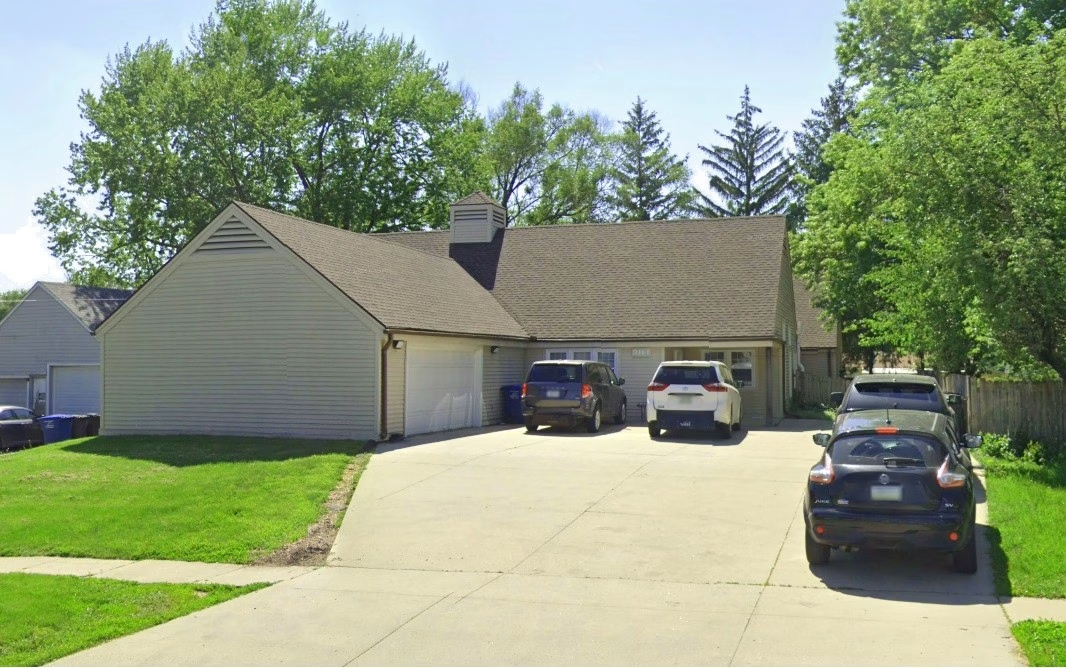
Three more Iowa care facilities for people with disabilities are accused by state regulators of violations related to the alleged misuse of residents’ money.
In recent weeks, a total of four Iowa care facilities that serve intellectually disabled individuals have been cited for violations related to the alleged misuse of residents’ money or assets.



In the most recent case, state inspectors allege that in January 2026, the staff at Mosaic-East 42nd Street, a Des Moines care facility for people with intellectual disabilities, initiated an investigation that showed one resident’s money was being spent on household goods and grocery items that should have been provided by the facility itself.
As an example, inspectors alleged the resident’s debit-card receipts from Dollar General documented the purchase of $29 worth of toilet paper, as well as $57 spent on trash bags, wall hooks and other items. In addition, a step stool, batteries, carpet deodorizer, cake mixes, frosting, cereal and other grocery items were purchased using the same resident’s debit card, and those purchases totaled just under $93.
The resident’s service agreement with Mosaic states it is not the responsibility of the resident to purchase food or household supplies for the facility, inspectors allege.
In speaking to state inspectors, the home’s direct support supervisor reportedly acknowledged that none of the household goods or groceries should have been purchased using the resident’s debit card and instead should have been purchased using Mosaic’s money.
The Iowa Department of Inspections, Appeals and Licensing cited the home for nine regulatory violations related to an alleged failure to report allegations or abuse, failure to properly report the results of investigation, and failure to separate an accused abuser and their victims.
According to the inspectors’ report, the home’s internal investigation of January 2026 indicated a direct support supervisor working for Mosaic had “potentially misused” clients’ money in 2024 and 2025. The home’s investigation “lacked any action taken against the alleged perpetrator,” inspectors reported.
When asked about that, the manager allegedly explained to inspectors that the alleged perpetrator — presumably the direct support supervisor — was suspended for three weeks, at which point the home concluded any allegations of abuse were unfounded and so the facility let the individual return to work.
DIAL fined the facility $325, according to state records.
Patrick Costigan, Mosaic’s vice president of service line management, said Tuesday the “safety and well-being of those we support is our top priority” and that the company took “immediate action” in response to reports of resident funds being misused.
“Following a comprehensive internal investigation by Mosaic and an external investigation by Iowa Health and Human Services, the allegation was found to be unsubstantiated. Both investigations concluded that the claim was not supported by evidence. While we respect the process required to ensure transparency, we are pleased to put this matter behind us and return our full focus to providing high-quality support to individuals with developmental disabilities in our community.”
Door Dash meals, groceries purchased
It’s not the first time the Mosaic-42nd Street facility has been cited by the state for violations related to the alleged misuse of clients’ money.
In 2025, state inspectors reported that an employee of the home was reported to have used a female resident’s debit card throughout January 2025 to purchase food “for the house” through Door Dash.
Inspectors documented nine instances over four weeks in which the woman’s debit card was used to pay for Door Dash meals, with the cost of each meal ranging from $10.24 to $130.72.
When inspectors looked into the matter in March 2025, they reported that the resident’s debit card had been funded with an infusion of only $30 per month, and that the card, which the facility had custody of, could no longer be located.
Another Des Moines care facility for intellectually disabled people that’s operated by Mosaic was cited recently for similar violations.
Mosaic-Easton, which is located on Des Moines’ Easton Boulevard, was cited earlier this month for failing to properly report all allegations of abuse and exploitation. In that case, a direct support supervisor potentially misused client funds in 2024 and 2025, and the home allegedly failed to ensure it had completed a full accounting of the personal funds of all seven residents.
Inspectors allege the home’s investigations coordinator reviewed one client’s purchase history and found several instances in which household goods, cooking supplies and grocery items were purchased. The home’s direct support supervisor reportedly acknowledged to inspectors that none of the household goods or groceries should have been purchased using the resident’s debit card.
As with the East 42nd Street home, the Easton facility’s manager of traditional services allegedly stated the matter wasn’t reported to regulators since there was not “a specific victim” in the case.
The alleged perpetrator in both the East 42nd Street and Easton Boulevard homes may be the same individual, as the state inspectors in each of the two cases were reportedly told that Mosaic had concluded the allegations of abuse were unfounded and so the individual was allowed to return to work.
Walmart and McDonald’s gift cards fraudulently used
In December 2025, the state alleged that the staff at one of REM Iowa’s care facilities for people with intellectual disabilities, located on 33rd Avenue in Cedar Rapids, failed to protect residents from abuse through financial exploitation.
The inspectors cited an incident in September 2025 in which a resident’s Walmart gift card was “spent fraudulently” and no receipts for the purchases could be found. In addition, inspectors said, four McDonald’s gift cards belonging to a separate resident were spent fraudulently in July and September of 2025.
Separately, inspectors cited the Walton Group Home in Burlington for failing to obtain written consent to use the money of “an unknown number” of current and former residents when purchasing items to furnish the residential care facility over the past nine years.
State officials say that as of December 2025, the disabled residents of the home had not been reimbursed for their losses, and the home’s owners say no criminal referral has been made in the matter. The Iowa Department of Inspections, Appeals and Licensing has fined the home $500.
According to the recent findings of DIAL’s health-facility inspectors, a worker at the 12-bed care facility reported to DIAL in July 2025 that a table inside an office at the home, used only by the facility’s staff, had been purchased with a particular resident’s money. The worker then showed a DIAL inspector an enclosed tub and shower in a bathroom that was attached to the office of the former administrator.
“Behind a closed shower curtain was a 4- to 5-foot high pile of appliances and kitchen items, including a vacuum cleaner, two sets of pans, two sets of dishes, four of silverware, plastic drinking cups, 40 piece storage containers, an electric griddle, a stock pot with lid, four baking sheets and 16 plastic bowls,” inspectors reported.
The worker reported that she believed all of the items had been purchased with residents’ funds.
Inspectors then reviewed records showing that in April 2024, an employee had submitted paperwork asking one resident’s guardian or payee to add $1,750 to that resident’s debit so the money could be spent on “home decor.” A receipt from a local furniture store showed that two dressers were then purchased for $950, as well as a dining table for $470.
A subsequent review of expense receipts associated with one resident’s finances revealed that individual’s money was used to purchase bottled water, mini bowls, tumblers, baking pans, a vacuum cleaner and a griddle. In December 2025, inspectors interviewed that resident’s guardian, who stated she had not authorized any of the purchases and “felt betrayed by the actions of the former administrators to the point she considered moving her ward from the facility,” inspectors reported.
Although Walton Group Home has implemented new practices to prevent any additional misuse of residents’ money, inspectors reported in December 2025 that the home “had not taken any steps to reimburse residents for the funds which were used to purchase items without their guardian’s written authorization.”
The administrator of the home explained that she “did not know where they would start to determine the extent of the misappropriation,” inspectors reported.
According to Theresa Magnussen, the regional executive director for Walton Group Home’s owner and operator, Imagine The Possibilities Inc., the matter has not been referred to authorities for any sort of criminal investigation.
She also declined to comment on the state’s allegations and said the state’s published report of its findings speaks for itself.