




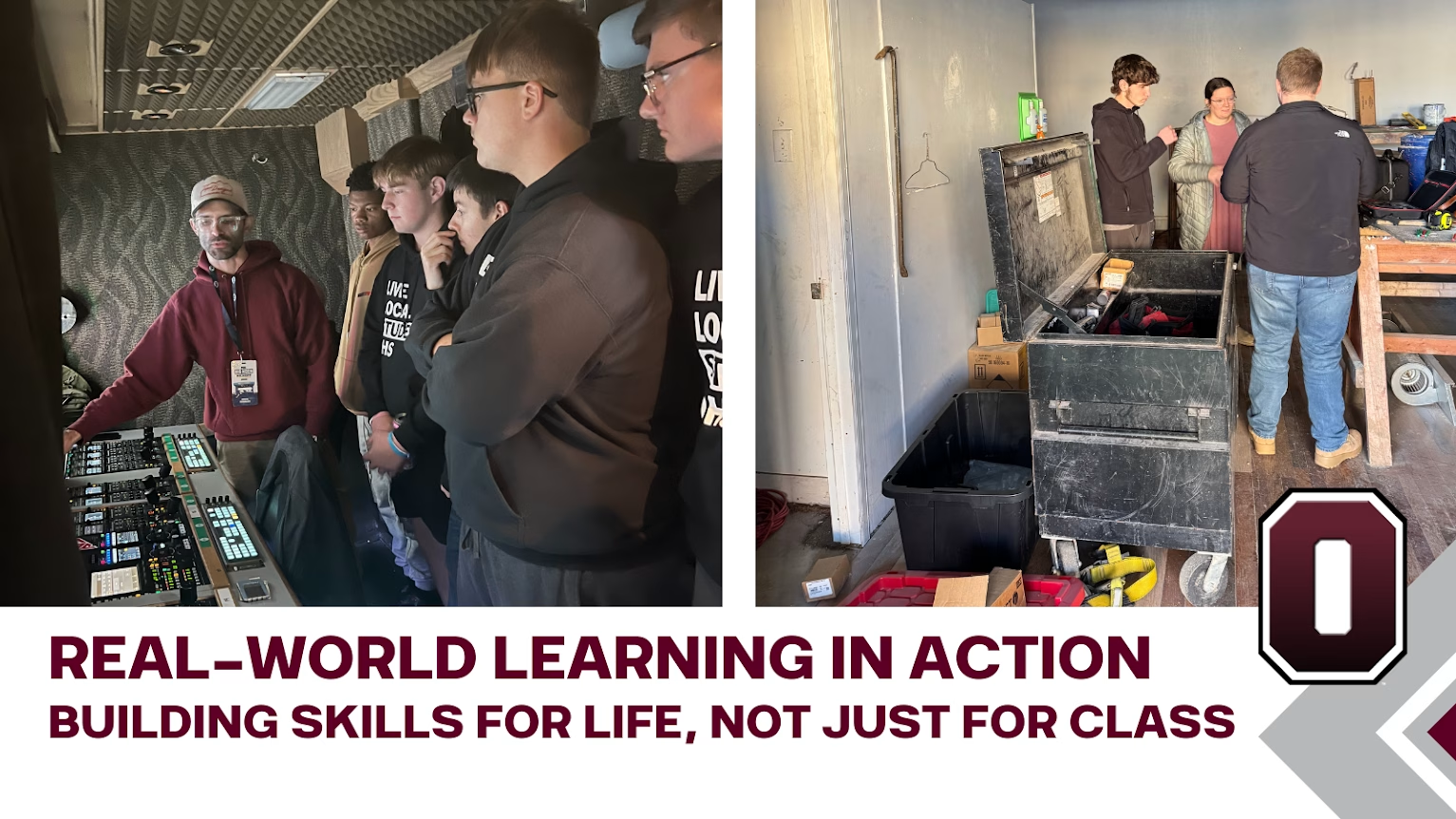
In a conference room in the basement of the MidWest One bank with a far different feel than a traditional classroom, Oskaloosa students are learning what it means to communicate professionally, collaborate with adults, think critically under pressure, and take responsibility for work that matters. These moments are not accidental. They are the intentional result of a five-year effort by Oskaloosa Schools to define what graduates truly need beyond high school and then build learning experiences that bring those competencies to life.
At the center of that work is the district’s Portrait of a Learner, a framework that identifies six key competencies every Oskaloosa graduate should demonstrate: coachability, collaboration, communication, critical thinking, curiosity, and citizenship. Rather than treating those traits as abstract ideals, the district has focused on embedding them into authentic learning opportunities that students experience every day.


Programs like Building Trades, Spirit Cafe, Oskaloosa Video Production (OVP), Work Experience, and the Innovation Hub have become living laboratories for these competencies. Each program places students in real-world environments where success depends not on memorization, but on how students interact, problem-solve and adapt.
“Businesses have been asking for these skills for years,” said Oskaloosa High School Principal Jeff Kirby. “They’re not asking schools to train kids for one job. They’re asking for people who can collaborate, communicate, show up prepared and solve problems. That’s about developing productive citizens.”
Those expectations are especially visible in the Innovation Hub, an off-campus learning program where students work on real projects for local businesses, nonprofits, and community organizations. Students choose their projects, manage their time, and respond to feedback from external stakeholders.
Lana Watters, an Innovation Hub student, said that accountability changes how students approach their work.
“How well we do it and how efficiently we get it done will either make or break who will work with us in the future,” she said. “If we do a good job, more people will trust us.”
That sense of responsibility directly reflects the Portrait of a Learner’s focus on citizenship, which emphasizes acting in the best interest of others and understanding one’s role in the larger community. When students know their work affects real people, the learning carries weight.
Communication is another competency students say develops quickly. Taylor Roovda recalled working with a local business and receiving direct feedback on professional expectations.
“They gave us a lot of feedback on what we were wearing,” she said. “We came straight from school in sweatpants, and that didn’t fit the setting. We learned fast how important that is.”
For district leaders, those lessons are exactly the point. Marcia DeVore, Director of Teaching and Learning, has said the Portrait of a Learner is about ensuring students can transfer skills across settings, not just succeed in one classroom.
“When students connect their learning to real-life experiences, engagement goes up, and transferability goes up,” DeVore said. “They’re not just learning a skill, but also when and how to apply that skill in multiple contexts.”
Collaboration and coachability are often tested when students are given freedom rather than step-by-step instructions. In the Innovation Hub, there are no traditional rubrics outlining every requirement. Students are expected to seek feedback, adjust their approach and work through challenges as a team.
“Our rubric is basically the six competencies,” said Lilia Morris, an Innovation Hub student. “You don’t get a checklist. You have a goal, and you have to figure out how to get there.”
That lack of structure forces students to practice critical thinking, defined in the Portrait as gathering information, considering perspectives, and generating solutions. Rian Allman described one of the biggest lessons as learning that progress is not always linear.
“Sometimes structure takes no structure at all,” he said. “If you want to build something meaningful, it’s not going to be done in a week or two.”
Curiosity also plays a central role. Students are encouraged to ask questions, explore interests and even discover what they do not want to pursue. Aamir Wilcoxon said the experience helped him realize it is acceptable to ask for guidance.
“It made me feel like it’s OK to ask for help,” he said.
Kirby believes that type of growth rarely happens when learning is confined to the traditional school environment.
“Schools have their own culture,” he said. “If we want students to practice real-world skills, we need to put them in real-world environments.”
That philosophy extends across district programs. Building Trades students learn teamwork and problem-solving by constructing real structures. Spirit Cafe students practice communication and collaboration while running a business open to the public. OVP students tell community stories through professional-grade media production. Each program offers a different pathway, but all point back to the same competencies.
The work has also addressed a broader challenge facing schools nationwide: student engagement. Leaders have found that when learning feels purposeful, attendance improves and motivation increases.
“I’ve had students call on snow days asking if they can come in because they have deadlines,” Kirby said. “That’s the best example of engagement I can give.”
The Portrait of a Learner is not a poster on a wall in Oskaloosa Schools. It is a living framework shaping how students learn, work, and grow. Through authentic, work-based experiences, students are not just preparing to graduate. They are practicing the mindsets and skills they will carry into careers, college, and civic life, proving that when learning is real, it lasts.