




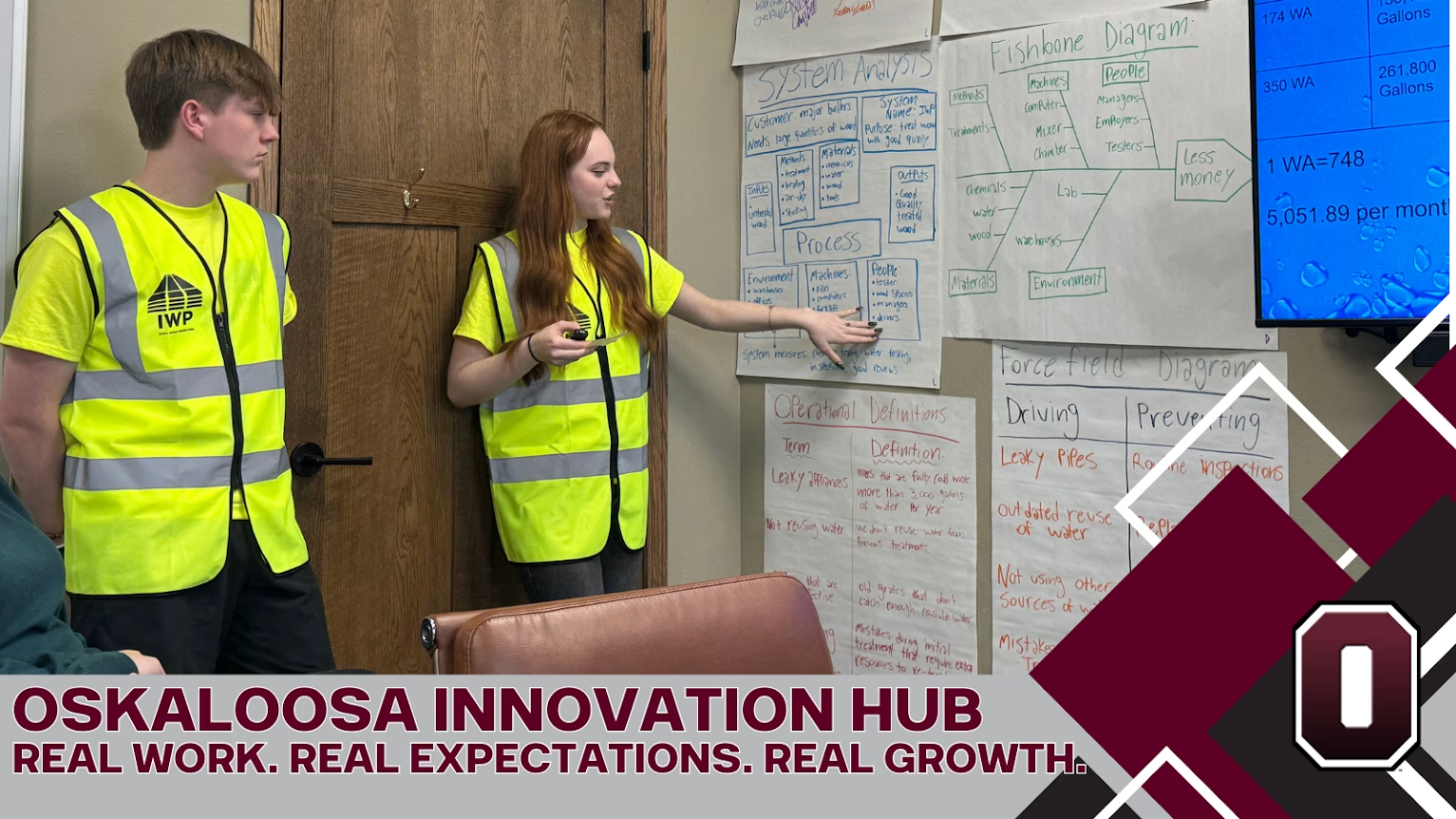
On a weekday afternoon, a group of Oskaloosa High School students huddle around a conference table in the basement of MidWest One Bank with just enough seating for student entrepreneurs, laptops open, ideas flowing. There are no rows of desks, and no bell signals the next activity. Instead, students move between small offices, community meetings and project work that stretches beyond the walls of a traditional classroom. This is the Innovation Hub, and for the students involved, learning feels different here because it finally feels real.
The Innovation Hub is an off-campus, project-based learning program of Oskaloosa Schools, where students work on real needs brought forward by local businesses and community partners while also pursuing passion projects designed to make a difference. For students like Rian Allman, that balance is what defines the experience.


“It’s basically a class where we have incoming and outgoing projects,” Allman said. “Businesses bring things they need help with, and we take the bottom of their to-do list. Then our outgoing projects are about what we can do to help others.”
That structure gives students both responsibility and choice. Projects are not assigned. Students select work that aligns with their interests, whether that means design, research, community awareness, or problem-solving.
For Lilia Morris, the freedom to explore has opened new interests. She is currently working on branding and logo development for the Innovation Hub, a project she said pushed her outside her comfort zone.
“I’ve never really gotten super into the design aspect of things, but I’ve always wanted to,” Morris said. “Trying to make a logo for something this big and abstract is challenging, but it’s exciting.”
Other students are tackling projects with a community focus. Aamir Wilcoxon and Liam Dykstra are preparing materials for Black History Month, highlighting historical figures whose contributions are often overlooked.
“We’re focusing on people who don’t always get talked about,” Wilcoxon said. “We’re making posters with their information and sharing their stories.”
For Henry Bru, the experience has included hands-on technical work. While exploring a local building, he helped create thermal imaging models that captured heat patterns and structural details.
“It made a model of the building,” Bru said. “Walking around and seeing that data come together was pretty cool.”
While the projects vary, students agree that the expectations are higher because the work has a real audience. Lana Watters said the quality of their work directly affects future opportunities.
“How well we do it and how efficiently we get it done will either make or break who works with us in the future,” Watters said. “If we do a good job, more people will trust us and want to work with us.”
The setting itself plays a role. The Innovation Hub is located off campus, in a professional space rather than a school building. Students say the change in environment shifts their mindset.
“Being in a different place from school is such a different feeling,” Morris said. “We have our own space and don’t feel like we’re in a normal class.”
Taylor Roorda said the structure, or lack of it, forces students to take ownership.
“Mrs. Bihn doesn’t tell us exactly what to do,” Roorda said. “You kind of have to figure it out yourself, set your own pace and schedule what you need to do.”
That independence can be uncomfortable at first, but students say it leads to deeper learning. Allman described one of the biggest lessons as understanding that progress does not always follow a neat plan.
“Sometimes structure takes no structure at all,” she said. “If you want to build something meaningful, it’s not going to be done in a week or two.”
Students also gain experience working directly with businesses. One group recently partnered with Modern Floor Covering to help select color palettes for the district’s Building Trades house. Others worked with MidwestOne Bank on a customer outreach project, delivering thank-you packages to local businesses.
Those experiences come with honest feedback. Roorda said students quickly learned that professionalism includes how you present yourself.
“They gave us a lot of feedback on what we were wearing,” she said. “We came straight from school in sweatpants, and that didn’t fit the setting. We learned pretty fast how important that is.”
Beyond technical skills, students say the program has helped them understand themselves better. Some have discovered they prefer independent work. Others have realized they need to strengthen communication or learn when to ask for help.
“It made me feel like it’s OK to ask for help and guidance,” Wilcoxon said.
When asked what they would tell parents about the Innovation Hub, students struggled to compare it to a traditional class.
“You can’t really compare it to a classroom,” Allman said. “You’re creating your own work. You’re kind of the founder of your project. You have to be a big kid about it.”
Morris echoed that sentiment, noting the absence of a typical rubric.
“Our rubric is the six competencies,” she said. “You don’t get a checklist. You have a goal, and you have to figure out how to get there.”
For Innovation Hub students, learning no longer stops at the classroom door. It shows up in meetings, deadlines, feedback, and real outcomes that affect real people. As Oskaloosa Schools continue to expand authentic learning opportunities, these students are proving that when learning has purpose, engagement follows and confidence grows.