





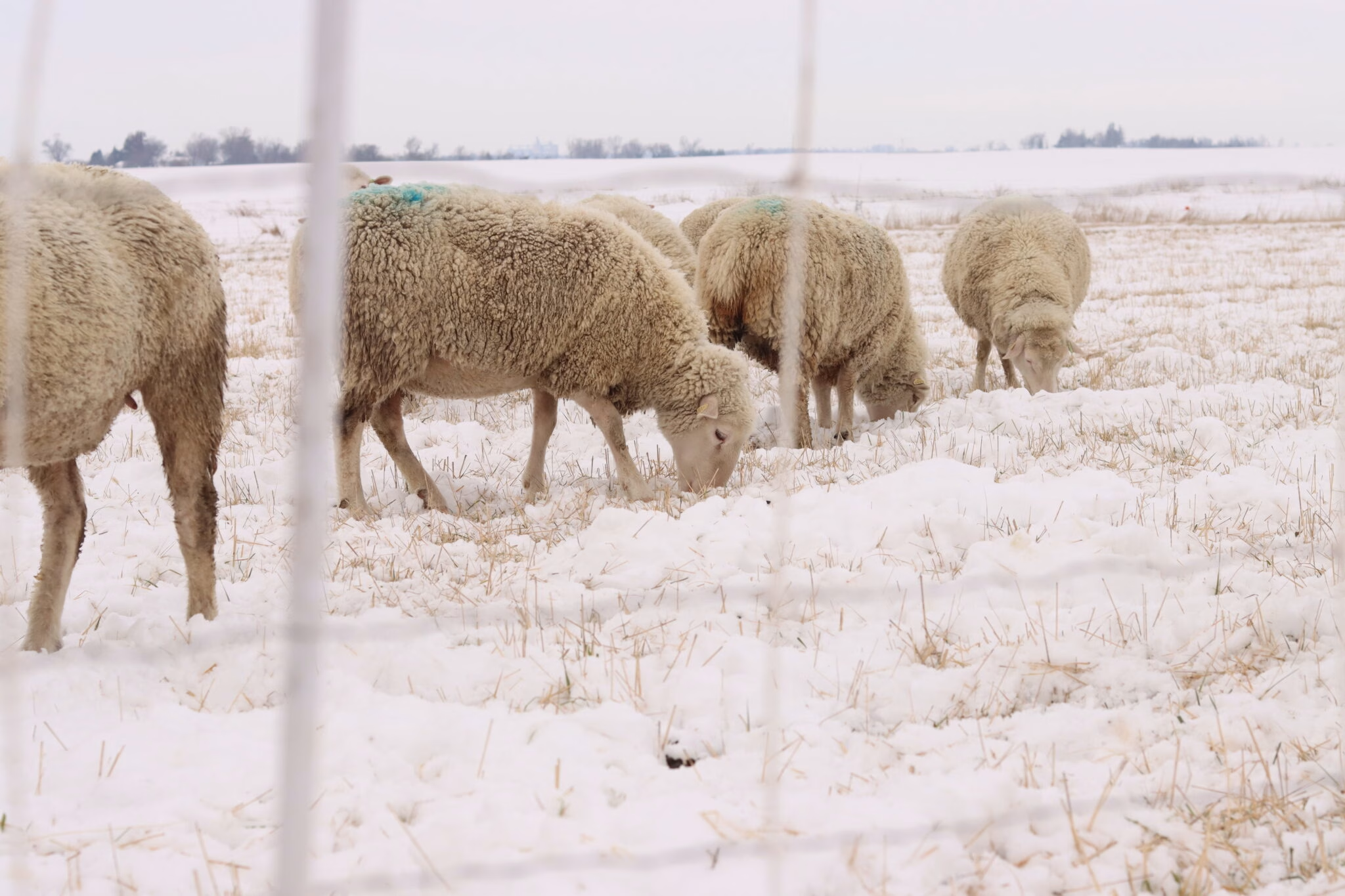
In a snow-covered field north of Des Moines, Lee Tesdell’s sheep seem comfortable, grazing in a paddock of Kernza, a perennial grain cultivated by The Land Institute in Kansas.
Tesdell is one of just two farmers in Iowa that grow the deep-rooted grain that boasts low inputs, nutritional grain and roots that are highly effective at absorbing nitrate before it can leach into waterways.


While Tesdell sells a bag of the grain here and there and gets to graze “the woolies” as he calls the flock, on the harvested field, the crop is more of an experiment. It has been grown in drier climates like Kansas and Nebraska, but Tesdell, and researchers at The Land Institute don’t know how the grain performs in Iowa.
Kernza is the grain produced from intermediate wheatgrass and was cultivated with the goal of creating a perennial grain for human consumption that would also reduce inputs and labor for farmers while providing environmental benefits.
Tammy Kimbler, chief communications officer at The Land Institute, said the institute is working to analyze the conditions under which Kernza could be optimally grown across the country.
Kimbler said the institute has a “pretty good feel” for the purpose Kernza can serve in Minnesota, Wisconsin, Montana, Kansas and Nebraska, where most of the grain has been planted. But it’s seeking a more “robust understanding” of the soil types, water, climate, historic crops and farmer knowledge in other states, like Iowa, that would impact Kernza adoption.
In drier climates, Kernza is valuable for its drought tolerance and ability to hold onto the soil. Studies in Minnesota have shown Kernza can absorb 96% more nitrate from soils than soybeans and corn. The crop has been planted around certain wellheads in Minnesota to evaluate if the crop could reduce the concentration of nitrate in drinking water.
High nitrate concentrations in Iowa drinking water sources has been an issue for decades. Recently, the issue was top of mind for central Iowans as Central Iowa Water Works issued its first-ever lawn watering ban to control demand on the system and remain compliant with federal drinking water standards while nitrate concentrations in the rivers soared.
“Kernza is a potential solution to that, because of the roots — and because of its perennial nature, it’s doing work all year, as opposed to just during the growing season,” Kimbler said.
In addition to the environmental benefits, as a perennial, versus an annual grain, Kernza reduces the number of times a farmer has to drive a tractor over the field to seed a crop, which The Land Institute also views as a benefit.
What’s it like growing Kernza?
Tesdell, who is in his third year with the crop, called it a “robust” plant. The first season he planted his seven-acre plot, he was worried it would be overtaken by weeds and other species in the field, but in the second year in the field, he said, the Kernza “just took over.”
His only input is some nitrogen fertilizer, but he said it takes a small amount compared to a crop like corn.
Tesdell gets three products out of the Kernza. The grain, which he takes to Nebraska for processing with the Sustain-a-Grain group where it is turned into the “flakes” he can sell to as a breakfast cereal or to breweries in the area. He also bales the plant and is able to sell it and use it like hay and finally, Tesdell grazes his sheep on the harvested Kernza fields.
But even with the multiple uses, marketing the grain is enough of a challenge right now, that Tesdell said it probably won’t take off as a popular crop in Iowa.
“For me, I’m interested in science; I’m interested in experimenting with crops,” Tesdell said. “I like the environmental benefits, system benefits because you get these really deep roots and there’s absolutely no surface erosion coming off that (field) there’s no way anything could escape.”
In addition to the Kernza plot, Tesdell has strips of his family property dedicated to prairie and even though he personally doesn’t grow corn and soybeans, he seeds cover crops on the portions of his land that he rents to neighboring row-crop farmers.
“That’s one thing I want to do is keep the top soil where it should be,” Tesdell said.
Because it’s still a bit of an experimental crop in Iowa, Tesdell said he’s not sure how long the plants will have a high grain yield. He plans to harvest for grain again next year, which would be the fourth year of the plants, and then assess if it needs to be replanted.
“I just, I have no idea,” Tesdell said.
Developing the Kernza market
Tesdell said he hasn’t filled out his spreadsheets for the year, but said he’d be “lucky to be breaking even” on the crop.
“It’s not going to be a popular type of crop in row-crop Iowa, because it doesn’t yield very much,” Tesdell said. “And then the marketing is a challenge.”
Tesdell travels to Nebraska, or pays to ship his Kernza harvest to Nebraska, to be processed into “flakes,” an oatmeal-like product, at a miller that works with other Kernza growers. It’s a bit more complicated, and expensive, than hauling his harvest to the local farm cooperative and selling it in one go.
Kimbler said in addition to understanding the practicalities around farming Kernza, farmers need access to processors and viable markets if the grain is to become more popular. The crop has been used like oatmeal, ground into flours and used as a brewing ingredient in beer.
Beer doesn’t offer a huge market for Kernza, but Kimbler said a Kernza beer gives people an opportunity to engage with the grain and its agricultural significance.
“Because beer is such a social product, it has a tradition of storytelling that carries with it, it’s turned out beer, and brewers in particular, are amazing ambassadors,” Kimbler said.
Farm Hand on tap
Kernza has been a featured ingredient in select beers at breweries in Kansas, Oregon and other states but is now in a beer on tap at Brightside Aleworks in Altoona.
Andrew Frana, the head brewer and owner of Brightside, said he tries to feature local ingredients and producers as often as he can.
The brewery hosts farmers’ markets, is a member of the state’s Choose Iowa program and collaborates with the Iowa Food Cooperative, where he first met Tesdell.
Frana learned about Tesdell’s perennial crop and decided to give it a try.
“We found that it acts similarly to rye and wheat, and it’s a fairly high protein grain compared to those two, so it works well in our hazy IPAs,” Frana said. “It adds body, mouth feel, head retention – foam on top of the beer – it does similar things to those grains, but it’s more sustainable and super local.”
Farm Hand is a hazy IPA — India pale ale — brewed with Nelson and Riwaka hops and has 7.0% alcohol by volume.
Frana said the Kernza in the beer acts like the flavor enhancer monosodium glutamate (MSG) or rice wine vinegar in cooking.
“It just makes everything pop and brighten up so much,” he said.
Right now, Kernza is a fairly pricey grain to work with, but Frana cares about conservation practices, regenerative agriculture and wants to support the endeavor.
“It is close to our heart to work as much as we can reducing our impacts,” Frana said. “… we would like to be a first mover in this project to bring notoriety to (Kernza) as a sustainable product here in Iowa.
Frana said when he works with a local ingredient, be it Tesdell’s Kernza or tea from Gong Fu in Des Moines’ East Village, he tries to build the beer so it highlights the ingredient.
Farm Hand is on tap currently and he said it should last into the first half of January before the keg is dry.
“But we do intend to work with Kernza in the future,” Frana said.