


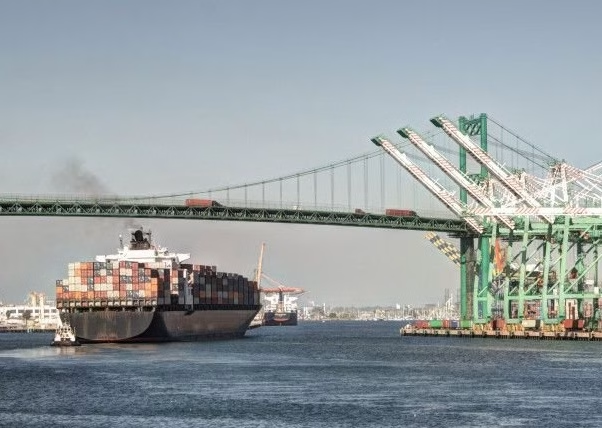
AUDIO: Economist Danny Munch with American Farm Bureau Federation discusses President Trump’s waiver of the Jones Act to allow foreign ships to haul between U.S. ports with Brownfield’s Larry Lee.
President Trump has waived a 106-year-old shipping law so foreign vessels can transport goods between U.S. ports.



Economist Danny Munch with American Farm Bureau Federation tells Brownfield that President Trump’s waiver of the Merchant Marine Act of 1920, also called the Jones Act, allows more ships to bring critical fuel and fertilizer materials to America’s ports. “Because of some of the obvious Iran conflict-induced market disruptions as it relates to fuel, fertilizer, and other chemical inputs that are coming out of that part of the world, allowing a little bit more flexibility in ships that are able to bring those products to our ports will hopefully provide some relief.”
Munch says the waiver won’t solve all the market disruptions for oil and fertilizer caused by the U.S.-Iran conflict. “Most of our fertilizers, except for potassium, which is mainly coming from Canada, are coming from domestic sources, but we have to remember that places like Brazil and China have a substantial amount of fertilizers that do come out of the Strait of Hormuz, and that’s setting global market prices.”
The Jones Act requires that all goods transported by water between U.S. ports be carried on ships that have been constructed in the United States, fly the U.S. flag, and are owned and crewed by U.S. citizens.
Farm Bureau sent a letter to President Trump suggesting the waiver. They also suggested utilizing the Navy to provide safe fertilizer transport through the Strait of Hormuz, leveraging federal tools to address shipping insurance and financing barriers, and suspending countervailing duties on imported fertilizer.
The Fertilizer Institute sent a similar letter to President Trump. TFI President and CEO Corey Rosenbusch says, “It can cost significantly less to ship fertilizer internationally than between U.S. ports, where Jones Act requirements can nearly double transportation costs.” He says, “We appreciate the Administration’s recognition of the importance of efficient fertilizer movement to American agriculture as we approach our narrow window of a few weeks to get fertilizer applied and crops in the ground,” Rosenbusch added. “The fertilizer industry remains committed to ensuring farmers have reliable access to the nutrients they need to grow the crops that feed communities across the country and around the world.”