


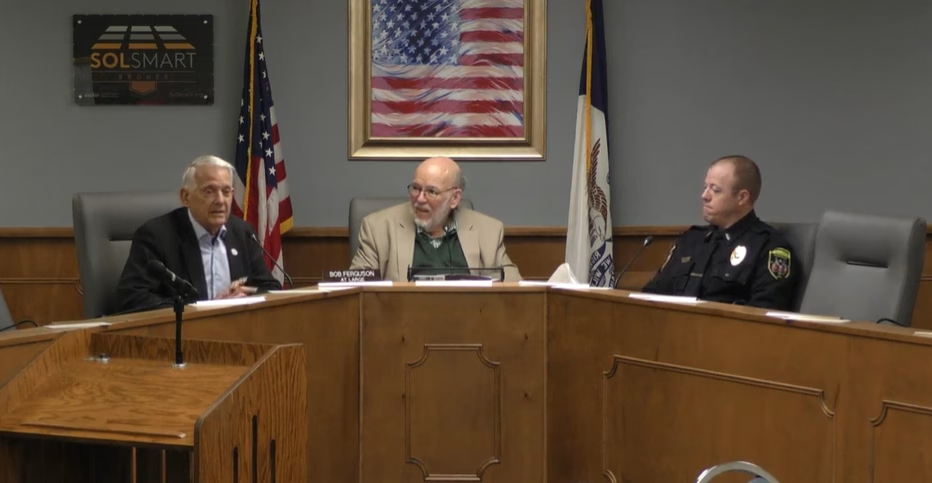
Fairfield City Hall hosted a standing-room public meeting Tuesday afternoon, March 17th, to address community questions about how local law enforcement handles requests from federal immigration authorities. City Attorney John Morrissey and Interim Police Chief Joel Smith led the discussion before a crowd of residents, many of whom expressed concern about the current national immigration enforcement climate. Council member Bob Ferguson, who organized the event, opened by saying many residents — and he himself — had wondered what exactly the city’s policy was regarding immigration enforcement, and that he thought the best approach was to bring together the two people who know the most about it.
Fairfield’s Immigration Landscape



Morrissey opened by describing Fairfield as an internationally diverse community, home to roughly 90 nationalities and multiple visa categories connected to Maharishi International University. He said that in his experience spanning 35 years as city attorney — and previously 18 years as county attorney — immigration matters in Fairfield have generally been handled quietly and cooperatively. The most notable example he offered was several years ago when 1,400 visitors arrived on religious and short-term visas, stayed in Vedic City, attended the domes daily for contemplative meditation, and at the end of their visa period, boarded buses and returned to their home countries — exactly as the process is supposed to work, with no confrontation or enforcement action required.
Morrissey noted the community currently has a handful of visa types in circulation — student visas, work visas, religious visas, and specialized qualification visas among them — and that Fairfield has five immigration lawyers practicing locally, which he said speaks to the volume of visa and immigration work that goes on regularly. In the past six months, the only direct ICE contact he was aware of was a single agent — whom he referred to as “a nice guy with a tie” — who came to his office with a folder about an ongoing immigration case and worked cooperatively to ensure the affected person was properly notified and had access to legal representation.
Smith echoed that account, saying that in 15 years with the Fairfield Police Department, the department has never been asked to assist with immigration identification or enforcement operations. The only circumstance in which the department has had any immigration-related involvement is when someone is arrested on a criminal charge and the county jail system independently receives an immigration detainer — a process the police department itself is not party to.
The City’s Written Policy
Morrissey distributed a handout outlining the city’s formal policy on assisting ICE when requested. The policy, which was first outlined in a January 27th email from Morrissey to Council Member Ferguson and formalized in a January 29th letter, establishes four core conditions that must be met before local law enforcement will cooperate with federal immigration enforcement:
A. Enforcement must be based on a prior due process determination, resulting in a warrant issued by an Administrative Law Judge through an Immigration Tribunal, or a court order or warrant from a federal or state judge or magistrate.
B. The person affected by the court order or warrant must be provided timely advance notice.
C. The person affected must be given a due process hearing — an opportunity to be heard — within a reasonable time and within the local jurisdiction, with no surprise transfers to out-of-state detention facilities.
D. Local authority must have the opportunity to review whether the process complies with constitutional and legal standards regarding search, seizure, and due process.
Morrissey said the policy also addresses specific scenarios. If citizens observe ICE attempting to detain someone without proper legal authority, they should call local police and provide contact information, written observations, and any photos or video documentation as early as possible. If ICE attempts entry into a home or business without a lawful order or judicial warrant, residents should call police immediately, document everything, and not physically intervene — leaving compliance review to law enforcement. If local authorities determine ICE is acting without authority, police will work up the chain of command to halt the action and, if necessary, direct ICE to seek a writ of habeas corpus from a federal judge. If ICE attempts to stop vehicles or remove occupants without proper legal authority, local law enforcement will similarly move to shield citizens from unlawful acts.
Warrants and Legal Authority
A significant portion of the discussion focused on the critical distinction between judicial warrants and administrative warrants. Morrissey explained that a valid, enforceable warrant must be issued by a law-trained, sworn judge — whether at the state, federal, or administrative law level — supported by an affidavit establishing probable cause. Documents that appear warrant-like but are signed by non-judicial administrative personnel do not carry the same legal authority.
“If it goes out in the form of a warrant but it’s signed by Joe behind the desk who is not a law-trained judge hired as an administrative judge, the difference starts right there,” Morrissey said. He noted that magistrates, associate judges, district court judges, appellate judges, and properly sworn administrative law judges all have the authority to issue enforceable warrants — but documents produced by administrative personnel without judicial authority do not. He added that forging a judge’s signature on such a document is a serious crime, noting he was personally aware of at least one local case that resulted in a seven-year sentence.
Morrissey said that if any warrant-like document arrives with ICE, he will scrutinize it carefully and, if anything seems questionable, call the immigration department or U.S. Attorney’s Office to verify its validity before taking any action.
What Happens if ICE Arrives Without a Warrant
Several audience members pressed on what officers would do if masked, unidentified individuals attempted to enter a home without a judicial warrant. Morrissey said officers would position themselves at the scene, refuse to assist anyone acting without legal authority, and immediately work up the chain of command to identify who authorized the action. He said his first call would likely be to the U.S. Attorney for Immigration in Cedar Rapids.
“This is our town and you don’t break people’s doors down when you don’t have something lawful,” Morrissey said. “They’re going to be in the doorway. They’re going to tell ICE to go away. They’re going to tell them you come back with something.”
Smith confirmed he and his officers are prepared to stand their ground in such a situation, while Morrissey clarified the practical limits of that posture — the goal is de-escalation and working through the chain of command rather than a physical standoff, and officers would simultaneously work to get someone with higher federal authority to order ICE to withdraw.
Morrissey discouraged residents from physically intervening themselves, urging documentation instead. He encouraged residents to film and record events, noting that Iowa is a single-party consent state and that citizens have the right to record law enforcement as long as they are not physically impeding an investigation. Chief Smith advised keeping a reasonable buffer from officers while recording and using common sense about proximity.
If someone is seized illegally, Morrissey said, habeas corpus remains a powerful and fast-moving remedy in federal court.
“Habeas corpus has been around since King John,” he said. “It’s a valid equitable remedy that gets you out if they don’t have a valid reason for what they just did to you.” He acknowledged the process takes time — typically one to five days to get before a judge — but said it should play out the same way every time and is a far better outcome than using force in the moment.
Decorah and Dubuque: Iowa Precedents
Morrissey described two recent situations in Iowa that shed light on how these dynamics play out in practice. In the Decorah area, ICE requested that the local sheriff’s department assist in the wholesale detention of people — some of whom held college visas — without proper judicial warrants. The sheriff refused, citing the lack of lawful orders. The Iowa governor and attorney general threatened both the Decorah-area sheriffs and law enforcement in Dubuque with sanctions for non-cooperation. Both communities stood their ground, demanded trials, and approximately three months later, the attorney general’s office dismissed the cases against both sheriffs and withdrew the claim against Dubuque.
“That basically showed the real story about the orders they were getting — which were signed, but not by judges,” Morrissey said.
House File 2041
Morrissey raised concerns about House File 2041, a piece of legislation introduced by Representative Tyler Collins that would require local law enforcement to assist federal immigration agencies upon request, with no explicit exceptions or limitations tied to constitutional standards. He said the bill has made it through the legislative funnel but has not yet been fully debated.
“This is right in the face of local rule. This is right in the face of county and city home rule. And this particular piece of legislation doesn’t care,” Morrissey said. He called the bill politically popular but legally incomplete, saying it needs explanations, limitations, and constitutional guardrails that are not currently present. He encouraged residents to contact local state representatives — including Jeff Shipley, Adrien Dickey, and Helena Hayes — to ensure they understand the bill’s implications. Council member Ferguson noted he had already been in contact with Shipley about the legislation and was crafting a request for a no vote.
Community Questions and Concerns
Audience members raised a wide range of concerns throughout the meeting. One resident who had recently moved from Minneapolis described witnessing what he characterized as flagrant constitutional violations by federal agents firsthand and raised a concern that local law enforcement managing crowds during immigration raids can inadvertently provide cover for federal agents to violate people’s rights. Morrissey acknowledged the concern and said local policy is to avoid facilitating anything unlawful, though sorting out in real time whether crowd management crosses that line can sometimes take days.
Another audience member asked for explicit clarification on the difference between a judicial warrant and an administrative warrant, which Morrissey addressed at length. A third resident asked whether Fairfield had considered passing an ordinance banning mask usage by law enforcement, citing Denver’s recent action on the same issue. Ferguson said he did not yet have an informed opinion on that question and called it part of the broader conversation the city is just beginning to have. He noted that Fairfield has a police force of 14 to 15 officers and that being honest about what that force can and cannot do against a federal agency is an important part of the discussion.
One woman who had grown up 20 miles from the Texas-Mexico border and moved to Fairfield three years ago spoke emotionally about fears rooted in personal and family experience with racial profiling. She said she no longer felt comfortable driving outside Fairfield alone and asked whether she would be protected here. Morrissey assured her that the kind of checkpoint-style enforcement she feared has not been used in Jefferson County in his lifetime and that any proposal to do so would go through a full public process. He said the city does not flagrantly ignore immigration law violations, but also does not go looking for scenarios based on appearance or unsubstantiated suspicion.
One community member pushed back on what he saw as ambiguity in the city’s posture, asking Morrissey to clarify the difference between lawful deportation orders — which local authorities would cooperate with — and detainers, which are requests to hold someone past their normal release date. Morrissey and Smith both confirmed they would cooperate with a lawful deportation order from a properly constituted administrative tribunal, but that detainers without judicial backing are a different matter and local authorities retain the right to refuse them.
One attendee offered a detailed critique of the city’s written policy document, suggesting it should more clearly distinguish between administrative and judicial warrants, specify that local authorities will not extend detention beyond normal release time solely for immigration purposes without a judicial warrant, prohibit stops or questioning based solely on perceived immigration status, and require written documentation and public reporting of all ICE requests and responses. Morrissey acknowledged the points, saying some were valid and some depended on jurisdictional nuances, and agreed that the policy is a starting point that will continue to evolve.
Looking Ahead
Morrissey and Smith both acknowledged the unprecedented nature of the current environment and were candid that some of the hardest questions — particularly around what local officers can realistically do in a fast-moving confrontation with federal agents — do not have clean answers yet.
Smith acknowledged the department has not yet had a formal internal training discussion specifically on immigration enforcement scenarios, noting the department is navigating a difficult period of transition following the recent death of the previous police chief. He said he wants to hear from the community about its expectations before having that conversation with officers.
“This is something that’s fairly fresh,” Smith said. “In my 15 years in law enforcement, we’ve never had these kinds of things happen in the past. This is a conversation we can certainly have.”
Morrissey closed by thanking attendees for their engagement and encouraging continued participation through city committee meetings and future council sessions, which are open to the public.
“The conversation has started and we will stay in the conversation,” he said. “As a community, sometimes we’re called to deal with things that are ambiguous and things that we don’t choose. This is history repeating itself and we need to look at it that way.”
Photo via the Fairfield Media Center.