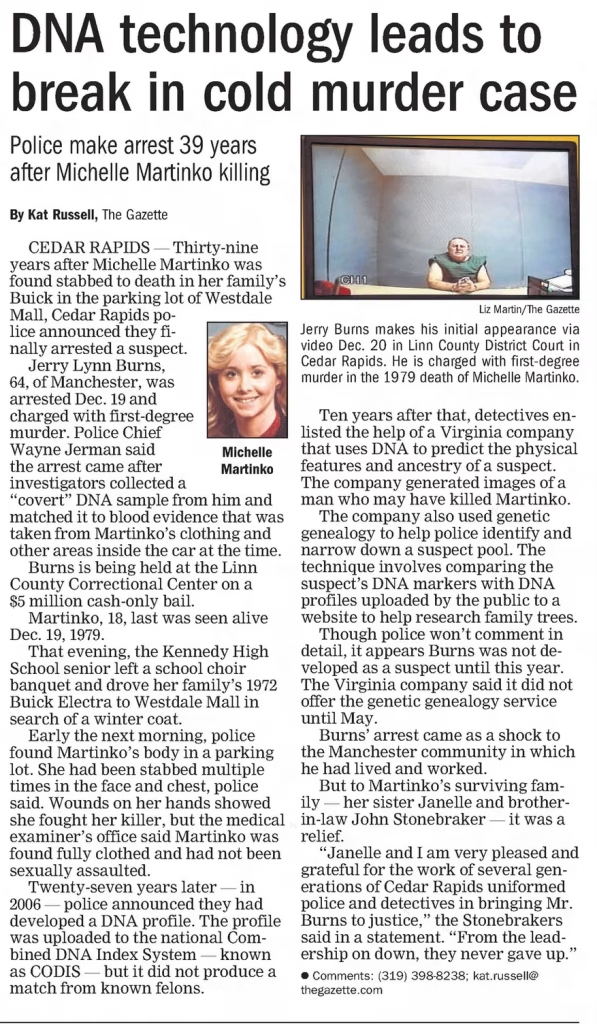



The murder of Michelle Marie Martinko remained one of Cedar Rapids’ most haunting unsolved crimes for nearly four decades, a case that lingered in the collective memory of the community until advances in forensic science finally brought answers.
Martinko, 18, was last seen alive on the evening of December 19, 1979. A senior at Cedar Rapids Kennedy High School, she was known as a bright, creative student who participated in choir, theater, and the school’s twirling squad. Friends described her as fashionable, kind, and full of ambition, with plans to attend Iowa State University and pursue a career in interior design.


That evening, Martinko attended a school choir banquet before heading to Westdale Mall to finish her Christmas shopping. She planned to pick up a winter coat her mother had placed on layaway. The mall, which had opened just two months earlier, was a popular destination for young people in the area. Martinko had asked a friend to accompany her, but the friend declined due to schoolwork.
She was last seen around 9:00 p.m. inside the mall. When she failed to return home, her parents contacted police shortly after 2:00 a.m. on December 20. Just hours later, at approximately 4:00 a.m., authorities discovered her body inside her family’s tan 1972 Buick Electra, parked in the northeast area of the Westdale Mall parking lot. The discovery turned a missing-person case into a brutal homicide investigation that would define a generation.
Investigators found the crime scene unusually rich in forensic evidence. Blood recovered from the vehicle’s gearshift indicated the presence of male DNA, and a bloodstain on Martinko’s black dress contained a complete DNA profile belonging to her killer. Although the suspect had worn gloves to avoid leaving fingerprints, the blood evidence preserved a genetic clue that would prove critical decades later.
For years, the DNA profile remained unidentified. In 2006, a cold case investigator reexamined the evidence and submitted the profile to the FBI’s Combined DNA Index System (CODIS), but no matches were found. The case stalled once again—until technological advancements opened a new path forward.
In 2018, investigators partnered with Parabon NanoLabs, a company specializing in genetic genealogy. The DNA profile was uploaded to GEDmatch, a public genealogy database, where analysts identified a distant relative. By building out the family tree, investigators narrowed their focus to three brothers living in Iowa.
That work led authorities to Jerry Lynn Burns, a 64-year-old Manchester businessman who owned a powder-coating company. Burns’ DNA was collected and tested, resulting in a definitive match to the blood evidence recovered from Martinko’s car nearly 39 years earlier. On December 19, 2018—exactly 39 years after the murder—Burns was arrested and charged with first-degree murder.
During questioning, Burns repeatedly urged investigators to test the DNA, a request that ultimately confirmed his involvement. Following a jury trial, deliberations lasted approximately three hours before a guilty verdict was returned on February 24, 2020. Burns was sentenced to life in prison without the possibility of parole, the mandatory penalty for first-degree murder in Iowa.
The conviction brought long-awaited justice to the Martinko family and closed a chapter on one of Iowa’s most infamous cold cases. For Cedar Rapids, it marked the end of a decades-long search for answers—and a powerful reminder that even time cannot erase the truth when science finally gives it a voice.